By Hamza Faisal
Pakistan's first astronaut is in orbit. Muhammad Zeeshan Ali lifted off aboard China's Shenzhou-24 spacecraft early on Wednesday morning and docked with the Tiangong space station less than four hours later, becoming the first Pakistani — and the first foreign astronaut of any nationality — to board China's station in orbit.
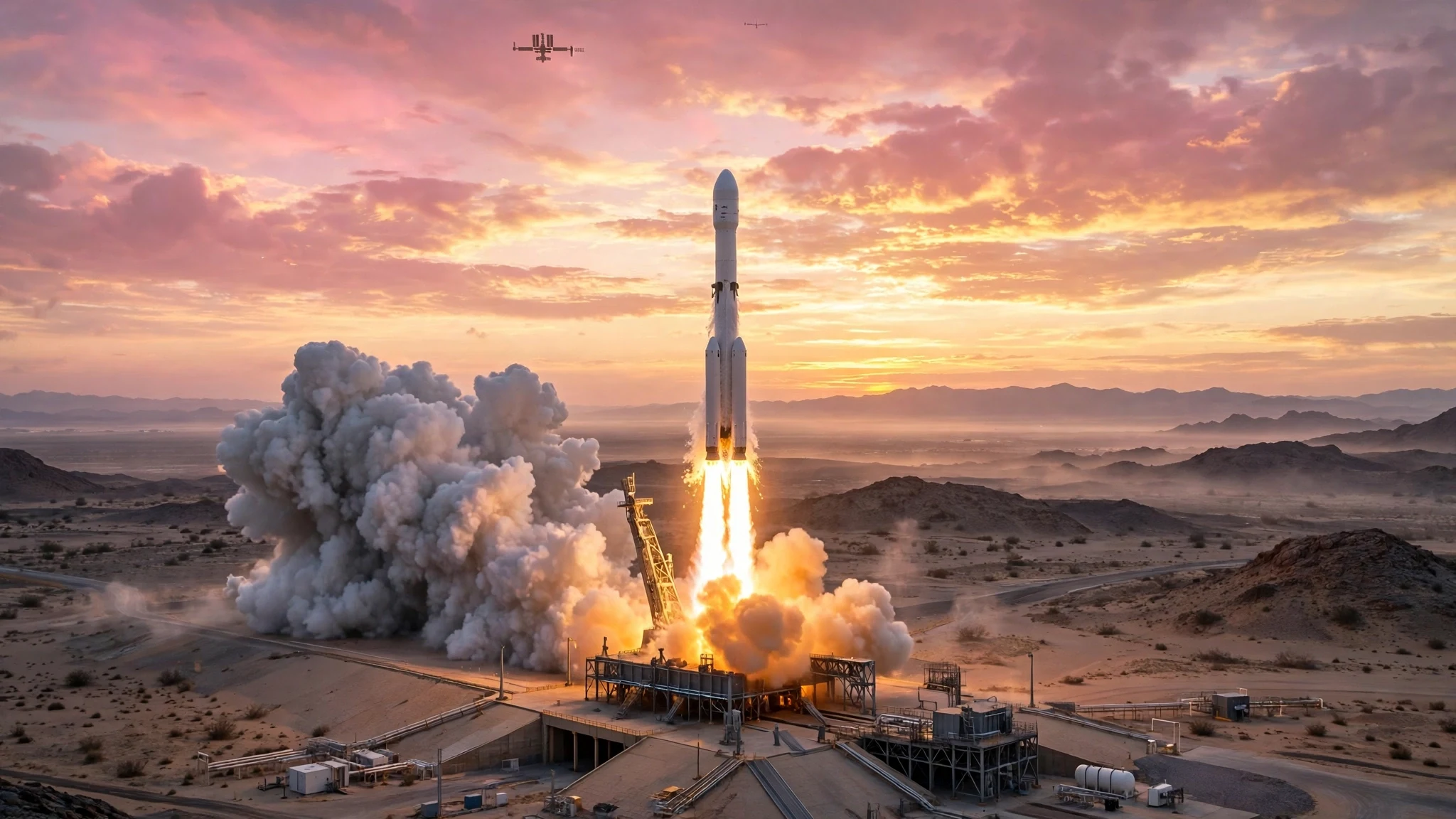
The Long March 2F rocket carrying the three-person crew blasted off from the Jiuquan Satellite Launch Centre in northwestern China at 8:18am Beijing time (5:18am Pakistan time), rising into a pink dawn sky, according to footage from state broadcaster CCTV. The spacecraft separated from its carrier rocket about 10 minutes later and entered its preset orbit. "The spacecraft is functioning well. I declare the Shenzhou-24 launch mission a complete success," an official at the Jiuquan centre announced.
Docking came at 11:56am Beijing time (8:56am Pakistan time), three hours and 38 minutes after liftoff, the China Manned Space Agency (CMSA) confirmed.
A veteran commander, a rookie pilot and a payload specialist
The mission is commanded by Tang Hongbo, 51, who previously flew to Tiangong on Shenzhou-12 and Shenzhou-17 and is now the first astronaut to visit the station three times. He is joined by Wu Yi, 39, a first-time spaceflyer serving as mission pilot, and Ali, 40, a Pakistani Air Force pilot who is flying as payload specialist.
Ali was selected under an agreement signed by China and Pakistan in February 2025 on choosing and training Pakistani astronauts for missions to the Chinese station. His selection was announced only on Tuesday, a day before launch — in keeping with China's practice of naming crewed mission line-ups at the last moment.
A week of experiments in orbit
Ali is expected to spend around a week aboard Tiangong — five to 10 days, according to mission officials — working alongside the Chinese crew on a programme of around 90 scientific experiments and technology tests spanning space biology, space medicine, materials science and microgravity physics.
Pakistan's space agency, SUPARCO, said Ali would run experiments of his own, including growing microalgae as a potential source of food and oxygen for future space missions and testing how spaceflight affects quinoa seeds. He will also carry out a photosynthetic cyanobacteria experiment during his short stay, according to Chinese state media.
At the end of his stay, Ali will return to Earth aboard the Shenzhou-23 spacecraft, together with its crew members Lai Ka-ying and Zhang Zhiyuan. Shenzhou-23 commander Zhu Yangzhu will remain in orbit, joining Tang and Wu for the station's next six-month rotation — a handover that will also feed Beijing's research into how the human body copes in space ahead of a planned crewed mission to the Moon.
A first for Pakistan — and for China
The flight is a milestone on both sides. For Pakistan, it marks the country's entry into human space exploration after decades of satellite work through SUPARCO. Planning Minister Ahsan Iqbal, who is in China for the launch, wrote on X that "a new era begins for Pakistan's space programme", adding that with Ali, "the Pakistani flag rises into orbit, lifting the hopes and aspirations of 260 million Pakistanis for technological advancement and space exploration."
For China, it is the first joint flight with a foreign astronaut in the history of its crewed space programme — and the 18th crewed Chinese spaceflight overall. Tiangong, whose name means "Celestial Palace", has been fully operational since late 2022, and Beijing has steadily opened it to international partners as it builds toward lunar missions.