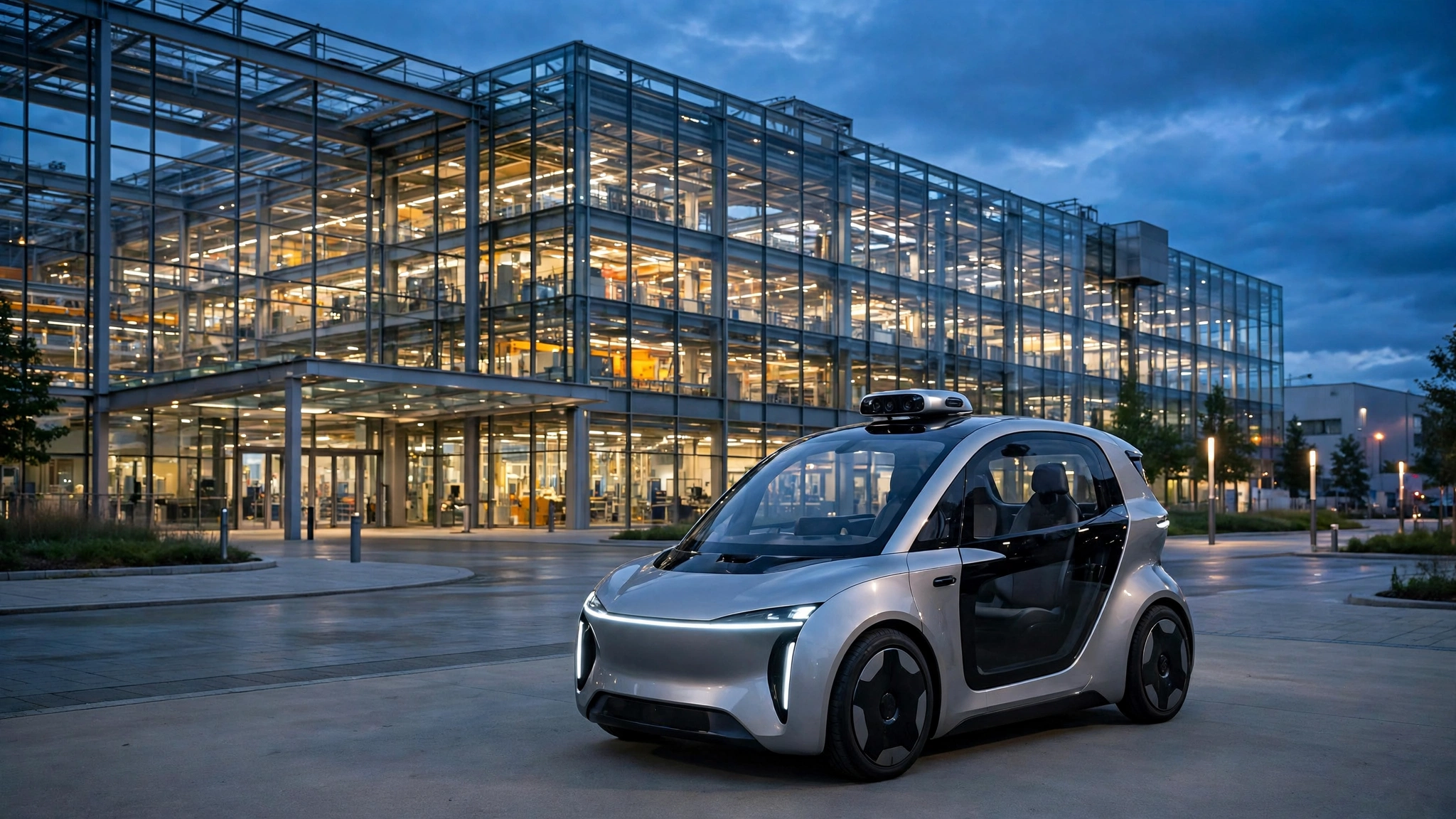
Tesla will invest €3 billion (about $3.3 billion) to expand its Gigafactory in Grünheide, near Berlin, adding a new production building designed to build up to one million Cybercabs a year. The company announced the plan on Monday, November 16, calling it a first investment in the expansion of its only vehicle factory in Europe.
The new hall, to be built north of the existing plant, will be roughly twice the size of the current main hall, with supporting buildings including a second wastewater treatment plant. Tesla plans to file the building permit application before the end of 2026, start construction in the first half of 2027, and begin Cybercab production in 2029. Model Y production will continue alongside the new line.
A million robotaxis — if Europe lets them drive
The Cybercab is Tesla's two-seat driverless vehicle, unveiled in October 2024, with no steering wheel and no pedals. Production began in Texas in April 2026, and 463 Cybercabs were registered there as of late October. The Berlin plan would make Grünheide the robotaxi's European home.
The catch is regulation. Under current European Union rules, a fully driverless vehicle can only be type-approved in small series — capped at 1,500 registrations a year per vehicle type across the whole EU. No unsupervised driverless approval exists in Europe yet: the Netherlands' RDW has approved Tesla's supervised system, which still requires an attentive driver.
Why Berlin, and why now
The investment lands as Tesla's profits run at roughly a third of where they stood two years ago, and as much of Germany's auto industry downsizes. Grünheide opened in 2022 after a two-year approval battle and received permission to expand in 2024. It currently builds only the Model Y, at roughly 375,000 cars a year, and Tesla has been hiring again at the site this year as European demand recovered, targeting 7,500 cars a week.
Plant manager André Thierig announced the decision on X, saying the investment lays the foundation for "the world's most technologically advanced Tesla factory" in Grünheide. The expansion is also expected to add several hundred construction and planning jobs.
A three-year wait — and a lot of paperwork
Between now and 2029, Tesla must win the building permit, complete construction, and — the harder part — secure a regulatory path to put a car with no steering wheel on European roads in volume. EU rules may change before production starts, but for now a million Cybercabs a year is a factory plan, not a fleet on the road.
If the permits and the rules line up, Grünheide would become the centre of Tesla's European robotaxi ambitions — a €3 billion bet that the continent is ready for driverless cars by the end of the decade.