By Hamza Faisal
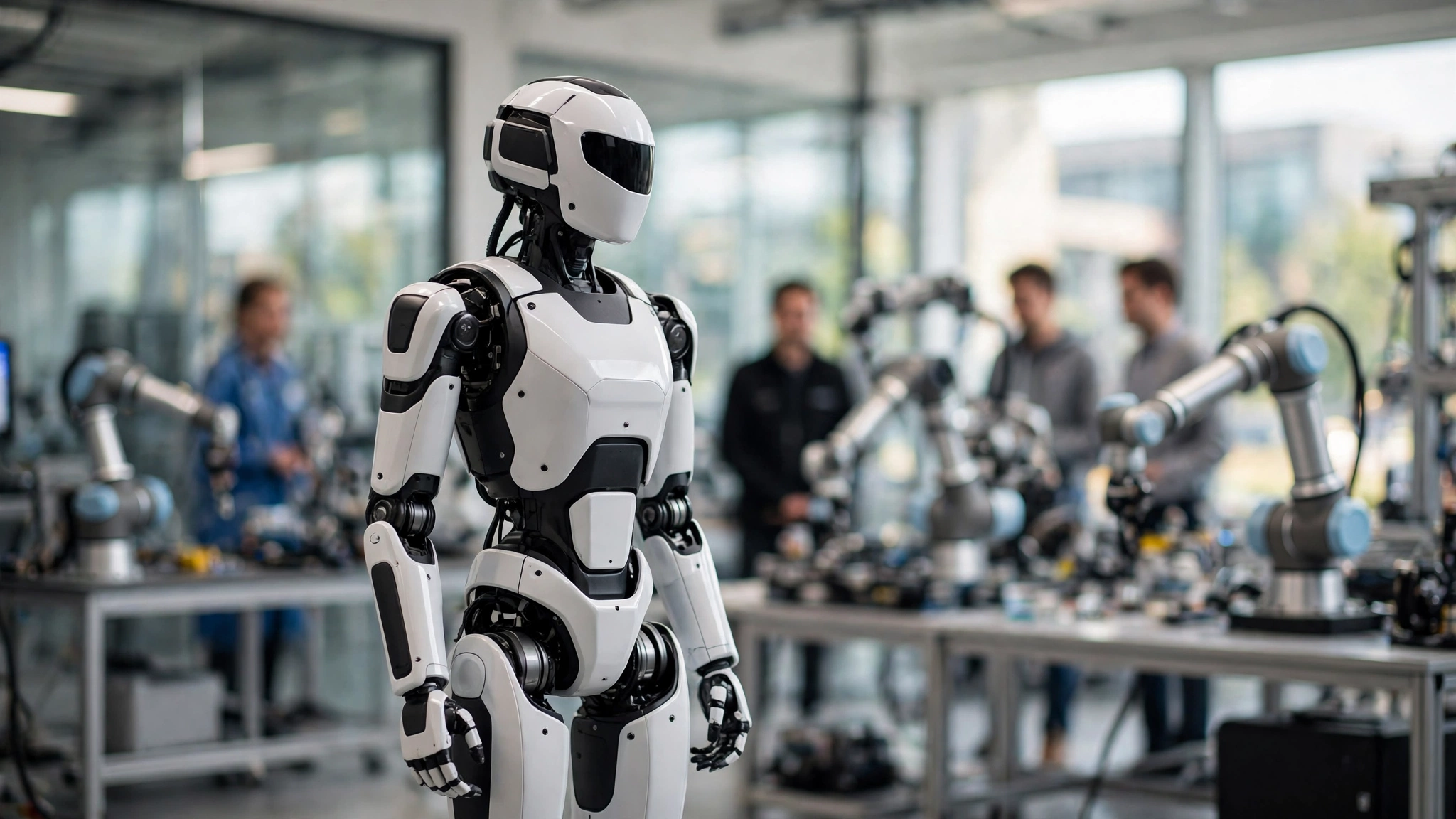
Germany's humanoid race just got a new flagship robot. NEURA Robotics unveiled the 4NE1 Gen 4, the latest generation of its "For Anyone" humanoid, and opened the TUM RoboGym powered by NEURA near Munich Airport — a 2,300-square-meter center where robots learn to do real factory work.
The launch happened on October 22 at LabCampus near Munich Airport, where NEURA and the Technical University of Munich opened the joint facility. Built with TUM's Munich Institute of Robotics and Machine Intelligence (MIRMI), the RoboGym brings research, robot training, and industrial application under one roof. The partnership runs for an initial three years, with the partners investing around 17 million euros in total — NEURA contributing roughly 11 million euros.
A robot built for the factory floor
The 4NE1 Gen 4 is positioned as a working machine rather than a lab demo. Founder and CEO David Reger said it is "designed for series production, built for productive work and powered by Neuron AI, our own foundation model that learns from experience in the NEURA Gyms." He added that the robot was developed, built, and trained in Germany, "for the world."
Neuron AI is the company's bet on physical AI: a foundation model trained on real-world robot experience, simulation-amplified data, and human demonstrations captured with sensor-equipped suits. The model supports five robot embodiments, including the 4NE1 Gen 3 and Gen 4 humanoids, a wheeled 4NE1 platform, and two bimanual robot platforms — with learned skills transferable across hardware. Crucially, inference runs on the robot itself, with no cloud connection required.
Companies bring the homework
The RoboGym's pitch is that industrial companies contribute real tasks and their process knowledge, while researchers and development teams figure out how robots can learn those tasks faster and perform them reliably. Reger framed it as a play for Germany's industrial core: the Mittelstand — the country's mid-sized manufacturers — "should be able to help shape this future."
The timing lines up with the company's recent demonstration streak. At NVIDIA GTC Berlin from October 20 to 22, NEURA ran its 4NE1 humanoid through an 11-minute autonomous laundry sequence — sorting, loading and unloading a washing machine, and transferring clothes to a dryer without human intervention. The company measures progress with a metric it calls Time-to-Skill: how fast a robot learns a new task and performs it reliably.
Europe's robotics build-up
NEURA has already lined up industrial data partnerships with Schaeffler and Bosch to feed training, and its Neuraverse platform lets customers fine-tune robot capabilities for specific workflows and distribute them across fleets. With the RoboGym, the company is trying to turn Germany's deep manufacturing know-how into robot skills — a deliberate counterweight to the humanoid pushes from Tesla, Figure, and a crowded field of Chinese players.
By Hamza Faisal