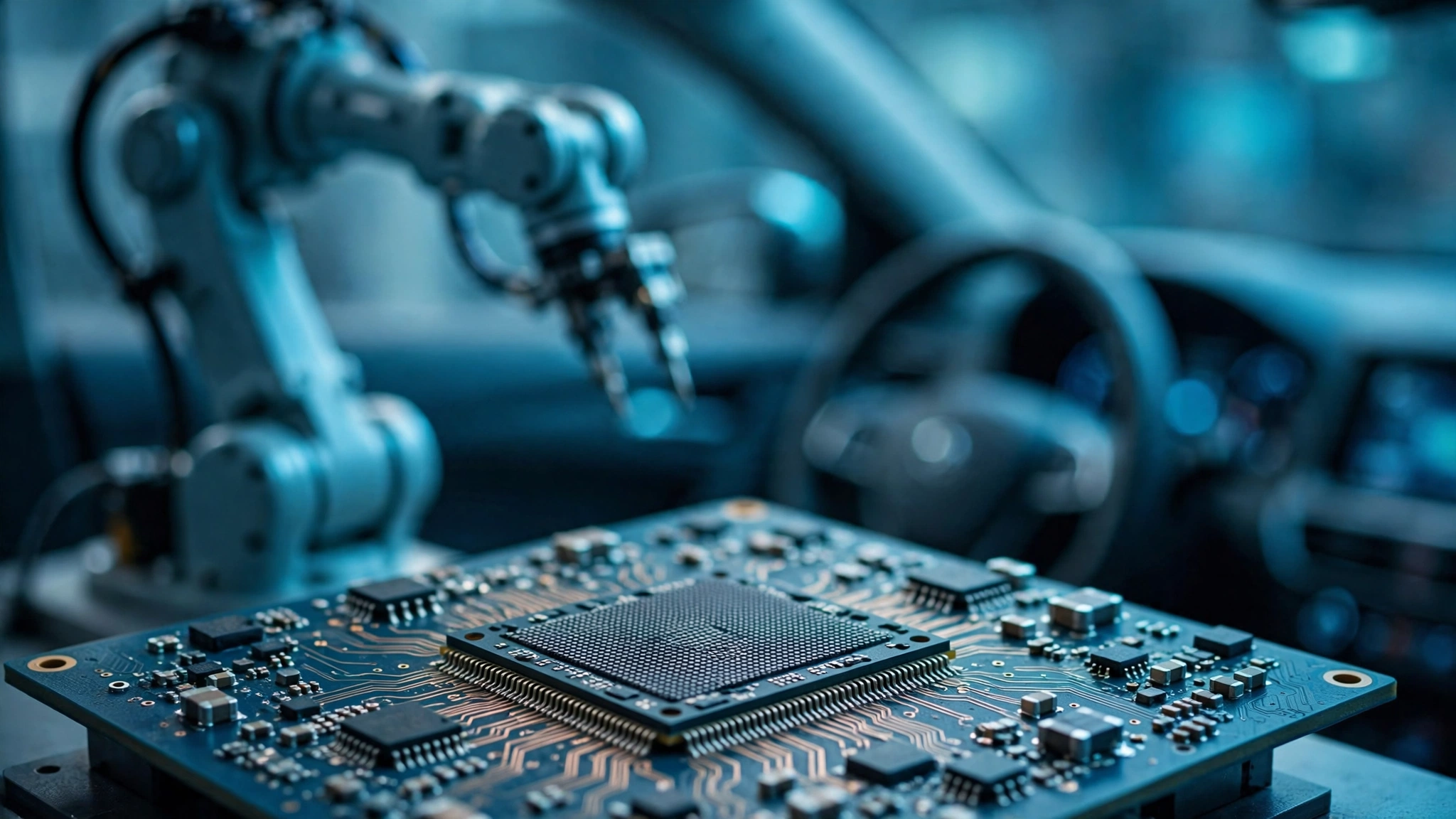
STMicroelectronics has pulled its sprawling microcontroller business into a single platform, betting that cars, factory machines and robots now need the same kind of chip. Announced on November 4 at the company's STM32 Summit 2026, the unified STM32 platform spans industrial, automotive and robotics applications, letting developers reuse architectures, software and tools across product families instead of starting over for each new device.
The Geneva-based chipmaker framed the move as a response to technology convergence: embedded systems are becoming more connected, more software-defined and more autonomous at the same time. Rather than maintaining separate chip lineages for each market, ST says one consistent platform — built on Arm Cortex-M cores, shared intellectual property and its STM32Cube software ecosystem — can carry developers from a factory sensor to a car's safety controller.
One platform, from factory floor to car
The platform rests on three pillars, according to ST. Portfolio consistency comes from Arm Cortex-M cores and reusable edge-AI, connectivity, safety and security building blocks. STM32Cube, the ST Edge AI Suite and the wider Arm ecosystem provide the common software base. And on the manufacturing side, ST combines its 40nm Flash and 18nm FD-SOI process technologies, with embedded phase-change memory, alongside TSMC embedded non-volatile memory technologies, so product roadmaps can share development and validation work.
"Embedded innovation should not require developers to start again with every new product," said Remi El-Ouazzane, president of ST's Microcontrollers, Digital ICs and RF Products Group. Arm, ST's long-standing partner, said ST will be a lead partner in defining the future Cortex-M portfolio, with Cadence participating as a key design partner.
STM32A takes the platform into safety-critical systems
The headline product news is the new STM32A family, which extends the STM32 platform into high-safety and automotive systems and supports software-defined systems and physical AI. The first three STM32A microcontrollers are sampling to customers now, with broader availability planned in 2027.
At the entry level, the STM32A4 targets automotive local control nodes and safety systems, with up to 0.5 MB of memory, QM/ASIL-B safety support and cryptographic features for sensors, actuators and compact controllers. The mid-range STM32A5, with up to 4 MB of memory and ASIL-B support, addresses body and comfort functions in vehicles as well as safety-critical industrial automation, robotics and energy applications. At the top, the STM32A9 handles safety-critical multi-domain control where real-time control, low latency, Ethernet connectivity and deterministic communication are essential, with up to 12 MB of memory, ASIL-D support and ST's Neural-ART dataflow accelerator. Its split-lock architecture can prioritise ASIL-D, or deliver twice the ASIL-B performance when the highest safety level is not required.
New chips for power, sensing and edge AI
ST also launched the STM32G5, a general-purpose mixed-signal microcontroller built on an Arm Cortex-M33 core running at up to 280 MHz — twice the compute performance of its STM32G4 predecessor. Aimed at datacentres, robotics, photovoltaic installations, wind turbines, industrial drives and commercial drones, it targets SESIP Level 3 and PSA Certified Level 3 security certifications and supports post-quantum cryptographic libraries. The series is in production now, with on-chip flash from 64 KB to 512 KB and prices starting at $1.0340 for orders of 10,000 units; a dual-core version is planned for next year.
Meanwhile, the STM32H7P becomes the company's first STM32H7 to combine a Cortex-M7 processor, a hardware signal processor DSP accelerator and an 82-GOPS Neural-ART accelerator, with availability planned in the first half of 2027. ST also demonstrated a Holoscan Sensor Bridge proof of concept with NVIDIA on STM32H7, with bridge software planned as a native STM32Cube component in the coming months.