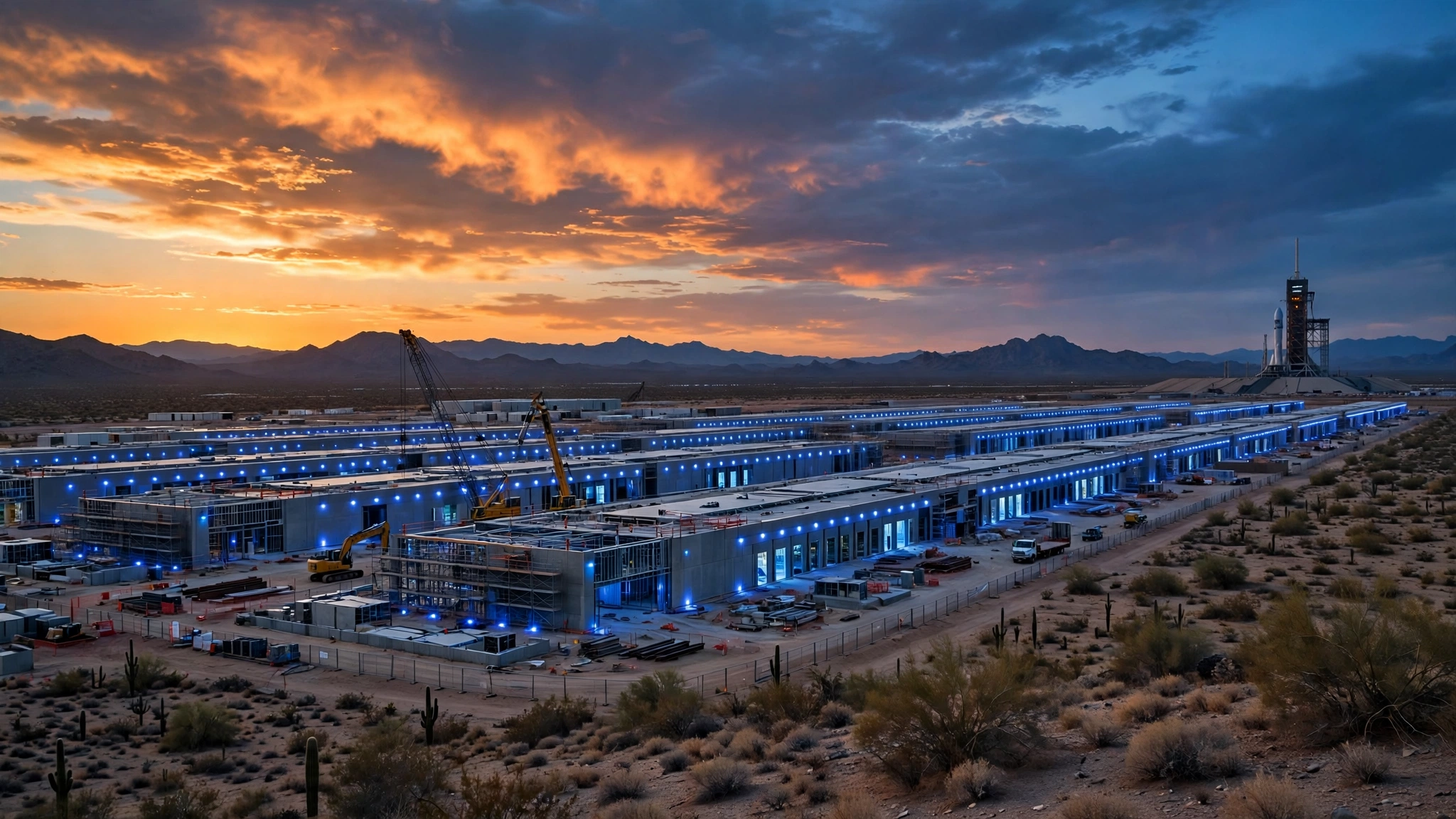
SpaceX said on Thursday it plans to invest more than $74 billion in two AI supercomputing campuses, one at its Starbase rocket site in South Texas and one in Cochise County, Arizona — the biggest bet yet on its transformation from rocket company to AI infrastructure giant. The announcement, made in a company statement under its "Building the Future" initiative and reported by Reuters, puts SpaceX's planned AI spending at roughly one and a half times the $48.1 billion in capital expenditure it reported for the first nine months of 2026.
SpaceX expects to spend more than $24 billion at Starbase and roughly $50 billion on the Arizona campus. Both sites still need local approval, and both face key decisions on December 9. Reuters reported that SpaceX's AI segment generated more than half of its revenue in the third quarter, overtaking both its launch business and Starlink satellite internet.
A 6-gigawatt bet in the Arizona desert
The Arizona campus would be the larger of the two. Built on about 747 acres near the Willcox Playa along US Highway 191, it would draw up to 6 gigawatts at full build-out, delivered in four phases of about 1.5 gigawatts each across nine single-storey compute buildings of roughly 493,000 square feet apiece. The application was filed by Tombstone Resources LLC, a SpaceX affiliate.
SpaceX estimates the project would create about 5,500 construction jobs at peak and 1,000 permanent positions. Unlike the Texas site, the Arizona campus would draw power from the grid through the Sulphur Springs Valley Electric Cooperative and Arizona Electric Power Cooperative, and SpaceX says it would use dry cooling with no planned industrial groundwater use, and could cut cooperative members' power bills by up to 20 percent.
Approval is far from certain. The project needs a special use permit from Cochise County, which does not allow data centres by right, and a petition carrying about 2,400 signatures has asked officials to deny it. The county's Planning and Zoning Commission will hold a public hearing on the application, numbered SU26-22, on December 9.
Starbase gets its own power plant
At Starbase, in the Rio Grande Valley, SpaceX plans a gas-fired power plant and supercompute site on 444 acres that would generate its own electricity rather than draw from the Texas grid. The facility is intended to train frontier AI systems for medical research, emergency response, advanced manufacturing and national security, while also supporting development and testing of future space-based computing.
The Starbase City Commission is due to consider a property-tax abatement for the project on the same day, December 9. SpaceX is also preparing Starship Flight 15, due Friday, which will attempt the first simultaneous catch of both the Super Heavy booster and the Starship upper stage.
AI is now SpaceX's biggest business
The campuses are the latest step in SpaceX's rapid transformation since it went public in June. The company reported 1.7 gigawatts of installed compute capacity at the end of September and is targeting 2.5 to 3 gigawatts by the end of 2026, while developing the Starmind orbital constellation — it has filed with US regulators for permission to launch up to one million Starmind satellites, with the first units slated for 2027.
Chief executive Elon Musk has also voiced interest in hiring former Nvidia chief executive Jensen Huang, who resigned on Wednesday, into his own companies. Neither company has disclosed which chip suppliers or network architecture the new campuses would use, and no commissioning dates have been given.


