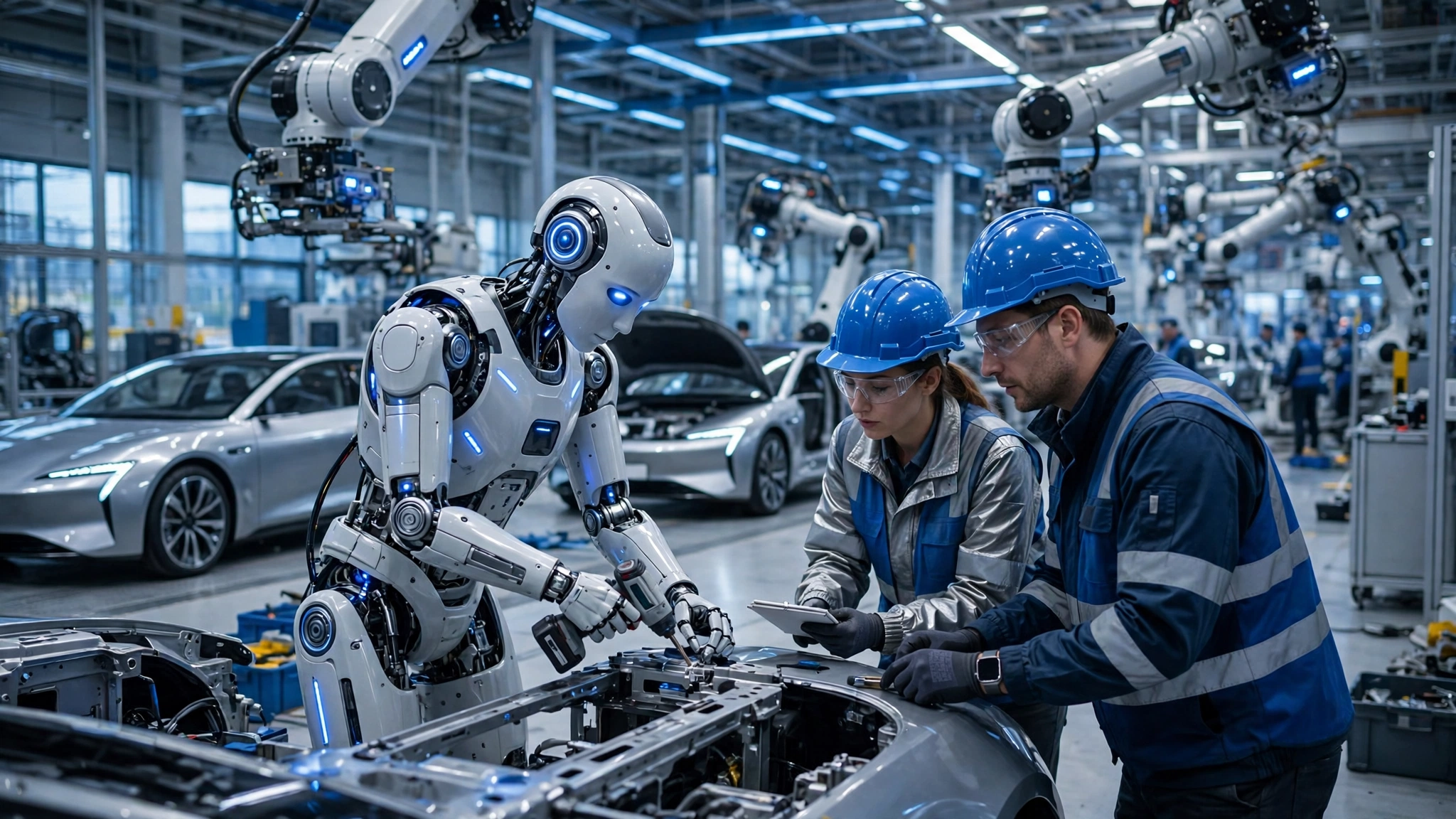
South Korea's two largest industrial groups are joining forces as a single team. Samsung and Hyundai Motor Group on Monday declared a strategic partnership aimed at future mobility, robotics and physical AI, extending a relationship that began with their founders and has so far run mostly through car parts, batteries and electronics.
Samsung hosted the announcement at an "HMG Appreciation Day" event on November 9 at its Seocheon training centre in Yongin, attended by 177 executives from both groups under the theme "One Harmony Toward the Future." Samsung Electronics Chairman Jay Y. Lee and Hyundai Motor Group Executive Chair Euisun Chung decided to elevate cooperation that had previously proceeded business by business into a group-wide strategic partnership.
"Hyundai Motor Group and Samsung are partners that have written the history of Korean industry together," Samsung Electronics Vice Chairman Jun Young-hyun, who hosted the event, told the gathering. Hyundai Motor Group Vice Chairman Jaehoon Chang said the two groups were "expanding the possibilities for cooperation in future industries such as robots and energy, beyond cooperation in auto parts areas including electronics, audio and batteries."
From car parts to robots and energy
The two groups have cooperated for years on vehicle components. Samsung Electronics supplies Hyundai with its Exynos Auto V920 chip for in-car infotainment, and Samsung SDI signed its first long-term electric-vehicle battery supply contract with Hyundai in 2023. Its high-nickel NCA prismatic batteries are set to power Kia's compact electric SUV and Hyundai's Ioniq 3.
The partnership now widens into areas where the two sides' strengths overlap. Samsung SDI and Hyundai Motor and Kia began jointly developing batteries designed specifically for robots in 2025, with Samsung handling high-capacity materials and battery design and Hyundai and Kia evaluating robot applications. At the event, Samsung's semiconductor division showed off advanced automotive chips, Samsung SDI presented next-generation energy technology including all-solid-state batteries, and Samsung Electro-Mechanics displayed camera modules for autonomous driving.
Self-driving cars and robots share the same building blocks — sensors, semiconductors and batteries — so combining Samsung's components with Hyundai's robot development and manufacturing could open new business in industrial robots and next-generation mobility.
Physical AI is the shared bet
Physical AI — AI applied to machines that move and work in the real world — is the field the two groups singled out. Samsung said the combination of its technologies with Hyundai's electric vehicles, autonomous driving, software-defined vehicles and robotics businesses could create synergies in physical AI, which it described as applying AI and robotics in industrial settings and daily life.
The partnership carries symbolic weight in South Korea, where Samsung and Hyundai were once arch-rivals. Their founders' ties span three generations of executives, and the two chairmen have met repeatedly in recent years, including at Samsung SDI's Cheonan plant in May 2020 and at Hyundai and Kia's Namyang research centre in July 2020. No financial terms, joint venture or investment figure was disclosed, and neither group has set out a timetable for specific products.
Why it matters
The move lands as the global race for physical AI accelerates, with carmakers, chipmakers and robotics firms all trying to own the hardware layer of the AI era. Samsung brings the components — chips, sensors, batteries and displays — while Hyundai brings vehicles, autonomous-driving systems and a growing robotics business. If the partnership delivers, the combined group could challenge rivals in China, the United States and Japan that are pursuing the same convergence of cars, robots and AI.
Whether "one team" becomes joint products or stays a slogan will be judged by what the two groups ship next.


