By Hamza Faisal
A chip startup tackling one of artificial intelligence's biggest bottlenecks has raised $86 million. Powerlattice Technologies, based in Vancouver, Washington, sold $86,009,965 of a $111,010,000 equity offering, according to a Form D notice filed with the U.S. Securities and Exchange Commission on October 30, 2026. The filing lists 18 investors so far and a first sale date of October 15, leaving about $25 million still open in the round.
The company has not announced the round and declined to comment; the filing names neither the round nor its investors. But the numbers mark a sharp step up: Powerlattice emerged from stealth in November 2025 with a $25 million Series A jointly led by Playground Global and Celesta Capital, and had raised $31 million in total at that point. The new $86 million nearly triples that figure.
Powerlattice was founded in 2023 by chief executive Peng Zou, Gang Ren and Sujith Dermal. Its pitch targets the power wall constraining AI data centers: as accelerators push past 2,000 watts per chip, operators face hard limits on electricity and cooling, and conventional delivery wastes much of the energy en route to the processor.
Power delivered from inside the package
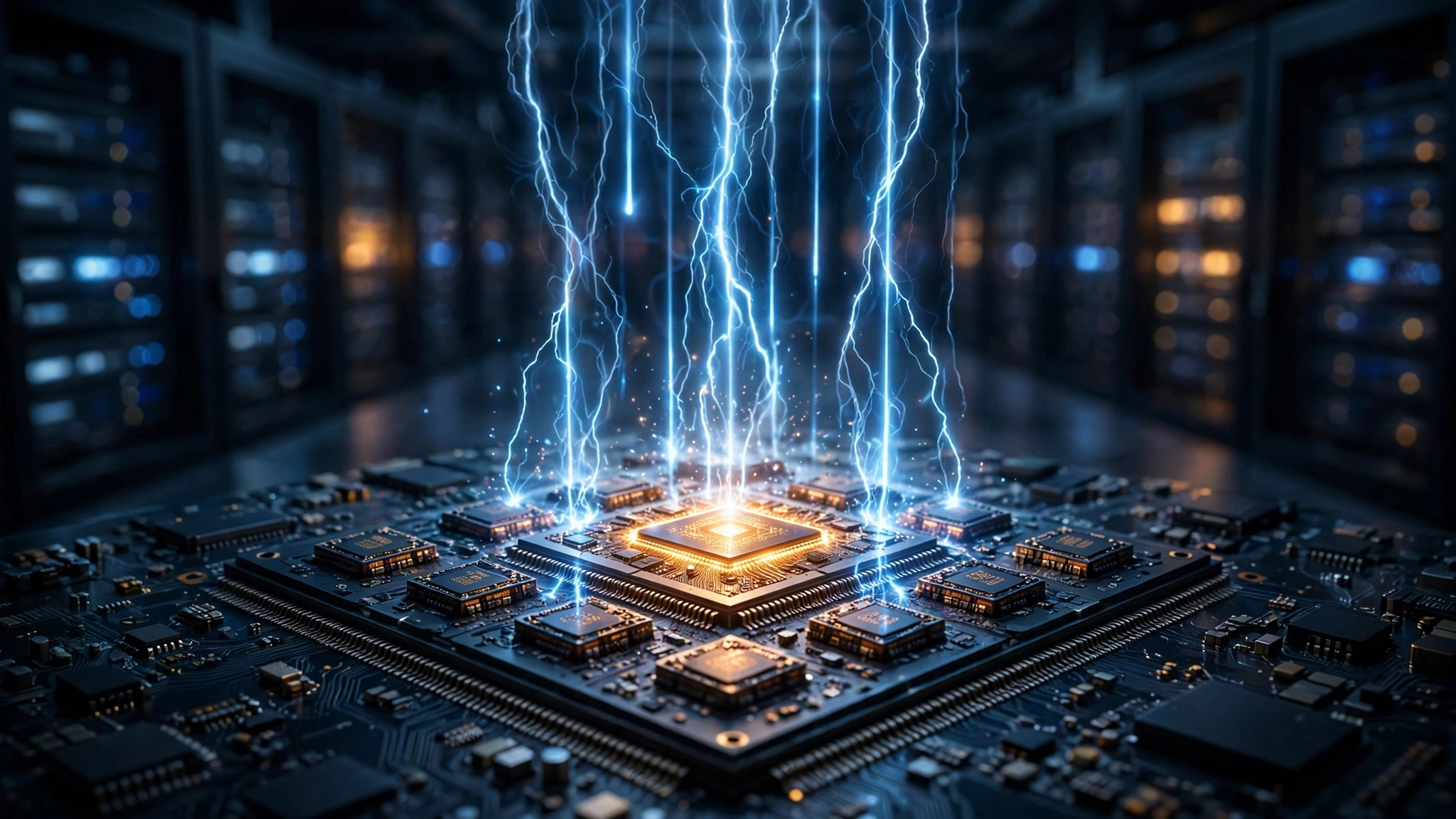
Powerlattice's answer is what it calls the industry's first power delivery chiplet: an integrated voltage regulator built directly into the processor package, delivering power vertically to the chip at the point of load instead of routing current over long paths from the motherboard. Its Rainier micro-IVR architecture combines miniaturized on-die magnetic inductors, which it calls PowerMagix, with control-circuit innovations and a programmable software layer.
The company claims the approach cuts total compute power needs by more than 50 percent, which it says can translate into twice the raw performance under a fixed data center power budget. Those efficiency figures are the company's own claims and have not been independently verified in real data centers.
On October 26, Powerlattice announced the successful demonstration of what it described as the industry's first monolithic integrated voltage regulator chiplet, packing the controller, power transistors and inductors onto a single piece of silicon. In the test, the chiplet powered a device built to mimic the fast-shifting electrical loads of next-generation AI accelerators, and multiple chiplets can be linked to work as one. The company said last year it was providing engineering samples for graphics processors, central processors and custom accelerators.
A board with chip-industry weight
The filing names Zou, Dermal and Ren as executive officers and directors, alongside Steve Fu of Celesta Capital, Wen Hsieh of Matter Venture Partners, and former Intel chief executive Pat Gelsinger, now a general partner at Playground Global. Gelsinger's presence gives the small startup a direct line to one of the semiconductor industry's most experienced operators at a moment when power delivery is becoming a strategic battleground, with Empower Semiconductor's $140 million raise in 2025 and its $1.5 billion acquisition by Analog Devices in May 2026 as the precedent.
Why power is suddenly the story
The raise lands in a week when Wall Street punished AI's biggest spenders over whether enormous data center spending will pay off: Intel crashed about 30 percent on Friday, and Amazon missed profit and revenue expectations while holding its 2026 capital spending guidance at $220 billion. In that climate, a component that promises more computing per watt has an obvious audience.
Next comes closing the remaining $25 million and turning engineering samples into customer chips. If its in-package regulators deliver on their claims inside real accelerators, Powerlattice will have solved a problem every AI hardware maker now shares.
By Hamza Faisal