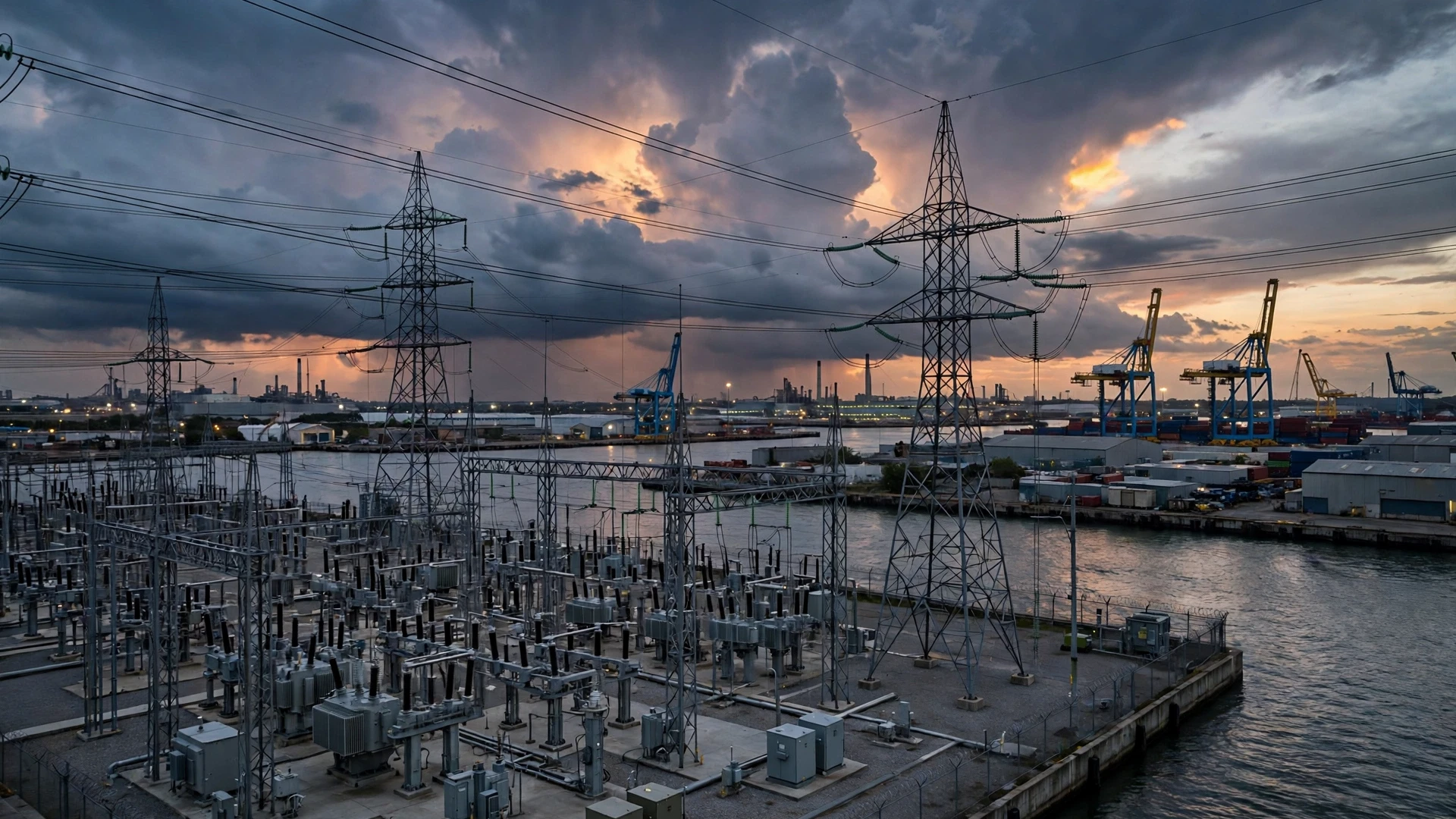
National Grid has agreed to buy a 29.5-hectare plot at Dorman Point on Teesside for what could become Britain's biggest electricity substation, taking a concrete step toward powering a vast AI datacentre planned next door.
The deal, first reported by Sky News and covered by The Guardian, was agreed last week. The land is owned by Teesworks, a public-private partnership developing the former Redcar steelworks site, which is billed as Europe's largest brownfield regeneration project at around 2,500 acres.
National Grid Electricity Transmission expects the substation to add more than one gigawatt of new capacity. Tees Valley mayor Ben Houchen has said the site could ultimately accommodate up to 3.2 gigawatts, enough to put the region in contention for the largest AI computing projects.
A substation sized for AI's appetite
The substation would form part of National Grid's Great Grid Upgrade, its programme to expand and modernise Britain's transmission network. Plans call for it to connect to a private-wire system serving the neighbouring datacentre campus and a battery energy storage system.
The UK government identified Teesworks as a possible site for a major AI datacentre in 2025, and planning applications have since been submitted for a campus spanning nearly 500,000 square metres. An outline planning application went to the local authority in September 2026 and is awaiting a response, while community consultation is expected to close on November 11.
Matt Pearce, National Grid's head of land, said the agreement "reflects the constructive work between all those involved to enable this vital infrastructure" and would "support the growth of AI and digital technologies, and enable the region's next phase of industrial and economic development".
Why power is now the bottleneck
The Teesside deal underlines a shift in the AI race: the constraint is increasingly not chips or models, but electricity. Datacentres capable of training and running frontier AI systems need gigawatts of reliable power, and developers say securing a grid connection quickly is often harder than financing the buildings.
Houchen put it bluntly to Sky News: "Everyone who has tried to build a datacentre in this country knows the biggest problem is getting enough power to the site quickly." He added: "If Britain is serious about having its own AI capability, it needs somewhere to physically put it," and that 3.2 gigawatts of capacity would mean the region can "finally compete for those projects".
The government underscored the point last week, publishing a draft national policy statement describing datacentres as "as fundamental to our economy as the railways and electricity networks on which we have long depended".
What happens next
Three things will decide whether the Teesside project lives up to its billing. The first is the outcome of the consultation closing on November 11. The second is the planning authority's response to the outline application. The third is whether a confirmed datacentre operator commits to the site, turning a promising power connection into an actual customer.
Construction names are already circling: Balfour Beatty has been reported as in line to deliver the substation for National Grid, with Steel River Power, a joint venture associated with Iberdrola, also heavily involved.
For now, the land deal is a step, not a finished substation, and no connection date is guaranteed. But it is a sign that Britain's AI ambitions are moving from announcements to groundwork, and that the places that can deliver power at scale will decide where the computing goes.