By Hamza Faisal
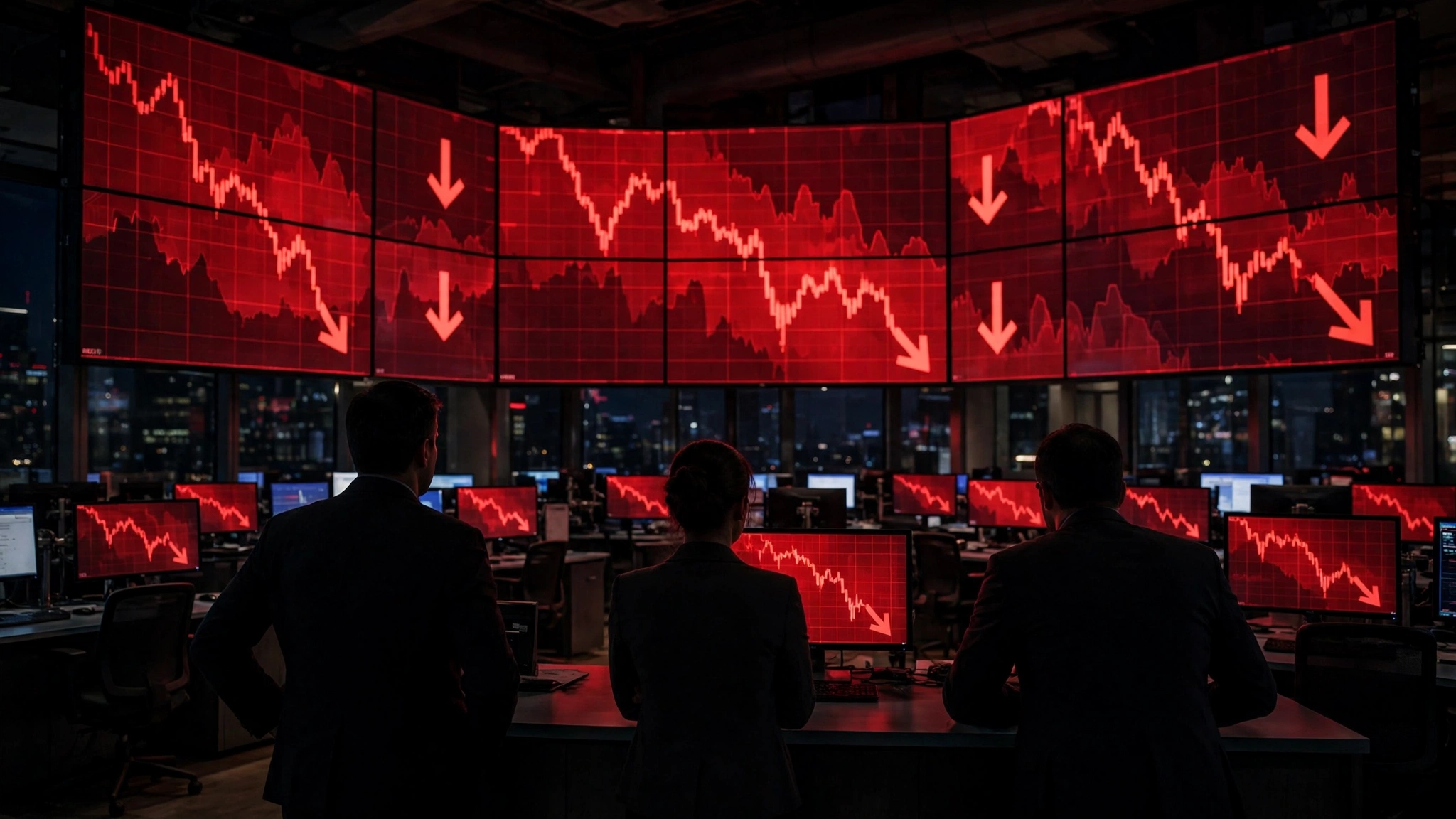
Wall Street's artificial intelligence rally suffered its sharpest blow in more than a year on Thursday, as the Nasdaq Composite plunged 5.52% in its worst single-day fall in 19 months and roughly $3 trillion in market value was wiped off S&P 500 companies. By Friday morning in Pakistan time, the rout had spread to Asia, with South Korea's Kospi index crashing so hard that trading was halted by a circuit breaker.
The Nasdaq closed at 24,315.00, more than 10% below its record close on October 6 — putting the index officially in correction territory. The S&P 500 fell 4.36% to 7,353.73, while the Dow Jones Industrial Average lost 3.44%, or more than 1,800 points, to 51,523.06. It was the steepest daily decline for the Nasdaq and the S&P 500 since the tariff crash of April 2025.
The immediate trigger was politics. Democrats won control of the US Congress in Tuesday's midterm elections, and investors fear the new balance of power will bring tighter regulation of artificial intelligence and a slower pace of data-centre construction. Voters in ten states also rejected most of the local data-centre measures on their ballots, adding to the sense that the breakneck buildout of AI infrastructure now faces real political headwinds.
Chipmakers take the worst of it
Semiconductor stocks bore the brunt of the selloff. Nvidia fell more than 9%, AMD plunged 17.3% just two days after guiding above expectations, and Micron lost around 15% in a single session. Broadcom dropped about 10% and Arm around 12%, while the Philadelphia Semiconductor Index tumbled more than 12% — its largest one-day fall since March 2020.
Qualcomm fell 9.5% after the chipmaker missed Wall Street estimates for fourth-quarter smartphone chip sales, a reminder that the selloff was not only about regulation. Even so, the pattern was unmistakable: the companies that supply the chips and equipment for AI data centres were the market's biggest losers of the day.
The data-centre trade unwinds
The damage spread well beyond chipmakers. Data-centre operators Iren and Applied Digital each fell more than 14%, neocloud company CoreWeave dropped almost 10%, and GE Vernova, which supplies power-generation equipment, slid 7.5%. Meta fell 4%, while Amazon and Alphabet each lost 2.2%.
The nerves were visible in the credit markets too. Dutch lender ING is putting a roughly $500 million portfolio of data-centre loans up for sale, Bloomberg News reported on Thursday, including a $25 million loan tied to a large New Mexico data centre that forms part of the Stargate AI infrastructure venture backed by OpenAI, SoftBank and Oracle. Bids are due by November 19. Reuters said it could not immediately verify the report, and ING did not respond to a request for comment.
Asia follows Wall Street down
The selloff did not stop at the US close. South Korea's Kospi plunged more than 8% in early trade on Friday, triggering a circuit breaker and dragging the index below the 5,000-point mark for the first time in nine months, as semiconductor and technology stocks were hit across the region.
For all the drama, one bad day does not prove the AI bubble has burst. The Nasdaq remains up 4.6% so far in 2026 despite Thursday's plunge, according to Reuters, and the index has bounced back from sharp corrections before. What Thursday did show is how quickly the market's mood can turn when the political winds around AI infrastructure shift — and with a new Congress promising tougher scrutiny, the data-centre trade is unlikely to feel comfortable again soon.


