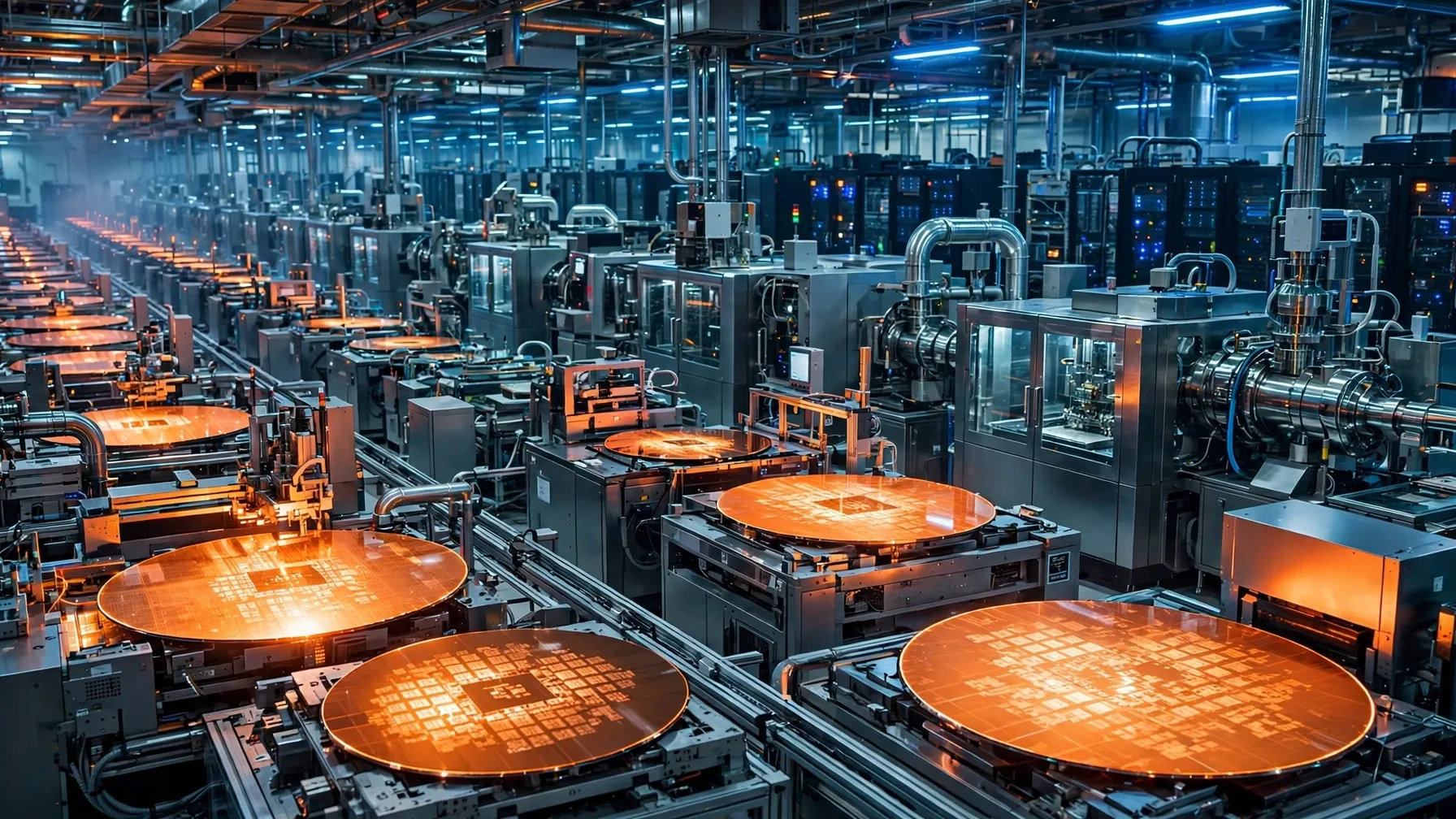
Intel is moving semiconductor manufacturing capacity away from personal computer processors and toward data-center server chips, as demand from the artificial intelligence industry outruns what its factories can produce.
The shift, detailed by executives on Intel's third-quarter earnings call and reported by Tom's Hardware, comes as the company's Data Center and AI division posted $7.3 billion in revenue for the quarter, up 17 percent from the previous quarter and roughly 80 percent higher than a year earlier. Chief executive Lip-Bu Tan described the industry as working through one of the most significant supply shortages in its history, driven by unprecedented demand for AI computing.
At the same time, Intel expects the consumer PC market to shrink in coming quarters. The company is betting that AI demand will more than offset that decline, and it is reshaping its factory footprint to match.
Ireland, Arizona and Oregon lead the pivot
The most visible moves are at three sites. Intel has begun expanding its Fab 24 complex near Leixlip in Ireland to produce more Xeon processors, with the additional capacity expected to come online by the end of 2027 unless the schedule is accelerated.
In Arizona, equipment installation has started ahead of schedule at Fab 62, which will become the company's second high-volume plant for its Intel 18A process and related technologies, alongside the ramping Fab 52 next door. Those lines will support future server CPUs as well as the Core Ultra 400-series Nova Lake chips for PCs.
In Oregon, Intel plans to convert manufacturing resources originally slated for Panther Lake client chips on Intel 18A over to Intel 3 production for data-center products. Chief financial officer Dave Zinsner told analysts that capacity freed up from client processors could be redirected to produce more data-center wafers, with the additional Intel 3 output not expected to reach volume until the second half of 2027.
Xeon 6 is the immediate priority
The immediate priority is increasing output of Xeon 6 Granite Rapids processors, built on the Intel 3 process. Intel says the family has become its fastest-ramping server processor line, yet demand still exceeds supply.
Advanced packaging is part of the same push. Intel is expanding packaging capacity in New Mexico and Malaysia to support its own chips — including Clearwater Forest Xeons that stack Intel 18A compute dies on Intel 3 base dies — as well as external foundry customers. The company is also working with suppliers to expand substrate output, projecting roughly 40 percent additional capacity in the second half of 2027.
Intel expects capital spending of roughly $20 billion in 2026, rising further in 2027, with firm purchase orders to equipment vendors climbing nearly 40 percent sequentially in the third quarter. Even so, executives warned that supply constraints will remain particularly severe during the first half of 2027, before substrate expansions and converted fab lines take effect.
What it means for PCs
The reallocation raises an obvious question for PC buyers: whether diverting capacity to servers will tighten consumer processor supply. Intel has not disclosed how much capacity is being moved, nor how the shift will affect client CPU output, prices or delivery times, and it still expects to reserve meaningful volume for PCs, including Nova Lake.
What is clear is the direction of travel. Intel expects data-center CPU demand to stay elevated through 2027 and 2028 as AI operators deploy more inference and agentic workloads, which lean heavily on general-purpose processors rather than accelerators alone. For now, the server side of Intel's business is where the growth — and the factory investment — is going.


