German robotics startup RobCo has joined the unicorn club. The Munich-based company has sold shares in a transaction that values the business at more than $1 billion — roughly double the level it reached earlier this year — underscoring investor enthusiasm for so-called physical AI systems.
The company said it sold $40 million worth of shares, most of them offered by existing employees, to a group of new and existing investors. The transaction is a secondary sale rather than a fresh fundraising round, meaning the cash largely flows to staff and early backers rather than the company's balance sheet. It follows a $100 million Series C round in January that had valued RobCo at around $500 million.
A self-learning factory robot called Alfie
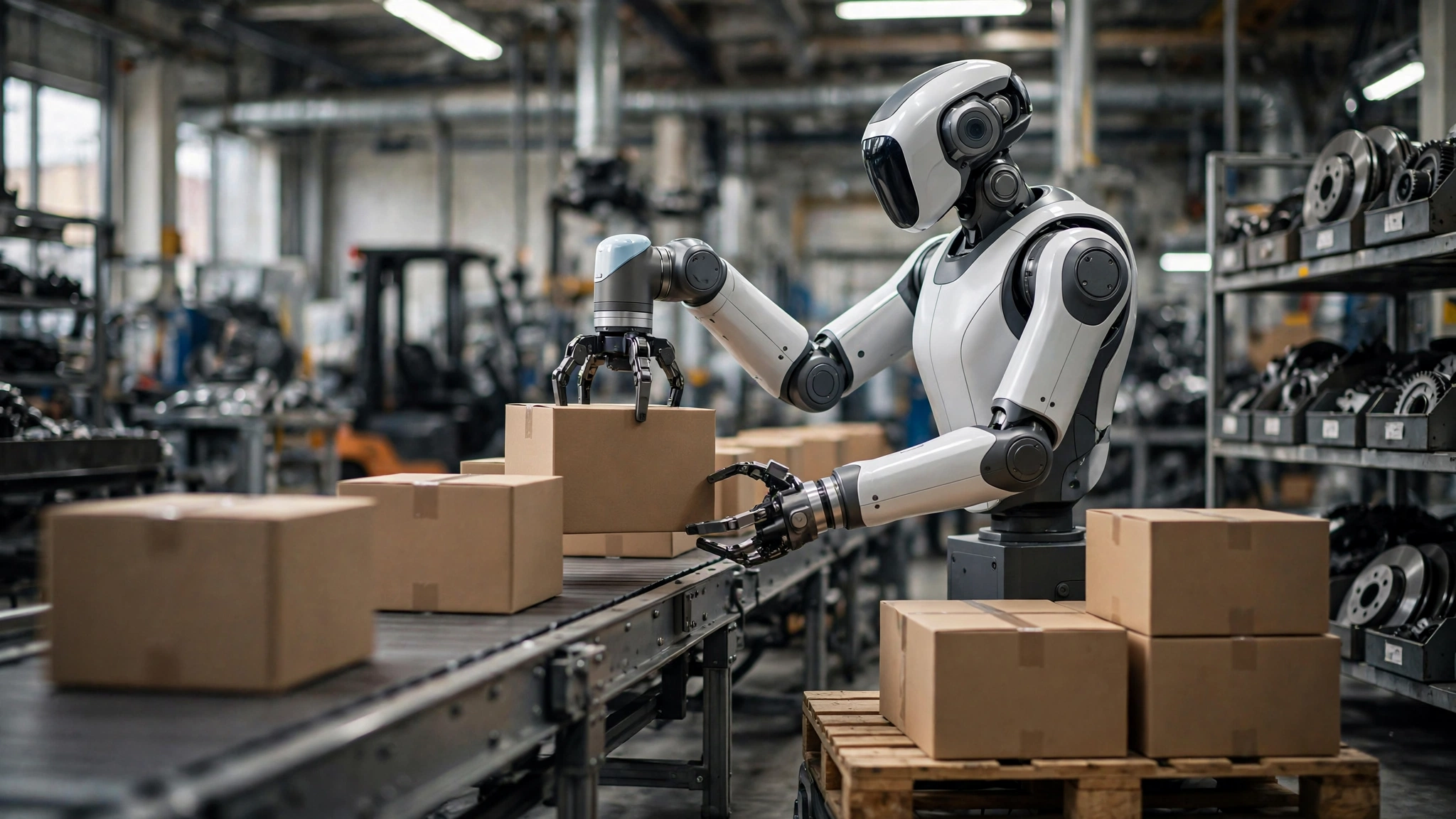
RobCo builds autonomous industrial robots designed to automate repetitive manual tasks such as stacking pallets, weighing raw materials, and assembling precision parts. Its new flagship product is a two-armed, self-learning robot called Alfie, built to mimic a human working on a factory floor.
Alfie combines bimanual manipulation with tightly integrated perception software, allowing it to handle everything from precision assembly to sensitive material handling and intralogistics processes such as picking and kitting. The robot learns by watching and adapting to variation rather than being manually reprogrammed, a step toward what the industry calls Level 4 autonomy on the factory floor.
Physical AI draws a flood of capital
RobCo's rising valuation is emblematic of a broader bet by investors that advances in AI will drive wide adoption of robots in factories and, eventually, homes. According to data provider PitchBook, robotics and physical AI startups raised $33.4 billion in the first half of 2026 — more than in all of 2025.
New investors in the share sale include Cherry Ventures and the European Tech Collective, a fund that counts founders of Wiz — the cybersecurity startup Google acquired last year for $32 billion — and payments giant Adyen among its limited partners. Existing backers participating include Sequoia Capital, Lightspeed Venture Partners, and Lingotto, a fund backed by the family behind Jeep owner Stellantis. Another is Leitmotif, an investment firm funded by Volkswagen.
From Munich research lab to global factories
RobCo was founded in 2020 by researchers from the Technical University of Munich, home to one of Europe's leading robotics and machine intelligence institutes. Since then it has sold more than 1,000 robots to industrial customers, including German automaker BMW, and expanded into the United States with operations in San Francisco and Austin.
The company's robots are deployed across a range of industrial environments, from large manufacturers to logistics operators, running on a vertically integrated platform that combines hardware and software into a single system. RobCo says its systems acquire task-specific skills through demonstration and self-learning, enabling faster deployment and easier adaptation to complex production processes.
As manufacturers confront labor shortages, reshoring pressures, and rising operational complexity, the demand for robots that can handle unpredictable, real-world factory conditions keeps growing. RobCo's doubled valuation suggests investors believe the company is positioned to be one of the winners in that shift.
By Hamza Faisal