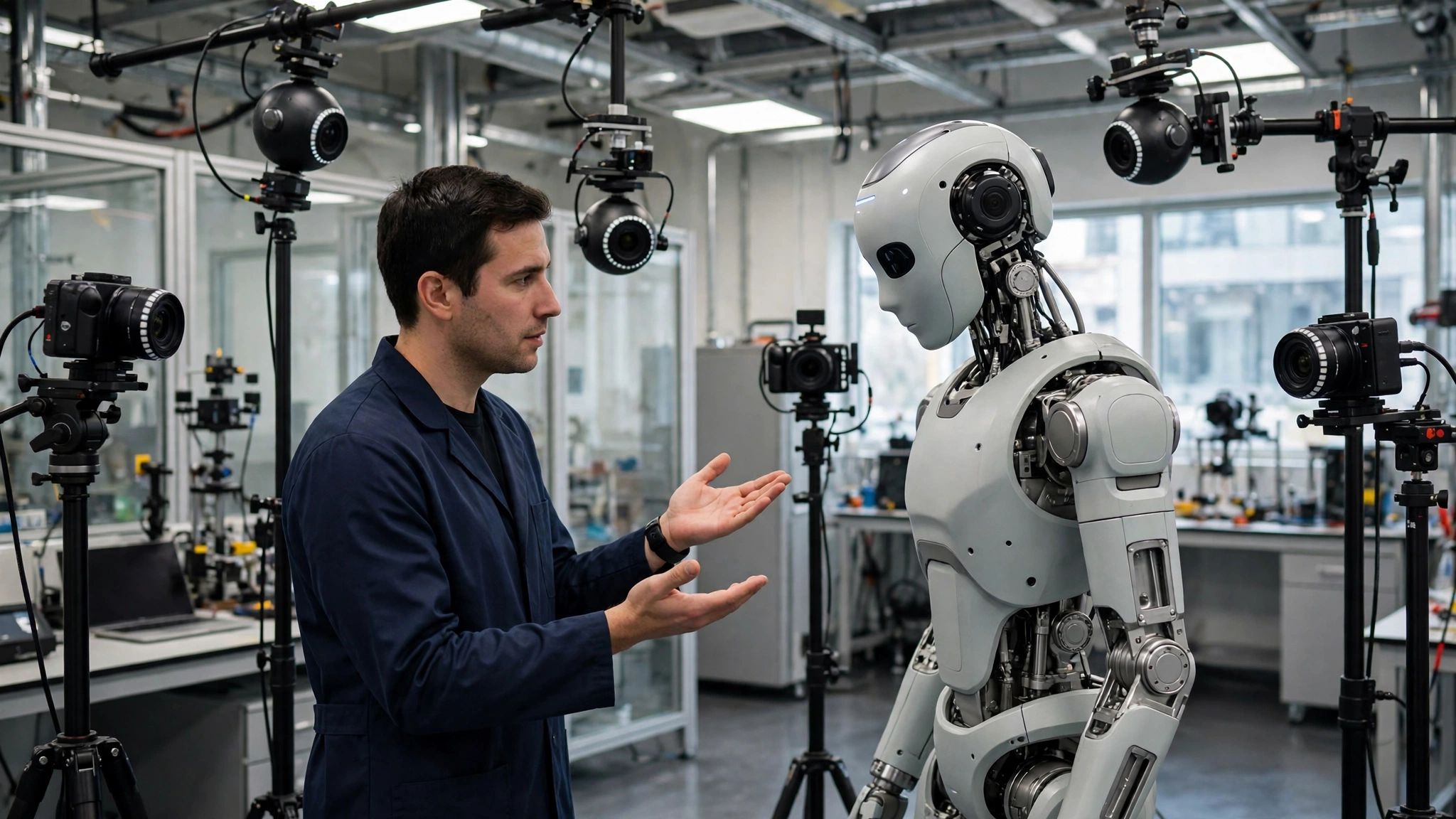
Beijing-based GenRobot AI has completed a $100 million Series A+ funding round, giving one of China's robot-data specialists fresh capital as the race to build capable humanoid and industrial robots shifts from hardware alone to the data used to train them. The financing closed in the third quarter and was disclosed on November 2.
The round brings together a notably broad investor list. Participating investors include SAIC Motor, Malaysia's Eastworlds, Baidu, Shoucheng Holdings and Galaxy General Robotics, alongside financial investors GL Ventures, CITIC Goldstone, CCB International and Huatai Zijin. The mix spans automakers, technology companies and institutional investors, reflecting how many different industries now have a stake in robots that can work safely around people.
GenRobot AI provides data infrastructure for robot development. Rather than building robots itself, the company builds the equipment and software used to collect human demonstrations that robots can learn from, a step that has become one of the main bottlenecks in embodied artificial intelligence.
What GenRobot actually sells
GenRobot AI's recording systems capture visual information together with hand and body movements as people carry out tasks. Those tasks span household work, manufacturing and logistics, three areas where robots are expected to move from controlled demonstrations to everyday use.
The company's Matrix platform then synchronizes, cleans and labels those recordings. That processing matters because raw video alone is of limited use for training: a robot developer needs data in which what a person saw, how they moved and what they were trying to achieve are aligned and clearly labelled.
The result is data for both training and evaluation. Developers can use it to teach a robot a task, and then test whether the robot can repeat that task reliably when conditions change, a crucial step before robots are trusted in homes, factories or warehouses.
Why investors are backing robot data now
The funding arrives at a moment when robot makers are discovering that clever models are not enough on their own. A robot that can understand a spoken instruction still needs to know how to grasp an object, adjust when something moves, or recover when a task goes wrong. Those skills are learned from large volumes of real-world demonstration, not just from text or simulated environments.
That is why data infrastructure has become a strategic asset. Companies that can collect high-quality demonstrations at scale, across many tasks and settings, can supply many robot developers at once. Investors in this round appear to be betting that the winners in robotics will include the companies that own that data pipeline, not only the companies that build the machines.
The presence of SAIC Motor is also telling. Automakers have deep experience with factory automation, supply chains and large-scale manufacturing, and they are increasingly interested in humanoid robots for production lines. Baidu's participation points in a similar direction, linking robot data to broader artificial intelligence and autonomous systems work.
What comes next
For GenRobot AI, the immediate challenge is scale. Collecting demonstrations is labour-intensive, and the value of a dataset grows with its diversity: more tasks, more environments and more variations on how people actually move and solve problems. Expanding that coverage while keeping labelling consistent will test whether the company's platform can grow as fast as demand.
For the wider robotics industry, the round is another sign that the data layer is becoming a business in its own right. As more robots reach pilot deployments, developers will need reliable, well-labelled training data to move from impressive demonstrations to dependable products.
By Hamza Faisal