After eight years and roughly nine billion kilometres, Europe and Japan's BepiColombo spacecraft is finally in orbit around Mercury — though the arrival did not go quite to plan. A software glitch cut short the braking burn meant to capture the probe, and for hours engineers in Darmstadt did not know whether the spacecraft had made it at all.
The European Space Agency (ESA) confirmed on November 23 that BepiColombo is safe and in a stable orbit around the Solar System's innermost planet, making it only the second mission in history to circle Mercury after NASA's MESSENGER, which operated there from 2011 to 2015.
A 37-minute burn that ended after 28
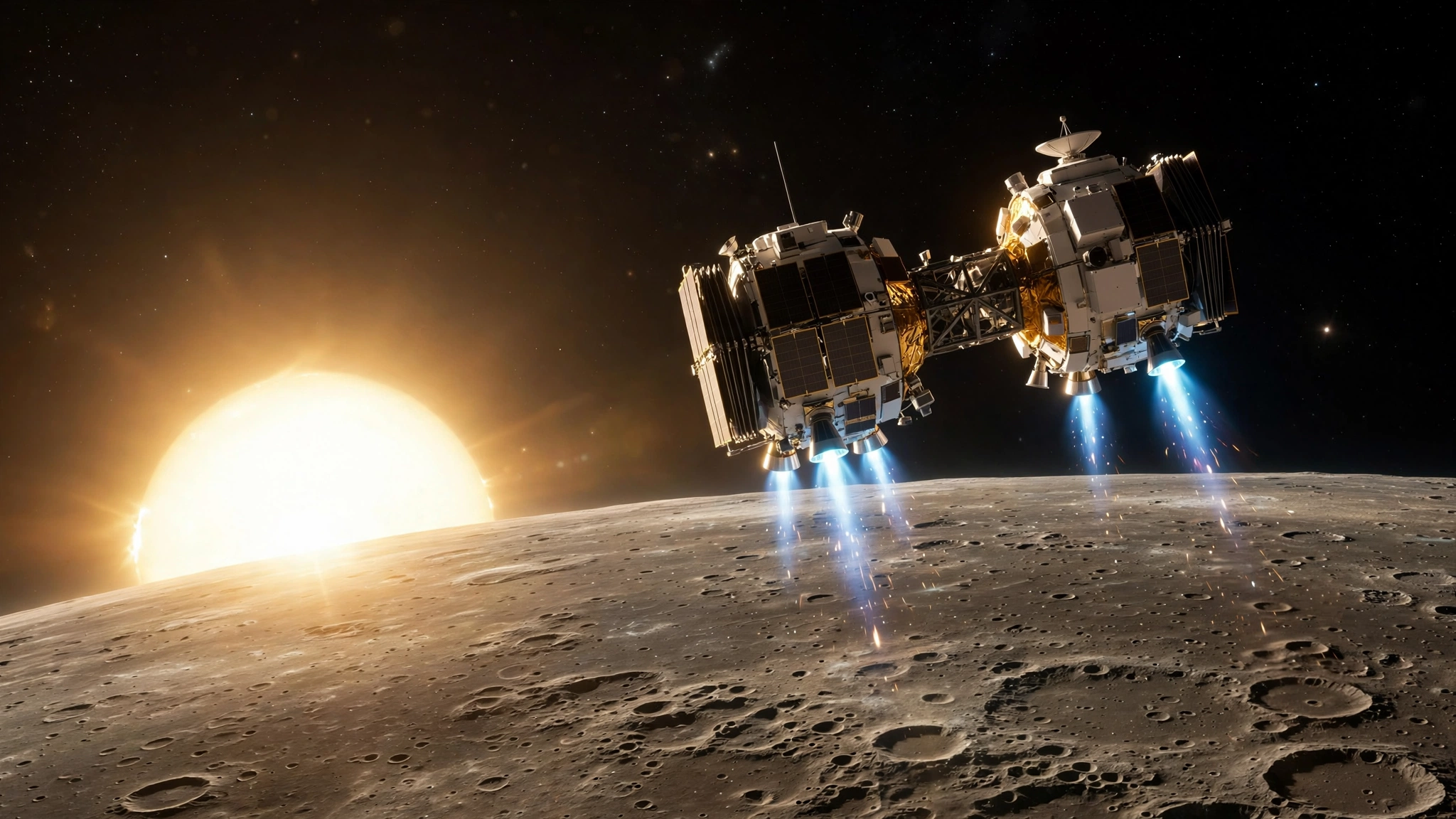
On November 21, at 18:24 UTC, BepiColombo passed about 635 kilometres above Mercury's night side and fired four axial chemical thrusters for what was planned as a 37-minute Mercury orbit insertion burn. The burn ended after just 28 minutes. Engineers later traced the fault to a timing mismatch between the spacecraft's guidance software and its thruster controls, which triggered an abnormally strong command and put the craft into safe mode. The interrupted burn delivered only about 77 percent of the planned change in speed.
The timing could hardly have been worse. The spacecraft was in a scheduled communications blackout, its antenna pointed away from Earth while the thrusters fired. After about four hours of data analysis, flight controllers confirmed the partial burn had still captured the probe — thanks to the mission's unusual arrival technique.
BepiColombo is the first spacecraft ever to enter orbit around another planet using weak stability capture — arriving slowly enough for the planet's weak gravity to catch it, a method previously used only by some missions to Earth's Moon. That slow approach is what saved the mission: even a shortened burn was enough to lock it into orbit.
A wider orbit than planned
The orbit is not the one engineers designed. Instead of circling Mercury every 58 hours, BepiColombo now takes about 75 hours, and at its highest point it flies roughly 10,000 kilometres higher than intended. ESA described the wider orbit as inconvenient but not terrible, while acknowledging it leaves less margin if further problems arise.
The glitch is the mission's second major setback. In April 2024, unexpected electric currents between the solar arrays and the power unit starved the ion engines of full power, forcing a redesigned route that pushed arrival from December 2025 to November 2026. The cruise also included nine planetary flybys to shed speed on the long inward spiral.
Two orbiters, one science mission
BepiColombo is really two spacecraft stacked together: ESA's Mercury Planetary Orbiter and the Japan Aerospace Exploration Agency's Mercury Magnetospheric Orbiter, known as Mio, carried by a solar-electric transfer module. The two orbiters are due to separate on December 9 — December 10 in Japan — a manoeuvre the glitch has made more complicated, before settling into their final orbits.
The science phase is set to begin on April 6, 2027, with the mission planned to run until 2029. Together the orbiters will study Mercury's surface, its magnetic field and how the Sun shapes the planet closest to it — questions MESSENGER could only partly answer a decade ago.
For now, ESA says BepiColombo is safe and on track. Eight years after leaving Earth, the mission has reached its destination — just not quite on the path its engineers drew.