By Hamza Faisal
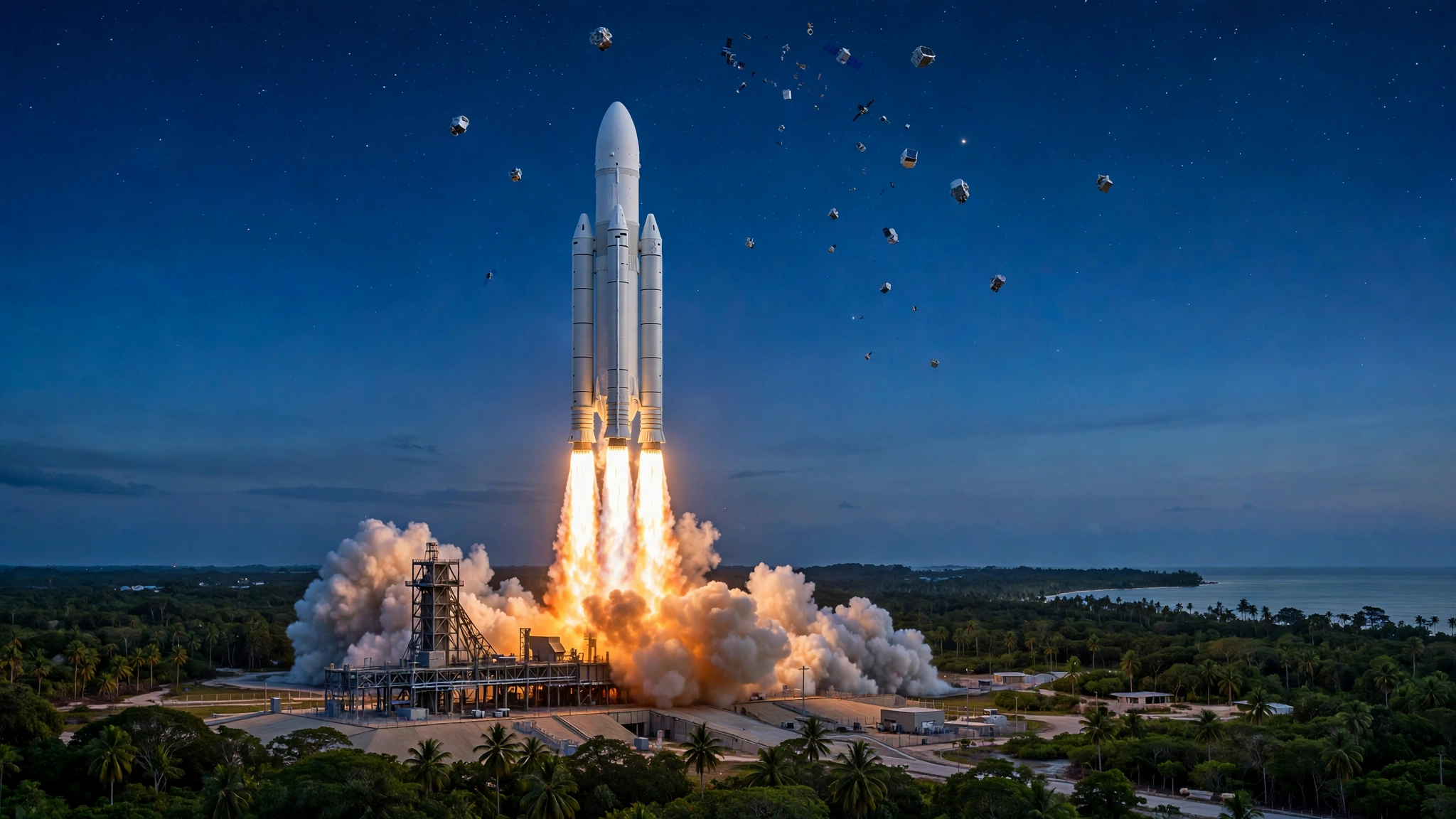
Amazon's satellite internet network is flying again. An Ariane 6 rocket lifted off from Europe's Spaceport in French Guiana on Tuesday carrying 36 Amazon Leo broadband satellites, nine days after a Vulcan rocket failure destroyed 40 of the constellation's spacecraft.
Liftoff came at 11:14 UTC (4:14 p.m. PKT), at the very end of the day's launch window, after Monday's attempt was scrubbed by a fault in the rocket's ground support equipment. Arianespace confirmed the rocket was in its first coast phase shortly after launch, with the satellites due to separate in batches between one hour 39 minutes and two hours four minutes after liftoff.
The flight, designated VA271 by Arianespace and LE-04 by Amazon, is the tenth flight of the Ariane 6 rocket and the fourth in its most powerful Ariane 64 configuration, which flies with four solid rocket boosters.
A second chance after Monday's scrub
Monday's countdown was halted before the mobile gantry was rolled back, after a technical event affecting the launcher's ground support systems. Arianespace said the rocket and its 36 passengers remained in stable and safe condition while engineers carried out checks, then set the new window for Tuesday.
The satellites will be released at an altitude of about 465 kilometres. Amazon's team in Redmond, Washington, will then take control of them, check their health and raise them to their working orbit of 630 kilometres.
If all 36 reach orbit, Arianespace will have launched 136 Amazon Leo satellites in total, and the constellation will grow to 428 spacecraft in orbit.
A comeback after a brutal nine days
The launch is Amazon's first since November 15, when United Launch Alliance's Vulcan rocket failed minutes into its return-to-flight mission, destroying 40 Leo satellites. It was the first full mission failure for ULA since the company was founded in 2006, and Vulcan remains grounded while the U.S. Federal Aviation Administration reviews the investigation.
Amazon's other launch providers have had a difficult year too. Blue Origin's fourth New Glenn rocket, which was to carry 48 Leo satellites, was destroyed along with some launch infrastructure during an explosion on the pad in a static fire test of its BE-4 engines. The satellites were not on board, and Blue Origin now expects its first flight in early 2027.
"There is risk with any launch, and that's especially true for inaugural missions like LV-01," Amazon said in a statement after the Vulcan failure. "ULA has been a trusted partner for Amazon, and we believe they'll learn from this mission and deliver on their long-term plans for Vulcan."
The race to 3,232 satellites
Amazon Leo, formerly known as Project Kuiper, is building a broadband constellation to compete with SpaceX's Starlink. The completed first-generation network will consist of 3,232 spacecraft, and Amazon must have the full constellation deployed and operating by July 30, 2029, under its Federal Communications Commission licence.
Amazon announced in October that it had built its 1,000th satellite at its facilities in Kirkland, Washington. The company has 24 Ariane 6 launches under contract, after adding six more in September, alongside its deals with ULA, Blue Origin and SpaceX.
With two of its biggest launch providers grounded, Amazon has significant ground to make up in 2027 — and Tuesday's flight is the first step.