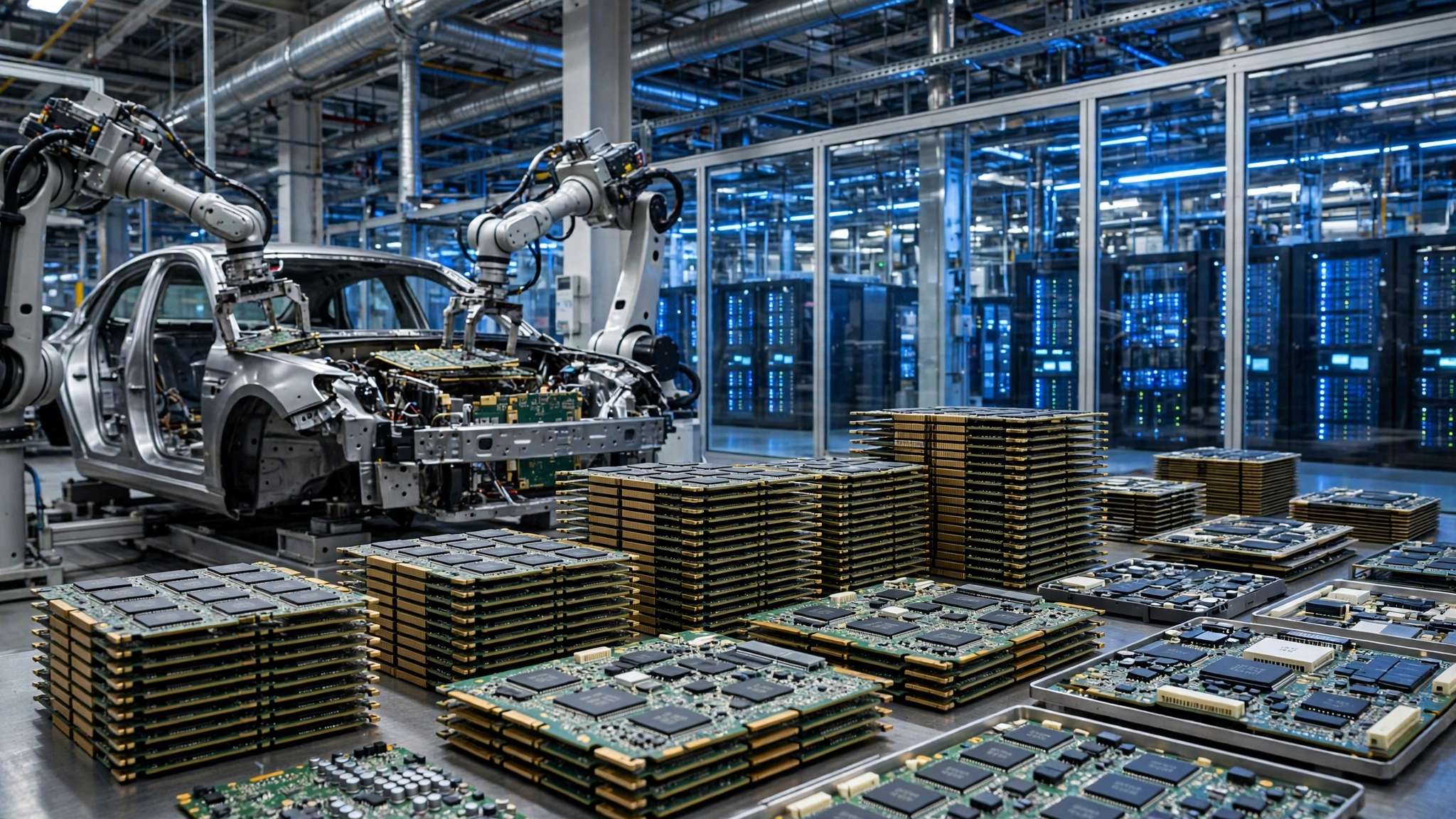
The artificial intelligence boom has a new casualty: the car industry. Surging demand from AI data centres is tightening global chip supplies, and Indian automakers say they are now paying higher prices — and building up inventories — just to keep their production lines running.
Tata Motors Passenger Vehicles managing director and chief executive Shailesh Chandra acknowledged the pressure during the company's September-quarter earnings call, saying the carmaker was paying more to secure semiconductors and electronic components, though it had so far avoided losing any production.
"There is definitely some level of stress that we have on the semiconductor side, electronic parts, but we are securing the supply or we are paying higher cost for that," Chandra said.
Carmakers pay more, or wait longer
Tata is not alone. Mahindra & Mahindra flagged similar concerns during its March-quarter earnings call in May, warning that growing demand for memory chips from AI applications could prolong supply constraints for automakers. Electric two-wheeler maker Ather has also pointed to a persistent rise in chip prices, despite earlier expectations that costs would moderate.
The squeeze is hitting the industry's fastest-growing segment hardest. India's electric-vehicle registrations reached a record 3.55 lakh units in October, but demand is now outstripping supply in part because of the chip shortage, with chips needed for everything from battery management to infotainment systems.
Capacity is drifting toward AI
Behind the shortage is a shift in where chipmakers earn their money. Semiconductor manufacturers are increasingly prioritising higher-margin chips used in AI infrastructure over conventional automotive and industrial parts.
At the Electronica trade fair in Munich on November 10, Nexperia interim chief executive Stefan Tilger told Reuters the Dutch chipmaker was "totally oversubscribed" as suppliers diverted manufacturing capacity towards AI data centres and away from conventional semiconductors. STMicroelectronics chief executive Jean-Marc Chery issued a similar warning, saying foundries and chip-packaging companies were shifting resources away from mainstream automotive and industrial applications.
The pain is showing up in suppliers' own forecasts. Aumovio, the supplier spun off from Continental, has warned that chip costs will climb sharply in 2027, with interim finance chief Claus Bauer expecting gross earnings to fall by about $1.1 billion next year, mainly because of chip inflation. SK Hynix's chief executive has forecast that 2027 will be the worst year for memory supply in the industry's history.
Memory prices could nearly double
The sharpest pressure is in memory. According to S&P Global Mobility, prices under new automotive DRAM contracts could rise by 70 to 100 per cent in 2026 compared with 2025, and supplies are expected to remain constrained through 2027 — although automakers willing to pay higher prices should generally be able to secure the volumes they need.
Counterpoint Research warned in an August report that shortages of DDR4 and LPDDR4 memory chips used by automakers could persist beyond 2027. Stellantis has already extended a production stop at its Mirafiori plant in Turin, blaming a shortage of chips for engine control units.
For now, Tata Motors says it has not lost a single vehicle to the shortage. But with data-centre buyers outbidding carmakers for capacity and memory prices set to climb, the industry's chip problem looks less like a blip and more like a structural squeeze — one that drivers may eventually feel in showroom prices.


