By Hamza Faisal
The military's most loyal soldiers are about to get a genetic upgrade. Warhound, a defense startup founded by Colossal Biosciences CEO Ben Lamm and Anduril founder Palmer Luckey, emerged from stealth on October 22 with a $200 million seed round that values the company at $1.2 billion — one of the largest seed rounds defense tech has ever seen.
The Dallas-based company plans to clone and genetically engineer working dogs for the U.S. military, law enforcement, and emergency response teams. The round was led by Sequoia Capital partner Shaun Maguire, with backing from In-Q-Tel, the venture arm of the U.S. intelligence community, plus 8VC, ARK Invest, Franklin Templeton, Lux Capital, and Breyer Capital. The company will be run by CEO Dave Spirk, a former Marine who served as the Pentagon's chief data officer.
A broken supply chain
Warhound exists because the U.S. has a dog problem. More than 80 percent of the military's working dogs are imported from Europe, and fewer than half of them are judged fit for service after a roughly three-year acquisition and training pipeline. The services must buy and train around 200 dogs just to field 100 working animals — and they are now bidding against foreign governments, including China and Russia, for a shrinking pool of European breeding stock.
Lamm told TechCrunch the idea came from a chance meeting with Luckey about a year ago, when Luckey said more should be done for the military's working dogs. Lamm dug into how the animals are bred and found that many wash out of training because of inherited problems — poor eyesight, predisposition to cancer, hip dysplasia, and muscle atrophy. "Every day, we ask dogs to put their lives on the line to protect ours," Lamm said. "Yet we're still relying on outdated approaches to breeding and training these extraordinary animals, with too many never making it through the process."
Cloning plus CRISPR
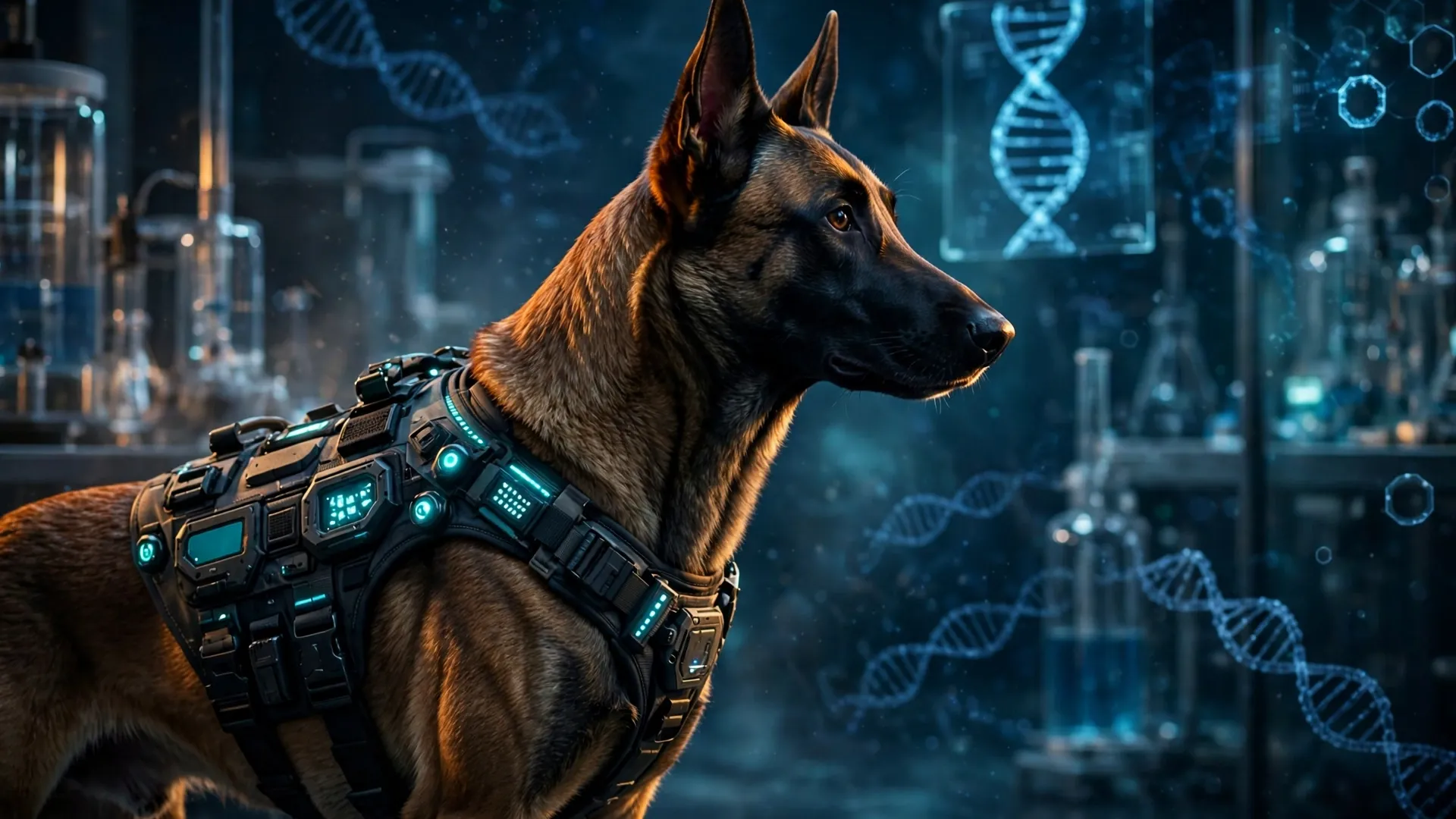
Warhound's plan starts with cell lines from Belgian Malinois and German Shepherds, the two breeds that dominate military and police work. Those cell lines will be stored in a biobank before researchers edit the dogs' genetic makeup — removing markers linked to career-ending diseases while enhancing traits like scent detection, speed, agility, and longevity. The company acquired animal cloning specialist Viagen in November 2025 to run the operations, and says its first genetically edited dogs could arrive within months, with a finished bio-enhanced canine deployed in about two years.
The dogs won't work alone. Anduril — which holds no equity in Warhound, though Luckey sits on the board — will supply protective equipment including eye and ear protection, body armor, and integration with its Eagle Eye system, so dogs, handlers, and autonomous systems can operate as one team.
The ethics question
Genetically engineering animals for warfare is bound to draw scrutiny, and Warhound appears to know it. The American Humane Society will certify the company's training programs and help place retired dogs with their former handlers, a move clearly designed to head off welfare criticism. The company is also exploring a "Canine-as-a-Service" subscription model rather than selling individual animals outright.
Whether gene-edited dogs prove better than conventional breeding — and whether the Pentagon is ready to buy them — remains to be proven. But with a $1.2 billion valuation on day one, investors are betting that the future of the K-9 corps is engineered, not born.
— Hamza Faisal