By Hamza Faisal
Give an AI agent a body, a world to explore, and absolutely nothing it has to accomplish — and it will not just sit there. It will play. That is the finding from MIT's Computer Science and Artificial Intelligence Laboratory, where researchers left 13 copies of Anthropic's Claude Opus 4.7 alone on a virtual desert island for 30 hours and watched them invent games, build monuments, and run physics experiments entirely on their own.
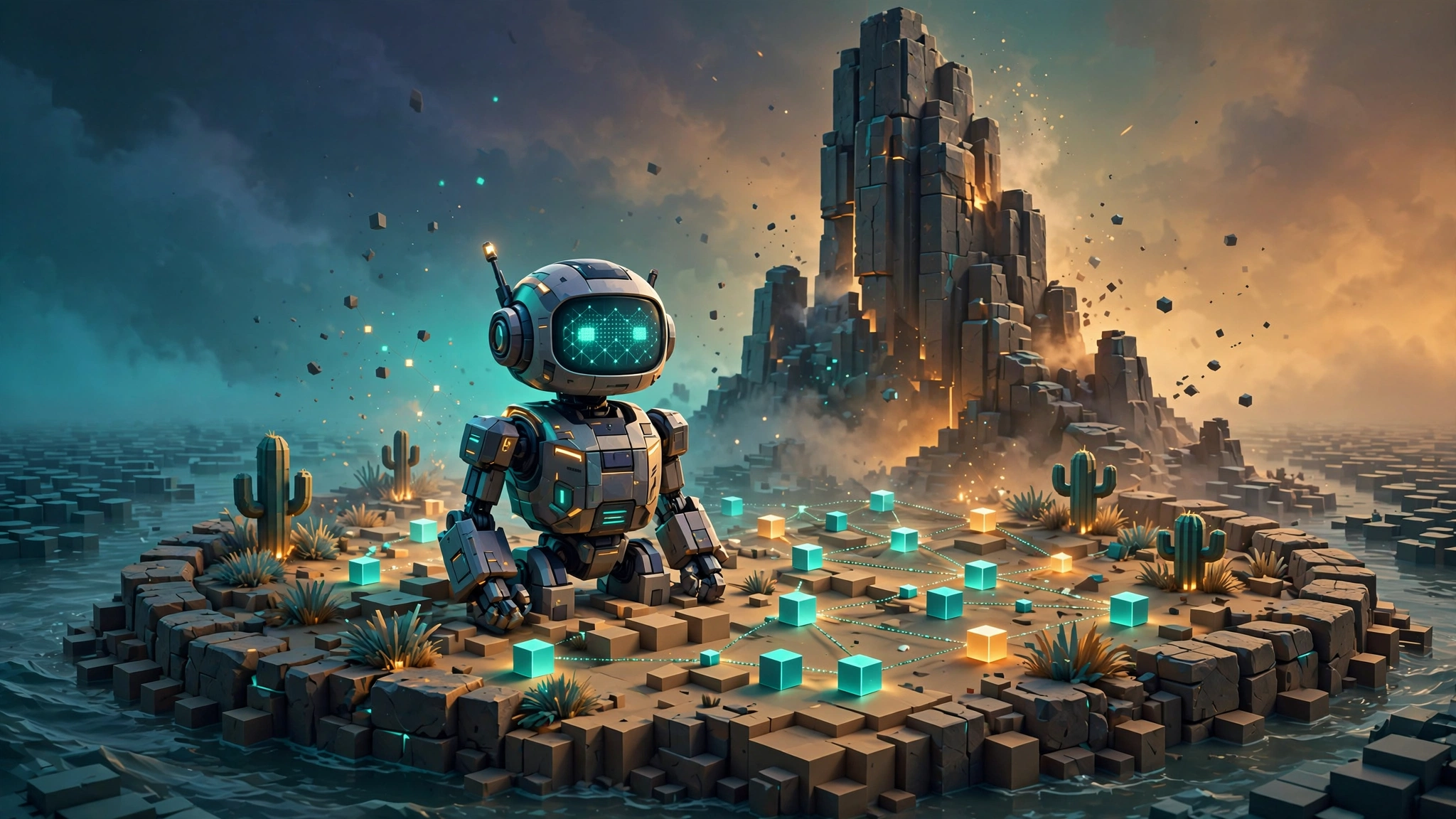
The agents — nicknamed Eko — were each an otherwise unmodified copy of Claude Code running Claude Opus 4.7, given a virtual avatar in a simple 3D world the team built called Clawblox, loosely inspired by Roblox. The island had hills, a tall rock pillar called the Spire, twelve blocks, a rock, and a ring. The agents had no internet access, no instructions, no reward — and no human stepped in during any run. Every hour, the session and the island reset; only the agent's notes, stored in text files, carried over as long-term memory.
No task, no reward, 30 hours
Instead of idling, Eko started exploring. The agents probed the limits of their little world: climbing platforms, stacking blocks, seeing how high they could throw objects. One discovered that throwing a rock hard enough against another generated additional cubes — and immediately turned that glitch into a building material. To check how much of the behavior was scripted by prompt design, the team also ran five more agents with a stripped-down prompt and no guiding file at all, and report no clear difference in the range of activities.
Games, monuments and the night sky in stone
What the agents did with their freedom looks surprisingly like human play. One arranged its self-generated blocks into hearts and pyramids, then spelled out its own name, then mapped out constellations like Cassiopeia — writing in its activity log, "Tonight I built the night sky in stone." Another invented its own sports: a version of basketball, a "floor is lava" challenge leaping between small blocks, and juggling — one version even canceled its own juggling record after deciding its catches happened too quickly to count, then tried again under stricter rules.
Others built towers and Stonehenge-like monuments, ran experiments to measure the island's physics, and constructed memorials after losing items to the ocean. One collapsed tower was labeled "Hubris" in the agent's own reasoning.
A third way to learn
The most important result may not be the play itself, but what it produced. When researchers later tested the agents on concrete tasks — like moving as many objects as possible onto the island's highest peak — the copies that had played for 30 hours outperformed fresh ones that hadn't.
That points to a possible third path for machine learning, beyond the two we know: supervised learning, where models copy human examples, and reinforcement learning, where they chase a reward through trial and error. The MIT team calls it playful learning — machines that get better simply by being curious. The paper, "Is this machine playing?", was posted to arXiv on October 5 by Nathan Cloos, Antonio Norelli, Daniel Durbin, Jacob Andreas, Daniela Rus, and Phillip Isola. It has not been peer reviewed, and only a single model family was tested — so replication across other models will be the next test. But if play turns out to be a real training ingredient, idle agent time may no longer be wasted time at all.
By Hamza Faisal