By Hamza Faisal
Kevin Weil, the former OpenAI chief product officer who later ran the company's science division, has emerged from stealth with a new startup. Warp Sciences, an AI-powered drug-discovery infrastructure company, has raised $215 million in Series A funding led by Lightspeed, Bloomberg reported on October 22, valuing the company at $865 million.
The founding team reads like a cross-section of Silicon Valley's elite. Weil serves as CEO. His co-founders are Solomon "Sol" Reisberg, a former Terremoto Biosciences executive, as chief scientific officer; Manohar "Mano" Paluri, the former Meta AI leader who co-founded Facebook AI Research, as chief technology officer; and DJ Patil, the White House's first chief data scientist, as chief operating officer.
The investor list is just as heavyweight. Lightspeed led the round, with participation from IVP, Mayfield, Lux Capital, Premji Invest, and Menlo Ventures. Weil's former OpenAI colleagues also joined, alongside Coinbase co-founder Brian Armstrong, Figma co-founder Dylan Field, LinkedIn co-founder Reid Hoffman, and Databricks co-founder Ion Stoica.
Robots for the slowest part of drug discovery
Warp does not plan to discover drugs itself. It is going after the expensive slog that comes after a promising molecule is found: chemists must make hundreds or thousands of variations of it to improve efficacy and cut side effects, a step that currently takes years and hundreds of millions of dollars before a compound ever reaches a human trial.
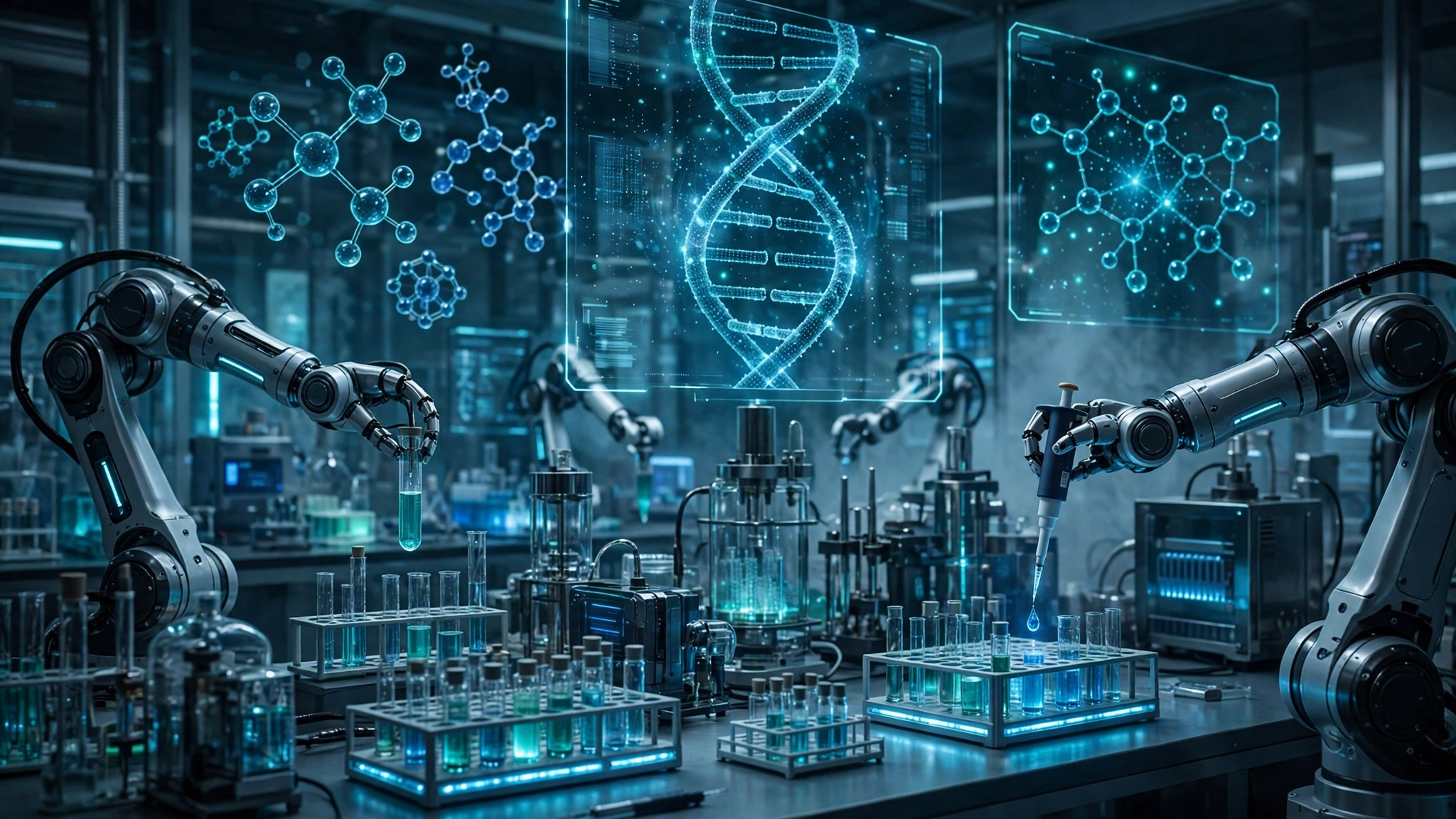
The startup's answer is a next-generation, US-based preclinical contract research organization that pairs expert chemists with AI and robotics. Its team of roughly 20 has already bought robotic arms and AI chips, and its chemists will wear cameras and pressure-sensing gloves during experiments so the company can collect the data needed to train its AI models. The company has not said where the automated lab will be or when it expects its first customers.
"AI has dramatically accelerated software engineering and mathematics, but it has yet to make the same impact in the physical sciences," Weil said. "Chemistry and biology move forward when you make something, test it and learn from the result."
The China dimension
Where that work happens matters politically. Drugmakers have long outsourced much of this chemistry work to Chinese contract firms such as WuXi AppTec; a 2024 survey by the Biotechnology Innovation Organization found that 74% of its members held contracts with Chinese companies for preclinical and clinical services.
The geopolitical backdrop has hardened. In June, the Pentagon added WuXi AppTec to its list of companies linked to China's military, and the BIOSECURE Act, signed into law in December 2025, established a framework for restricting federal procurement involving designated biotechnology companies. Warp's pitch — a fully automated, domestic chemistry engine — lands squarely on that fault line.
AI's big science bet accelerates
Warp arrives amid a broader land grab for AI in the life sciences. Earlier this week, OpenAI acquired Orchestra Bio, a startup building AI agents for pharmaceutical companies, and plans to fold its team into Rosalind, its AI models and tools for life-sciences research. Anthropic introduced Claude for Life Sciences in June, and Isomorphic Labs, Google DeepMind's drug-discovery spinoff, raised $2.1 billion in May led by Thrive Capital.
Weil knows the science bet well. He spent nearly two years at OpenAI — first as chief product officer running the teams behind ChatGPT, Codex, and the OpenAI API, then as head of OpenAI for Science, which built GPT-Rosalind, a model trained on chemistry, protein engineering, and genomics. Now, with $215 million and a robot lab, he is betting that the next frontier for AI is not the browser — it is the bench.