A smartwatch may soon do more than count steps and track heart rate. Google researchers report in the journal Nature that an artificial intelligence system reading the sensors already inside a consumer smartwatch can flag people likely to have high blood pressure — no arm cuff, calibration, or blood pressure reading needed.
Samsung is also rolling out an AI upgrade this month that grades sleep apnea severity on its newest Galaxy watches and the Galaxy Ring. Watches are shifting from fitness gadgets to opportunistic health screening — even if neither tool is a diagnosis.
How a watch reads blood pressure without measuring it
The Google system, called AI-PPG-ACC-HTN, does not try to produce systolic and diastolic numbers. It asks a simpler question: does this person probably have persistently high blood pressure?
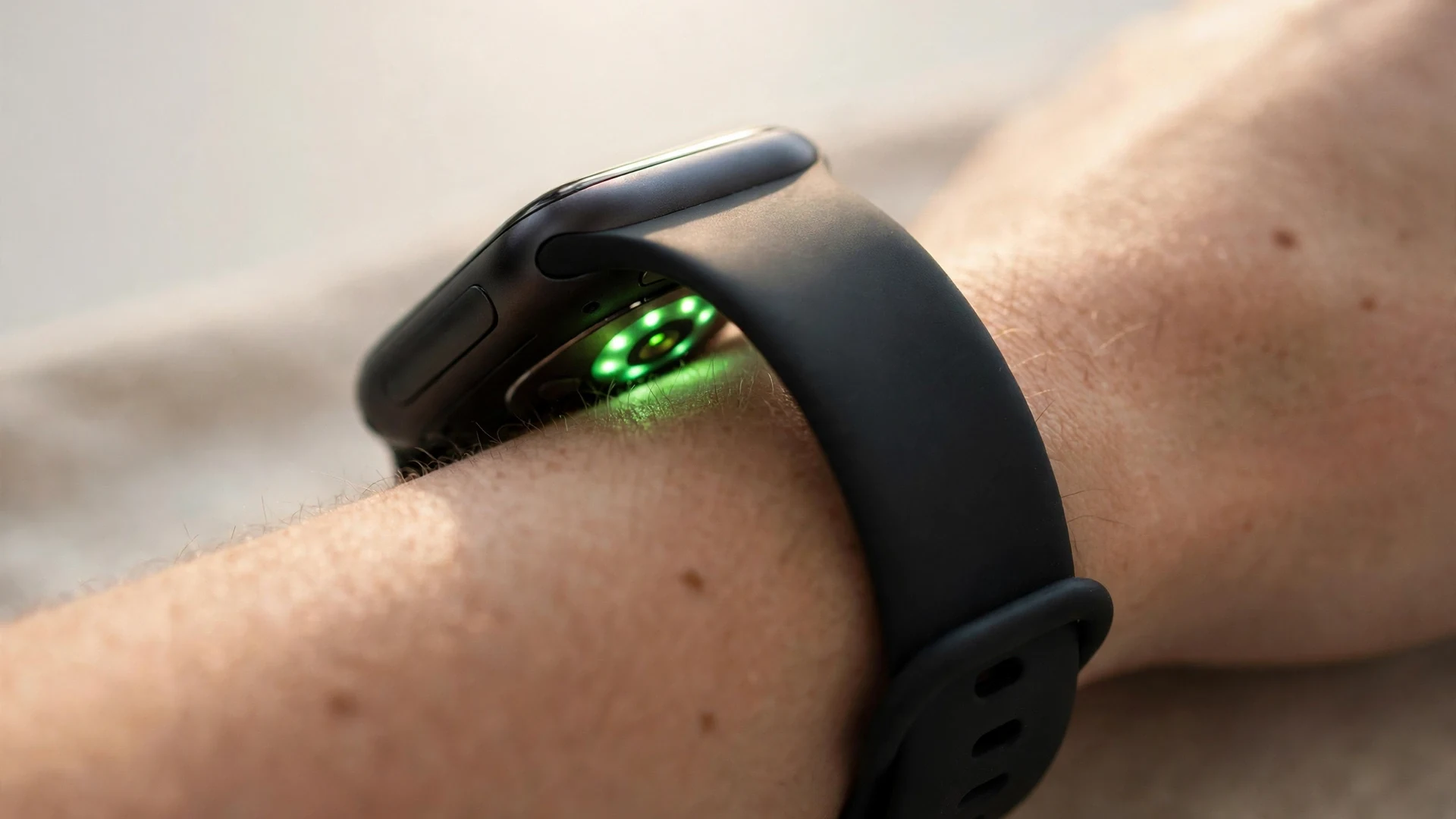
It answers using two sensors found on most smartwatches. The optical photoplethysmography (PPG) sensor — the green light on the underside — tracks the shape of each pulse wave at the wrist. The accelerometer picks up the ballistocardiogram, the faint vibrations each heartbeat sends through the wrist.
The team, from Google Research with collaborators at the University of Washington and Beth Israel Deaconess Medical Center, first trained the model without medical labels on 492,347 hours of sensor data from 2,109 people, then averaged short snippets over several days of wear into one hypertension probability score.
What the 196-person study actually found
The researchers tested the system in a prospective study of 196 adults at five sites in the United States, none with known heart disease or on blood pressure drugs. Each wore a watch for about a week and completed 24-hour ambulatory blood pressure monitoring, the clinical reference standard.
For initial screening, it flagged 65.8 percent of people with hypertension and correctly cleared 90.0 percent of those without it. A standard office reading caught 55.3 percent at the same specificity — a modest edge the researchers note was not statistically significant. Among 48 people with elevated office readings, it reached 78.4 percent sensitivity and 96.7 percent positive predictive value.
Google is careful about what the work means. It calls the system “early feasibility research,” “not intended to replace standard clinical arm cuffs” and “not indicative of any existing or upcoming commercial product feature.” The study was small and US-only, and the watch still missed about a third of cases. The findings helped inform a blood pressure trends feature in the Google Health app.
Samsung's wearables are grading sleep apnea too
Samsung is making a parallel move on sleep. It is rolling out an upgraded sleep apnea feature in South Korea this month, starting with the Galaxy Watch Ultra 2, Galaxy Watch 9 and Galaxy Ring. The new AI algorithm counts breathing disruptions per hour of sleep and sorts them into three levels — mild, occasional and frequent — where the old version only flagged moderate-to-severe signs.
The feature cleared the US Food and Drug Administration in July 2026 and won approval from South Korea's Ministry of Food and Drug Safety. It needs at least five hours of sleep on two nights within 10 days to produce a result. The Galaxy Watch 7 and Watch 8 follow later; the Watch 4, 5 and 6 will not get it.
Like Google's hypertension work, Samsung stresses its feature is a screening prompt, not a diagnosis — a nudge to seek a clinical assessment, not a replacement for one. The direction is clear: the sensors millions wear on their wrists are becoming a first line of health screening, and the AI reading them is getting better at spotting what a clinic cuff catches.


