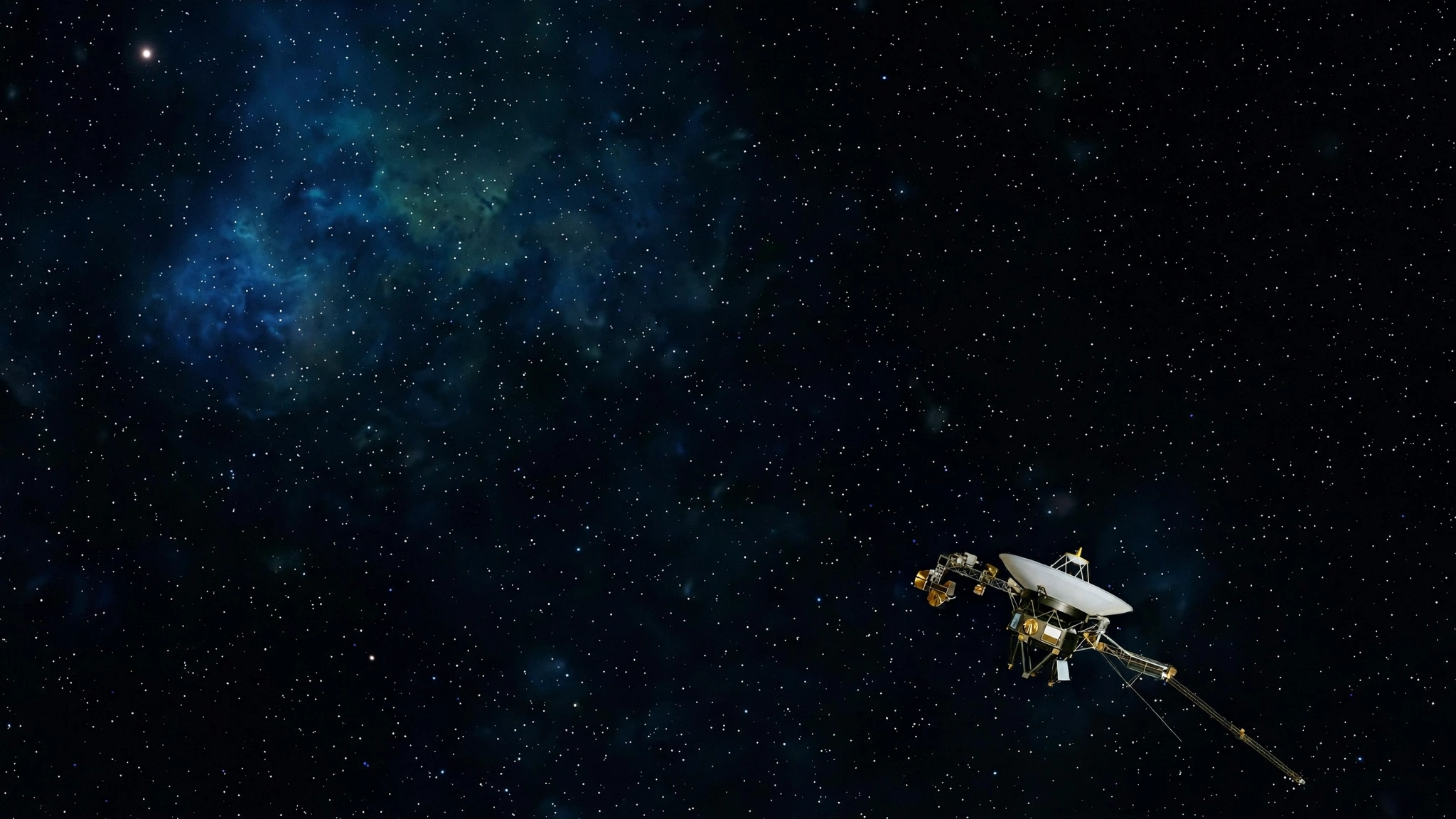
NASA's Voyager 1 spacecraft has reached a distance no human-made object has ever achieved: one light-day from Earth. The probe crossed the threshold at 5:16 a.m. EST on Wednesday, November 18, sitting roughly 16.1 billion miles (25.9 billion kilometres) from home — more than four times the distance from the Sun to Pluto.
A light-day is simply the distance light travels in 24 hours. At that range, a radio command sent from Earth now takes a full day to reach Voyager 1, and confirmation that it arrived takes another day — a 48-hour round trip for even the simplest instruction. NASA confirmed the milestone on Thursday, after the probe's signal — travelling at light speed — took a day to reach the Deep Space Network antennas in California.
A 49-year-old spacecraft still talking
Voyager 1 launched on September 5, 1977, sixteen days after its twin, Voyager 2, on a mission to tour the outer planets. It flew past Jupiter in 1979 and Saturn in 1980, then kept going — crossing the heliopause into interstellar space in August 2012, the first spacecraft to leave the Sun's protective bubble.
The spacecraft is running on borrowed time. Eight of its ten original instruments have been switched off, and its plutonium power source loses about four watts of output every year. Only two science instruments still operate: the plasma wave subsystem and the magnetometer, which measure the thin charged particles and magnetic fields of interstellar space.
NASA has not received science or engineering data from Voyager 1 since November 14. Engineers confirmed the milestone using the probe's carrier signal — a steady radio tone that rides alongside its data — combined with trajectory calculations, and heard from the spacecraft a day after it crossed the line.
Why one light-day matters
The milestone is partly symbolic — space has no signposts — but it is also a real operational boundary. Every command to Voyager 1 must now be planned at least a day ahead, and any fix takes two days to verify. The mission team at NASA's Jet Propulsion Laboratory has been working under those constraints for years as the light-travel time crept toward 24 hours; crossing it simply makes the wait official.
It also puts the scale of the journey in perspective. Light from the Sun reaches Earth in about eight minutes. Neptune, the farthest planet, is about four light-hours away. Voyager 1 is now six times farther out than Neptune — and still moving at more than 38,000 miles per hour.
What comes next
Voyager 2, travelling slightly slower, will not reach one light-day until around 2035 — and by then it may no longer have enough power to send signals back. Both probes turn 50 in the summer of 2027, and NASA plans to keep them operating as long as power allows, switching off instruments one by one to stretch the mission.
The Golden Record still rides aboard Voyager 1: a gold-plated disc carrying greetings in 55 languages, music, and images of Earth, intended for anyone — or anything — that might one day find it. For now, it is simply the farthest message humanity has ever sent, drifting deeper into the dark, one light-day out and counting.