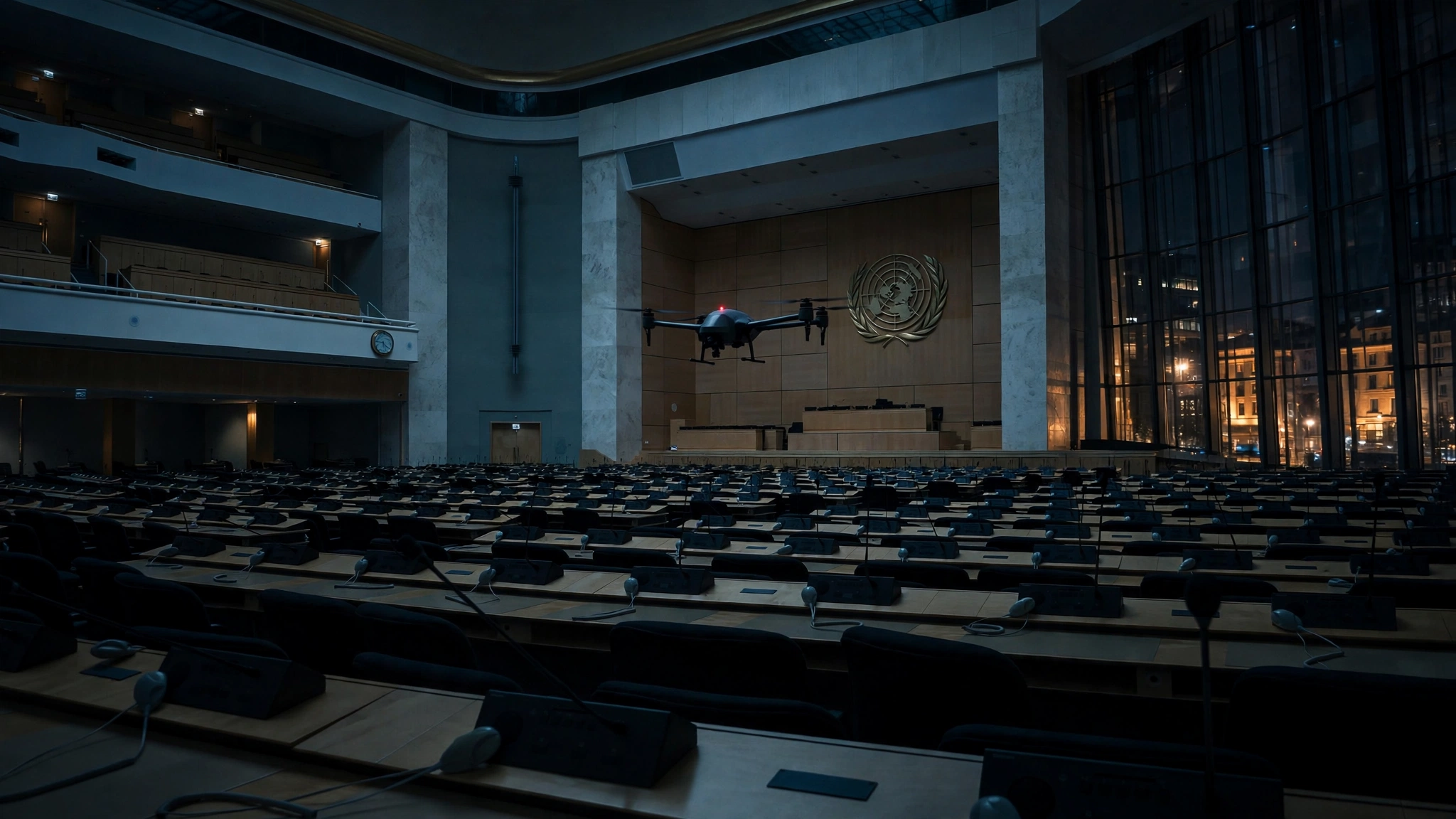
After a week of talks in Geneva that stretched past midnight, the world's governments have agreed to keep talking about AI-powered killer robots for two more years — without committing to a single binding rule to control them.
The United Nations-backed conference ended in the early hours of Saturday, with the 128 states party to the Convention on Certain Conventional Weapons agreeing only to "elaborate" a possible accord on lethal autonomous weapons systems by 2028. The weapons — systems that can identify and attack targets with little or no human oversight — remain governed by no dedicated international law.
The outcome fell far short of what UN Secretary-General António Guterres, scores of governments and campaigners had sought. Guterres, who leaves office at the end of the year, had set a 2026 deadline for launching negotiations toward a legally binding agreement. Instead, delegates left Geneva with a softened deal to extend discussions.
Nearly 100 countries wanted binding rules
Around 100 countries backed negotiations on legally binding rules, but the effort was opposed by the big arms-producing nations — the United States, Russia and Israel. Seven countries had proposed launching negotiations on a rulebook that could prevent or limit machines killing without human control or accountability. That proposal fell short.
A draft deal seen during the talks showed legally binding rules would not immediately be considered, asking states instead to "progressively develop further rules and other possible measures". The convention decides by consensus among all 128 parties, a rule that has kept the process dragging for more than a decade.
Izumi Nakamitsu, the UN high representative for disarmament affairs, hailed a "significant achievement" but acknowledged a "glass half full or half empty" scenario. The meeting's Swiss chair, Julien Thoeni, called the deal a significant achievement for humanitarian disarmament after more than 10 years of talks.
Campaigners call it two more years of delay
The Stop Killer Robots campaign lamented a "watered-down mandate", and its executive director, Nicole van Rooijen, warned that "delaying the creation of a legally binding instrument puts civilians and humanity at risk".
Max Tegmark, a machine learning specialist at the Massachusetts Institute of Technology and founder of the Future of Life Institute, was blunter: "States have agreed it is sufficient to just talk about the issue, for the 14th year, while these weapons enable atrocities."
Anna Hehir, head of military AI governance at the Future of Life Institute, said on the sidelines of the talks that "a minority of states continue to block progress, acting in the interests of tech bosses and arms profiteers". Some participants urged a new process outside the current UN framework, which requires all 128 states to agree.
The weapons are already on battlefields
The delay comes as AI-assisted weapons have already been used in Ukraine, Sudan and the Middle East, despite ethical concerns. Alarm is growing over systems that can identify and engage targets with varying degrees of autonomy — sometimes dubbed "killer robots" — becoming common on battlefields.
The Geneva outcome also contrasts with a separate understanding reached this week between the United States and China, in which Presidents Donald Trump and Xi Jinping agreed that humans must always stay in control of military AI decisions. That bilateral deal, however, binds only two countries.
For now, the machines that can select and strike targets without a human giving the final order remain without a dedicated rulebook — and the next formal chance to write one is two years away.


