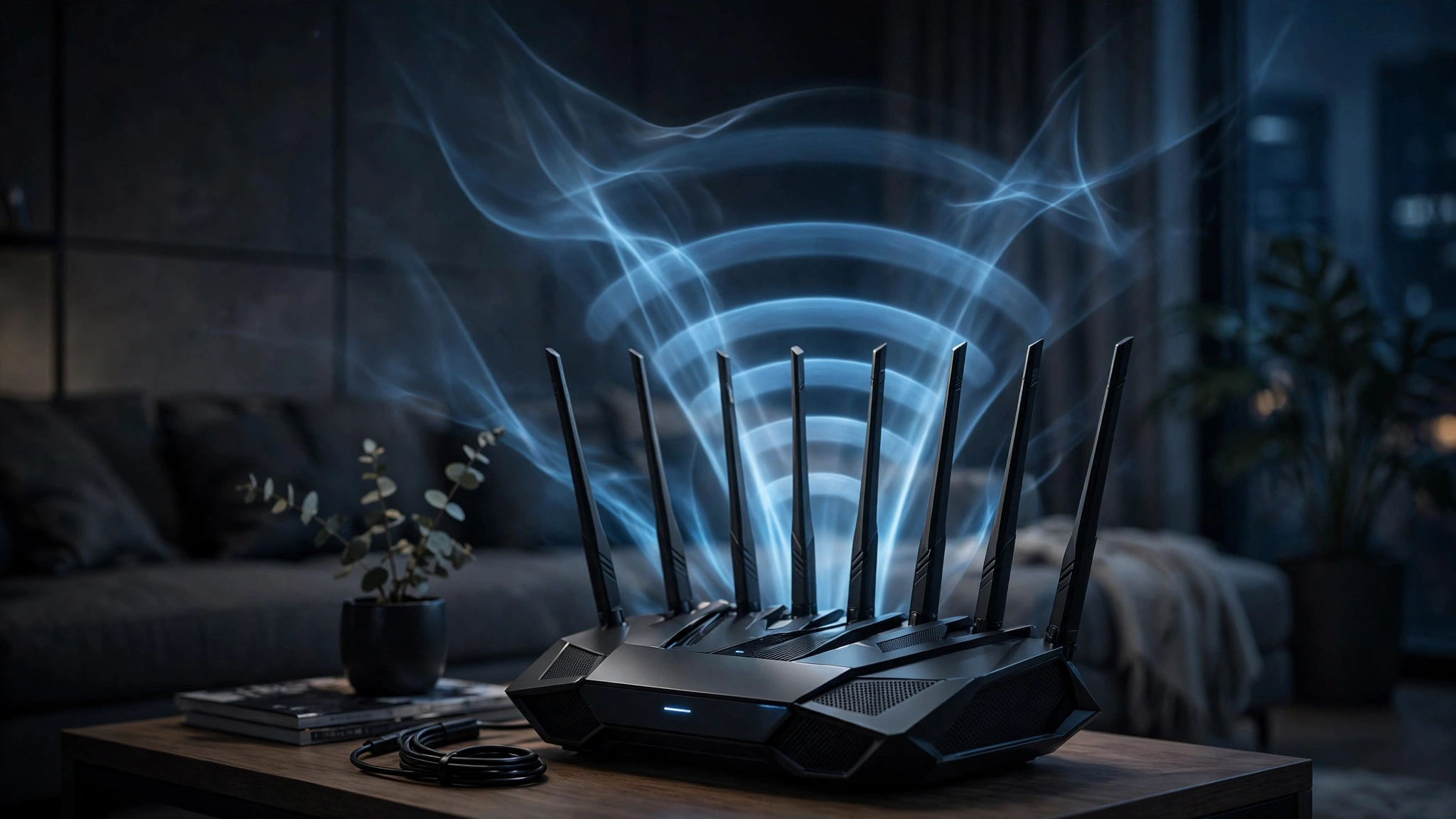
ASUS fired the opening shot with its ROG Rapture GT-BN98, a gaming-focused quad-band router that began worldwide shipping on October 6, 2026, after appearing in Canadian shops since early September.
TP-Link answered with the Archer 8 Ultra, which opened pre-orders in Germany on September 30 at €799.90 and in Australia on October 1 at AUD 1,499, ahead of a November 1 release.
Reliability, not raw speed
Here's the twist: on paper, Wi-Fi 8 is no faster than Wi-Fi 7. ASUS says so itself — “theoretical data speeds remain unchanged.” The new IEEE 802.11bn standard's headline promise is ultra-high reliability: steadier connections when the house gets crowded and signals get messy.
TP-Link claims the Archer 8 Ultra delivers up to 33 percent more consistent throughput at mid-to-long ranges and 24 percent more consistent throughput under interference than Wi-Fi 7.
One early review of the GT-BN98 found measurable wireless throughput improvements at distance even when tested against existing Wi-Fi 7 clients, thanks to updated radio hardware.
Both routers are hardware heavyweights regardless of the wireless generation. The GT-BN98 packs a 2.6 GHz quad-core processor, 2 GB of RAM, dual 10-gigabit ports and four 2.5-gigabit LAN ports, with up to 30,000 Mbps of combined wireless throughput.
The Archer 8 Ultra is a tri-band unit with up to 19 Gbps combined wireless speeds, 10 Gbps wired connectivity, 18 internal antennas and coverage of up to 3,600 square feet.
The catch: nothing to connect to it
There are currently no phones, laptops, or tablets that support Wi-Fi 8 — and the Wi-Fi Alliance hasn't even certified the standard yet, with final ratification expected in May 2028. Both routers are backward compatible with Wi-Fi 7 and Wi-Fi 6 devices, but those clients won't unlock the new reliability features.
That hasn't stopped the pre-order sweeteners. In Australia, customers who pre-order the Archer 8 Ultra before the November 1 release receive a free Tapo RV30 Max Plus Gen 2 robot vacuum worth $499 — a bonus that costs nearly a third of the router itself.
Why buy a router for a future that hasn't arrived?
The early-adopter math is familiar: ASUS and TP-Link get to plant their flag on the new standard first, and the router that establishes brand credibility in a new generation tends to hold it through the client-device adoption curve.
For buyers, the dual 10-gigabit wired ports deliver real value today, while the wireless Wi-Fi 8 benefits arrive incrementally as client devices ship over the next couple of years.
If you're not already maxing out multi-gigabit internet or a fast home network, though, this generation is easy to skip. Wi-Fi 8's pitch — fixing connections that drop, lag, and stutter rather than chasing bigger speed numbers — will be judged in living rooms, not spec sheets.
Those real-world verdicts can only start landing once the first Wi-Fi 8 phones arrive.
By Hamza Faisal