Tesla has started rolling out Full Self-Driving v15, its biggest self-driving software update in years, claiming a 25-fold improvement in how the system handles safety-critical situations. The first wave of customers began receiving the update on November 21, with a wider release planned for December.
The update, announced by Tesla on X, upgrades "every part of the end-to-end driving network," according to the company's release notes. At its core is a new vision encoder — the part of the system that turns camera images into an understanding of the road — shared across FSD, Tesla's Robotaxi service and the Optimus humanoid robot, and trained on millions of internet videos.
Tesla says the new encoder improves the critical intervention rate by 25 times, the measure of how often a human has to step in. The company has not published the underlying rate or the data behind it, so the figure remains Tesla's own claim. Electrek estimates that a 25-fold improvement would put v15 at roughly 50,000 miles between critical interventions.
Reality View shows what the car plans to do
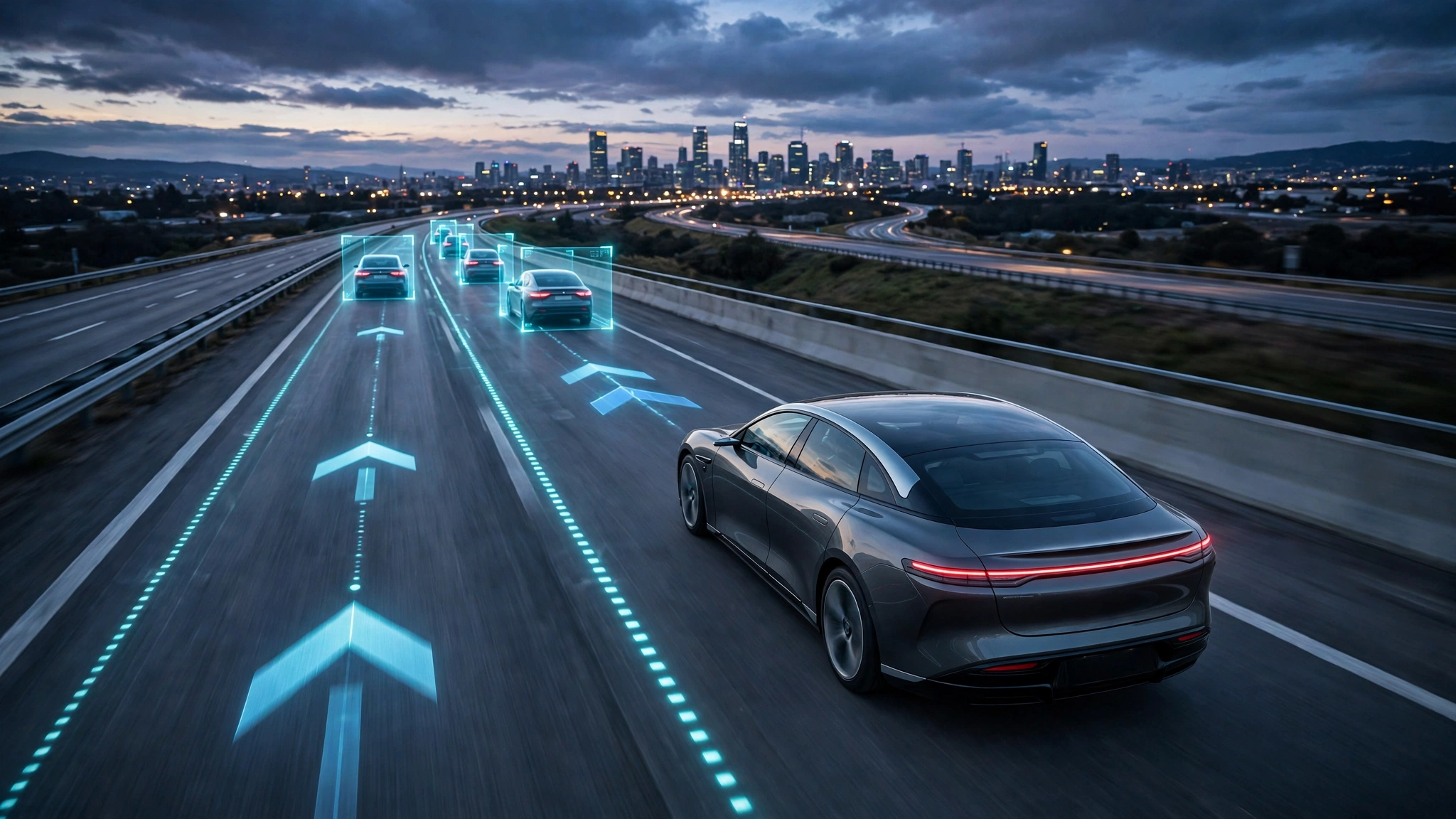
The most visible change is Tesla Reality View, a new live visualization that replaces the simplified driving graphics Tesla owners are used to. The release notes describe it as a real-time generative view streamed from a virtual camera above the vehicle, showing the road, surrounding traffic and the car's planned path in detail.
Tesla says the view lets drivers "see and control what FSD is planning to do," and that it uses less computing power than the old set of separate model signals. Ashok Elluswamy, Tesla's vice president of AI, said the same end-to-end driving model that steers the car also renders the scene. Tesla has not explained how the touch controls work, and the feature still needs independent testing in everyday driving.
Better at signs, potholes and school zones
Beyond the headline safety claim, v15 targets some of FSD's most persistent weaknesses. Tesla says the update improves detection of road signs, small animals, road debris, chains and potholes, and adds avoidance of deep standing water. It also promises more natural speed handling for each driver profile, in school zones and in bad weather.
Smaller additions: FSD can now slow down for speed cameras, and a new Bike Rack Mode keeps the system working with a bike rack or similar hitch accessory fitted. Navigation learning initially covers only the start and end of trips, with full-route learning promised in later v15 releases.
The first build, v15.0.1, is reaching Early Access Program members first, and the driving features apply to cars with Tesla's HW4 (AI4) hardware. Chief executive Elon Musk said the wide release arrives next month as part of Tesla's 2026 Holiday Update.
Still supervised — and still Tesla's word
Despite the scale of the update, v15 remains Full Self-Driving (Supervised): the driver must keep paying attention and be ready to take over at any moment. The 25x figure, meanwhile, deserves the usual caution — it is a multiplier with no published baseline, and no outside group has tested it.
The school-zone improvements also land while the US road-safety regulator NHTSA reviews a defect petition into whether Tesla's robotaxis exceed posted speed limits in active school zones. Tesla has not said whether the change is related.
For Tesla, the timing matters. FSD v15 is the first release built on the shared vision encoder that also powers Robotaxi and Optimus — one model, three machines. If the safety gains hold up, December's wide release will be the biggest test yet of Tesla's camera-only bet on self-driving.