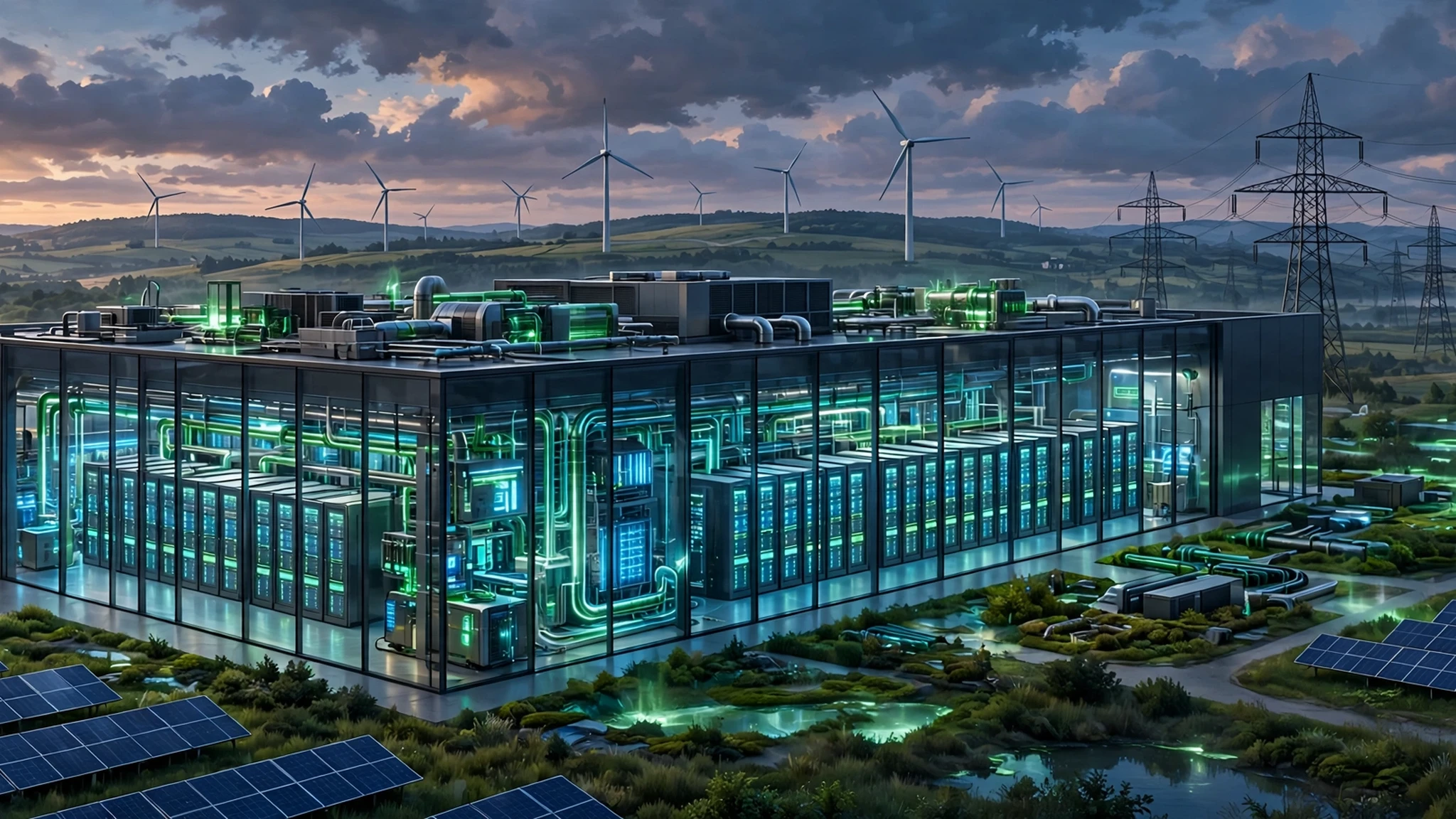
SWI Compute, a new artificial intelligence infrastructure company within Euronext Amsterdam-listed SWI Group, emerged from stealth on October 26, 2026, announcing plans to build and operate Nvidia AI factories, starting in Europe. The company says it is backed by 3.6 gigawatts of power capacity that SWI Group spent six years securing across Europe and the United States, and that it has ordered approximately $1 billion worth of Nvidia systems and signed contracts with its first customers.
The launch lands at a moment when power, not just chips, is shaping who can build AI infrastructure. Across Europe, grid connections are scarce and slow to secure, while demand for training and inference capacity keeps rising. SWI is betting that power it locked in years ago is now its sharpest advantage.
Cambridge first, then a 530 MW campus
SWI Compute's first large-scale AI factory, in the United Kingdom, will start with 30 megawatts of capacity, close to 7,000 Rubin graphics processing units and 3,500 Vera central processing units in Nvidia Vera Rubin NVL72 racks. The site, identified in independent coverage as Cambridge, is expected to come online by the end of 2027. The racks will be connected by Nvidia Quantum-X800 InfiniBand and Spectrum-X Ethernet networking.
That 30 MW build is only the opening phase. SWI says the United Kingdom campus is planned to grow to 530 MW, and that it forms the first step toward 2.3 gigawatts of Nvidia AI factory capacity by 2029. The company became a Preferred Nvidia Cloud Partner in August 2026, about two months before its public launch.
Power is the pitch
Chief executive Halil Mirakhmedov framed energy access as the central bottleneck for European AI infrastructure. “Energy availability represents the primary bottleneck facing European AI infrastructure. Having spent six years acquiring grid access, SWI Group is now deploying these power resources into dedicated Nvidia AI factories through SWI Compute,” he said.
“Just two months after joining the Nvidia Cloud Partner program, our team secured approximately $1 billion in advanced hardware orders and executed initial client contracts. The market continues to surpass available capacity, and we are rapidly expanding our footprint to fulfill this requirement,” Mirakhmedov added.
The company argues that Europe has the researchers, founders and enterprises to build frontier AI, but much of that building has happened on capacity outside Europe. Capacity that does exist, it says, has been committed first to global hyperscalers and frontier laboratories able to sign multi-year contracts at scale. SWI's pitch is dedicated capacity aimed closer to home, with deployments planned globally but the strongest presence in Europe.
What to watch next
What SWI has not disclosed matters as much as what it has. The company has not named most of its first customers, beyond independent coverage identifying one as a United States-based AI inference platform, and it has not detailed pricing, financing for the full 2.3 gigawatt build-out, or sites beyond the first United Kingdom campus.
Its timelines are also plans, not delivered capacity. The first factory is still more than a year from coming online, and the 2029 target will depend on power delivery, hardware supply and further customer sign-ups. If Cambridge opens on schedule at the end of 2027, SWI will offer an early test of a simple idea: in Europe's AI race, secured power may prove as decisive as the chips themselves.


