SpaceX's Starship has reached orbit for the first time. On Monday, the 40-storey rocket lifted off from the company's Starbase complex in Texas on its 14th test flight and, after a circularization burn about 26 minutes into the ascent, mission control confirmed what no Starship had ever done before: "Starship is orbital."
All 13 of the vehicle's previous test flights since 2023 had been deliberately suborbital — kept on trajectories that guaranteed reentry no matter what went wrong.
Monday's mission required a second engine burn after the initial climb to push the ship past 17,500 mph, the velocity at which the Earth's surface curves away fast enough that the craft is in permanent freefall around the planet rather than falling back toward it. That burn worked.
An engine failure that didn't stop the climb
The flight was not flawless. Minutes after liftoff, one of Starship's engines shut down, raising questions about whether the spacecraft could reach its orbital objective. Flight controllers assessed the situation and decided the mission could continue; the circularization burn was completed on a single Raptor engine.
The Super Heavy booster also splashed down in the Gulf of Mexico as planned, although two of its engines reportedly failed to reignite during the landing sequence.
Out of an abundance of caution over the ascent engine issue, SpaceX cut the mission short. The plan had called for roughly 10 hours in orbit — six full laps around the Earth from about 275 kilometers up, ending with a Pacific splashdown.
Instead, the ship executed a deorbit burn and splashed down in the Pacific near Hawaii roughly three hours after launch.
First operational payload: 26 Starlink V3 satellites
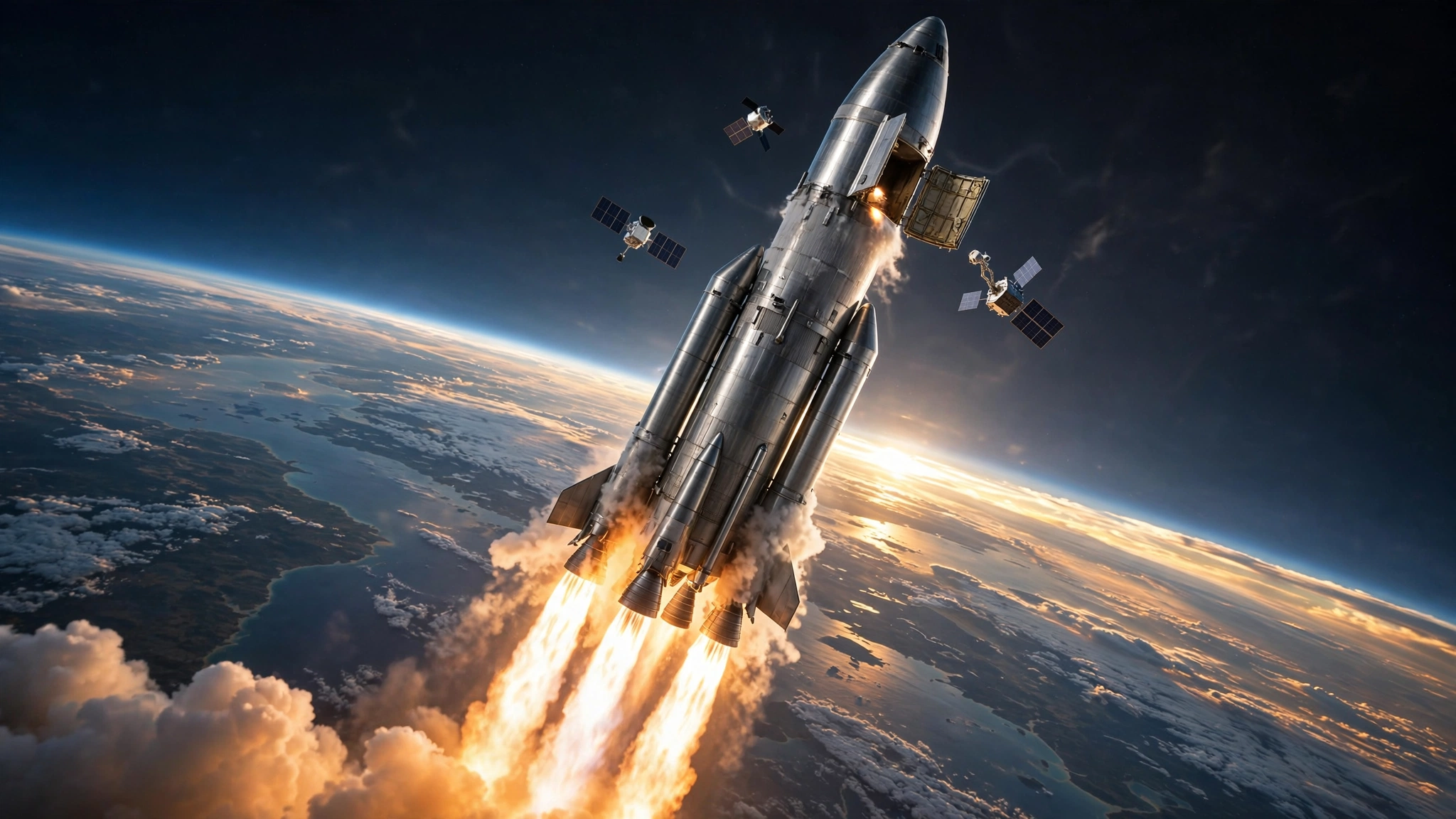
This was also the first time Starship flew with a payload it actually needed to deliver intact. While in orbit, the ship's satellite deployer — working like a giant Pez dispenser — pushed out 26 next-generation Starlink V3 satellites one after another at an orbital altitude of about 116 miles.
SpaceX chief executive Elon Musk said on X that the satellites were operational.
The V3 satellites are heavier than the current models and designed for up to 1 terabit per second of download capacity each — roughly 10 times the capacity of SpaceX's existing constellation of more than 11,000 satellites.
They will be key to expanding the Starlink broadband business into mobile wireless and direct-to-device services, and they need Starship's much larger payload capacity to reach orbit at scale. A July Starship flight had carried V3 satellites too, but because the ship never reached orbit, they re-entered the atmosphere and burned up.
A decade-long milestone for NASA's Moon plans
Reaching orbit is a primary benchmark for any new rocket meant to carry payloads to space — and a long-delayed one for Starship. Musk once predicted the milestone would be hit in 2022, followed by satellite deployments in 2023, after a development campaign that has cost SpaceX more than $15 billion.
The vehicle is central to NASA's plans to return astronauts to the Moon under the Artemis programme, and to SpaceX's ambitions for deep-space transportation. Musk said on Sunday that Starship is "two to three years away from hourly flights."
Investors, for their part, took the achievement in stride. SpaceX shares rose briefly after liftoff but closed the session down 2.5%, a sign that a successful test flight is increasingly priced into expectations.
The next step is the hardest one: demonstrating reliable recovery and, eventually, orbital refuelling — the capabilities that will decide whether Starship becomes the heavy-lift platform Musk is betting the company's future on.
By Hamza Faisal