By Hamza Faisal
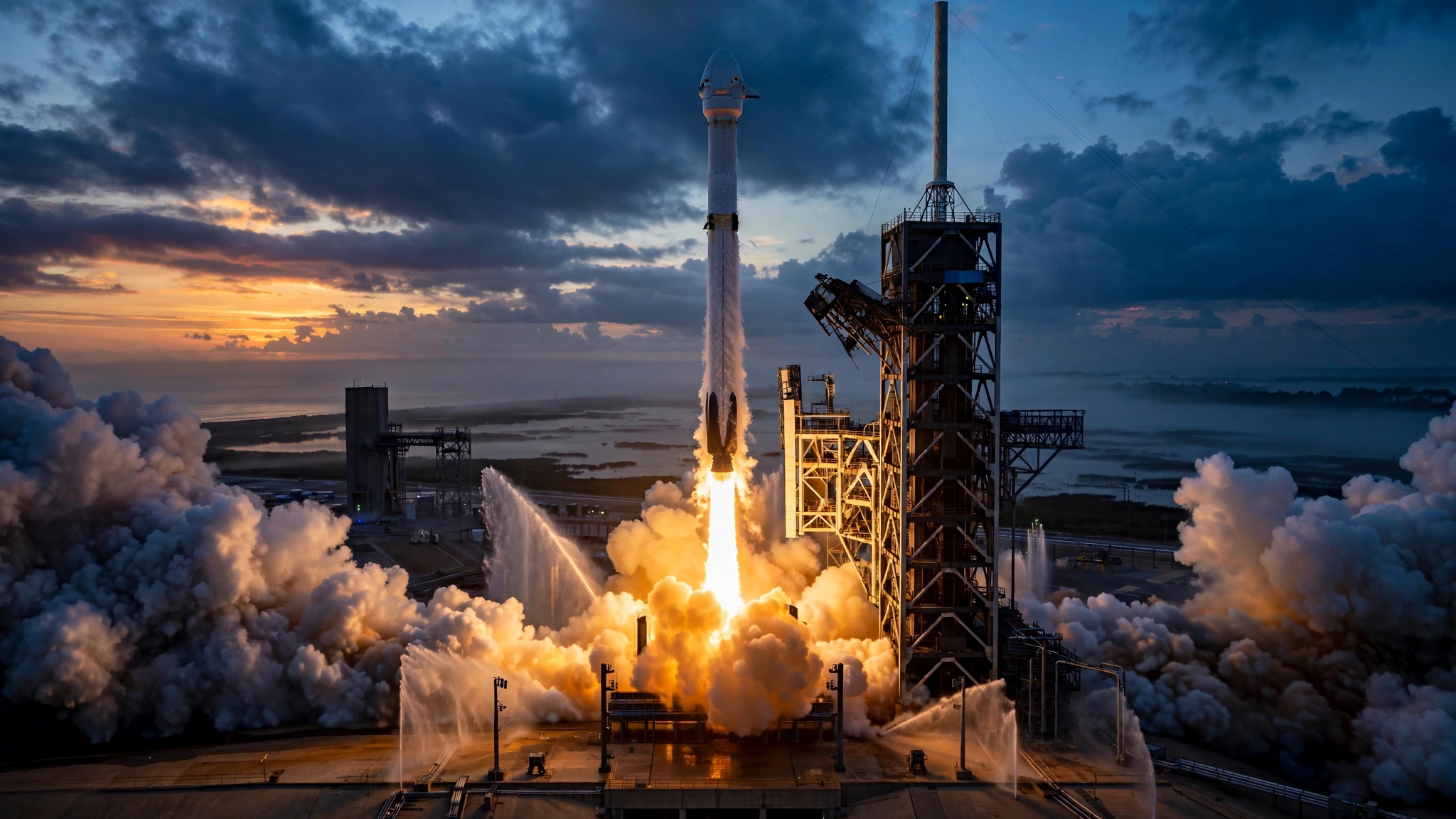
A SpaceX Falcon 9 rocket thundered off the launch pad at Cape Canaveral on Thursday, carrying NASA's Crew-13 mission toward the International Space Station in what could be one of the Dragon capsule's final crewed flights.
Liftoff came at 11:10 a.m. Eastern time from Space Launch Complex 40 at the Cape Canaveral Space Force Station.
About 15 minutes after launch, the Falcon 9's first-stage booster touched down back at the Cape, rattling windows with twin sonic booms, while the Crew Dragon spacecraft — named Grace — separated from the rocket's second stage and continued on to orbit.
The four-person crew is led by NASA astronaut Jessica Watkins, the mission's commander and the only returning space traveler in the lineup. Watkins, who previously flew on a 2022 long-duration mission, is expected to become the first NASA astronaut to launch aboard a Crew Dragon for a second time.
NASA's Luke Delaney is serving as pilot on his first trip to space, while Canadian Space Agency astronaut Joshua Kutryk and Roscosmos cosmonaut Sergey Teteryatnikov are flying as mission specialists, also first-time spacefarers.
A six-month science mission
Dragon is scheduled to dock with the station's Harmony forward port around 7 p.m. Eastern on Thursday. Once aboard, the crew will join Expedition 75 and begin a six-month stint supporting hundreds of scientific investigations, technology demonstrations, and station maintenance.
Among their jobs: helping install the Nanoracks External Laboratory from Voyager Technologies, a new external platform designed to run experiments in the harsh conditions of low-Earth orbit — intense radiation, wild temperature swings, and exposure to atomic oxygen.
After a brief handover period with the outgoing Crew-12 team — NASA astronauts Jessica Meir and Jack Hathaway, ESA astronaut Sophie Adenot, and Roscosmos cosmonaut Andrey Fedyaev — the four will depart for a splashdown off the coast of California.
One of Dragon's last rides?
Crew-13 is the 13th operational NASA Commercial Crew rotation flight and the 21st crewed orbital flight of a Crew Dragon spacecraft. It is also the second flight for the capsule Grace, which previously carried the Axiom Space Ax-4 mission in June 2025.
But Thursday's launch may mark the beginning of the end for Dragon.
SpaceX has indicated it plans to retire the capsule — built with partial NASA funding to keep the station staffed — and sunset older platforms like Falcon and Dragon as the company concentrates on its next-generation Starship vehicle, NASA Administrator Jared Isaacman said at a pre-launch press conference.
With the International Space Station program slated to wind down by 2030, the commercial crew workhorses that defined the last decade of American human spaceflight are approaching their twilight.
A weather gamble that paid off
The launch almost didn't happen on Thursday. The Space Force's 45th Weather Squadron had put the odds of favorable weather at just 40 percent on Thursday morning, with cumulus clouds and rain threatening the pad. By mid-morning, those odds had climbed to 60 percent, and SpaceX's launch director declared "go for launch" shortly before liftoff.
"Congratulations @NASA and @SpaceX teams, on another gorgeous launch. Godspeed Crew-13," Isaacman wrote on X after the successful ascent.