By Hamza Faisal
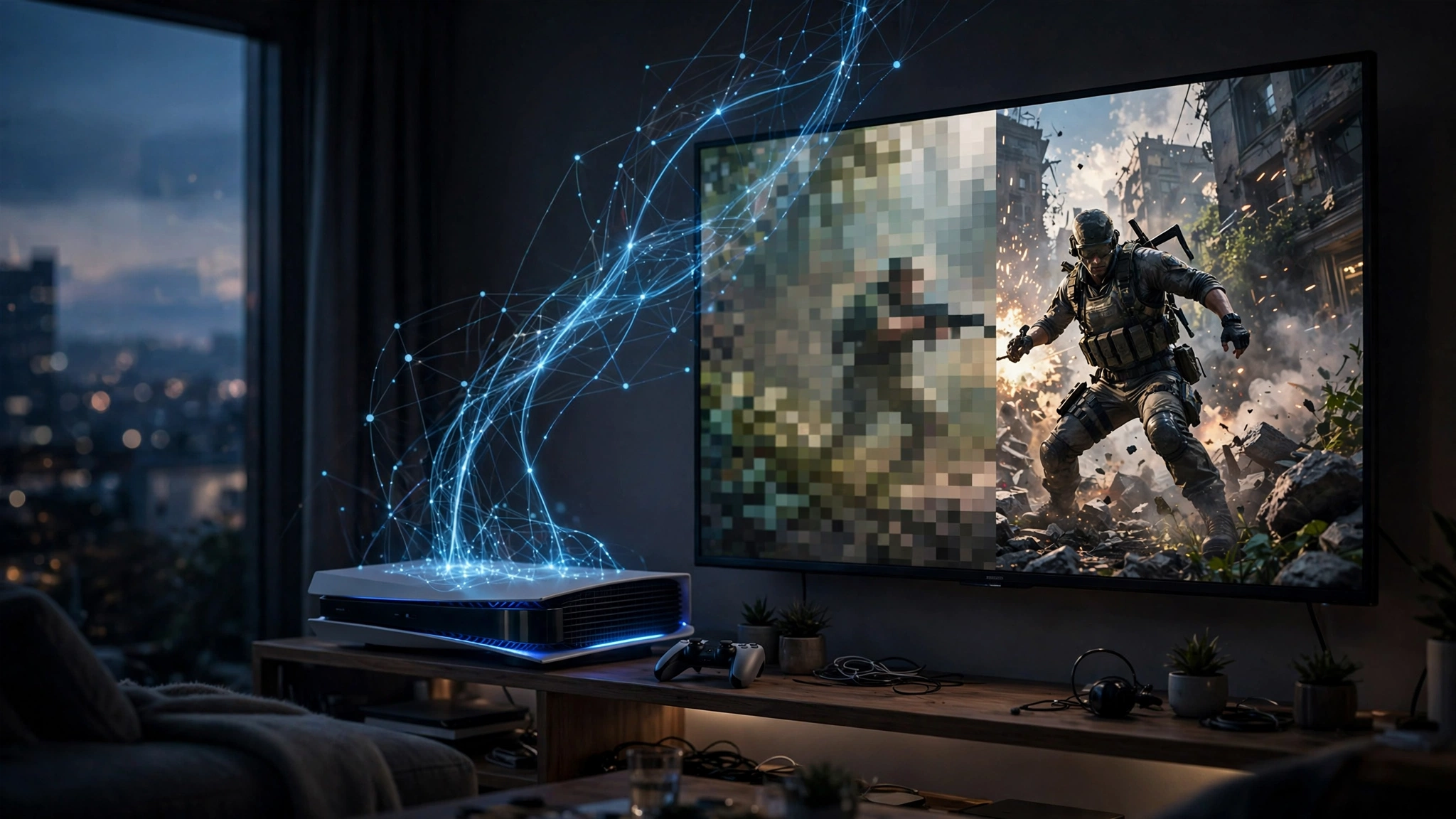
Sony has switched on AI upscaling for the base PlayStation 5 for the first time, introducing Quick Spectral Super Resolution, or QSSR, a new technology that brings neural image reconstruction to more than 60 million standard consoles. The company announced it on the PlayStation Blog on October 1, 2026, in a post by Daniel Craig, principal engineer of graphics R&D at Sony Interactive Entertainment.
The first games to use it are Insomniac's Marvel's Wolverine and Sucker Punch's Ghost of Yōtei. Both received patches on October 1 that add QSSR as a graphics option on the standard console. Marvel's Wolverine update 1.002 enables QSSR by default, while Ghost of Yōtei picked up the option alongside its own October 1 update.
A two-year gap finally closed
Until now, AI-driven upscaling had been an exclusive of the PS5 Pro, which launched in November 2024 with PlayStation Spectral Super Resolution, or PSSR, as one of its headline features. For almost two years, standard PS5 owners relied on older techniques such as checkerboard rendering and temporal reconstruction, which can leave foliage edges shimmering and fine detail unstable during camera movement.
QSSR is described by Sony as a new performance tier of that same technology. The base PS5 lacks the dedicated machine-learning hardware found in the Pro, so the new upscaler had to be engineered around a much tighter compute budget, relying on FP16 math and packed math instructions rather than dedicated ML cores.
Sony is careful not to pitch the two as equals. The company says PSSR “remains the gold standard on PS5 Pro,” while QSSR “provides some notable improvements to both image detail and image stability on PS5.” In other words, this is not full Pro parity on the base machine, but a meaningful step up from what the base console was already doing.
Early testing points to 1440p as the sweet spot
Early technical analysis from Digital Foundry suggests 1440p output is the ideal target for QSSR. In their testing, reconstructing Marvel's Wolverine from 864p to 1440p added roughly 1.5 to 1.8 milliseconds of frame time compared with Insomniac's existing upscaler, which works out to about eight to ten frames per second in uncapped performance mode. Pushing output to 2160p in the game's fidelity mode raised the cost to around 4.4 milliseconds.
Ghost of Yōtei showed a different profile, running at roughly the same frame rate as its existing FSR 3 implementation in unlocked performance mode. The numbers suggest developers will weigh QSSR's image-quality gains against its frame-time cost on a per-game basis, just as they do with any upscaler.
Both studios praised the results in Sony's announcement. Mike Fitzgerald, Insomniac's head of technology, said QSSR adds clarity and stability at the pixel level to Marvel's Wolverine, calling it a taste of the PS5 Pro experience for base-console players. Jasmin Patry, lead rendering engineer at Sucker Punch Productions, said QSSR resolves fine detail with a level of temporal stability that had not been possible on PS5 until now.
What comes next
QSSR comes out of Project Amethyst, Sony's AI graphics collaboration with AMD that also produced the upgraded PSSR that PlayStation 5 Pro owners received earlier in 2026. Importantly, QSSR is upscaling rather than generative AI: it clarifies the image a game already renders instead of altering its assets, lighting, or character designs.
Sony says the QSSR developer tools will be offered broadly to all PlayStation studios, and that it expects to see the technology in many more titles going forward. Each game will still need its own patch, and Sony has not announced a system update or a list of upcoming supported games.