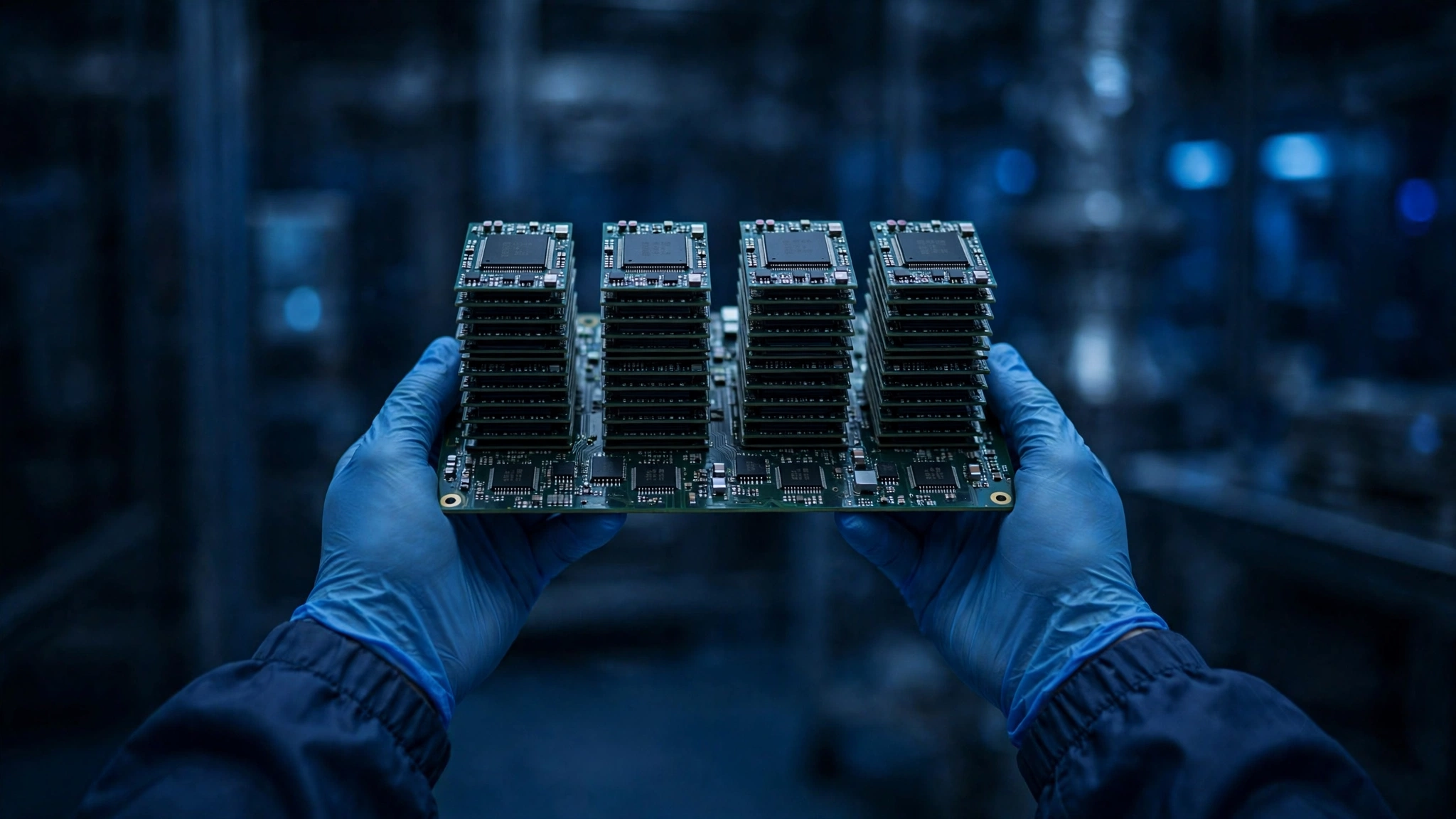
Smugglers have found a way around America's ban on shipping advanced AI memory to China: they bolt the banned chips onto cheap server processors, declare the package as a low-end computer part, and let it sail through customs. Once inside China, technicians heat the boards, peel the memory off, and throw the processors away.
The scheme was detailed by The Information this week, and it exposes how a single classification gap in US export rules is feeding the supply chain behind Huawei's next flagship AI chip — at black-market prices that have risen roughly tenfold in a year.
How the loophole works
US export controls ban standalone shipments of high-bandwidth memory, or HBM, to China. But the rules judge a package's computing capability by its processor, not by the memory attached to it. Smugglers exploit that distinction by bonding premium HBM stacks from Samsung Electronics and SK hynix onto boards with low-cost server processors whose performance sits comfortably below the restricted threshold.
Declared as server processors rather than memory, the boards clear export checks. They are routed through Hong Kong, then carried into Shenzhen — in some cases in personal luggage — where workshops heat the circuit boards to soften the solder and carefully pry the HBM units off. The cheap processors and host boards are discarded. The work is delicate: heating a board too quickly or for too long can warp or crack the memory stacks, and the failure rate is high.
$4,000 a chip, and climbing
The economics explain why the trade is growing. A Shenzhen broker told The Information that a single HBM3E unit, which changed hands in China for a few hundred dollars a year ago, now fetches about $4,000. A finished AI chip package needs six to eight HBM units, putting the memory alone at $24,000 to $32,000 per chip.
The memory is sold mainly to customers of Huawei, according to people familiar with the company's supply chain. Huawei has told some customers that its next-generation flagship AI chip, the Ascend 960DT, due in the first quarter of 2027, will rely heavily on HBM produced by Samsung and SK hynix — and has asked buyers to secure the memory themselves.
Neither manufacturer is accused of supplying Huawei directly, and the accounts do not establish that either did. SK hynix said it strictly complies with all relevant laws and regulations, including export controls in the United States and South Korea, and has not supplied products to Huawei since US restrictions took effect in 2020.
A widening enforcement gap
The controls at the heart of the story date from a US Commerce Department rule published in December 2024, which restricted HBM exports to China but carved out co-packaged chips where the dominant function is processing. That carve-out is precisely what the smuggling networks are now exploiting, and it shows how product-classification rules can blunt direct-sales bans.
South Korea is already feeling the pressure. The country recorded $645.8 million in trade-security violations through May 2026, exceeding the $549.7 million logged for all of 2025. One smuggler sourcing chips from Korea told The Information he plans to sell most of his company's equity next year, fearing tighter scrutiny from South Korean and US regulators.
The episode echoes an earlier enforcement failure: TSMC came under US government investigation in 2024 after chips it had manufactured were found inside Huawei products, and Washington subsequently ordered the Taiwanese chipmaker to halt all AI chip exports to China. The HBM route suggests that as long as the classification gap stays open, the controls will keep leaking — one $4,000 chip at a time.