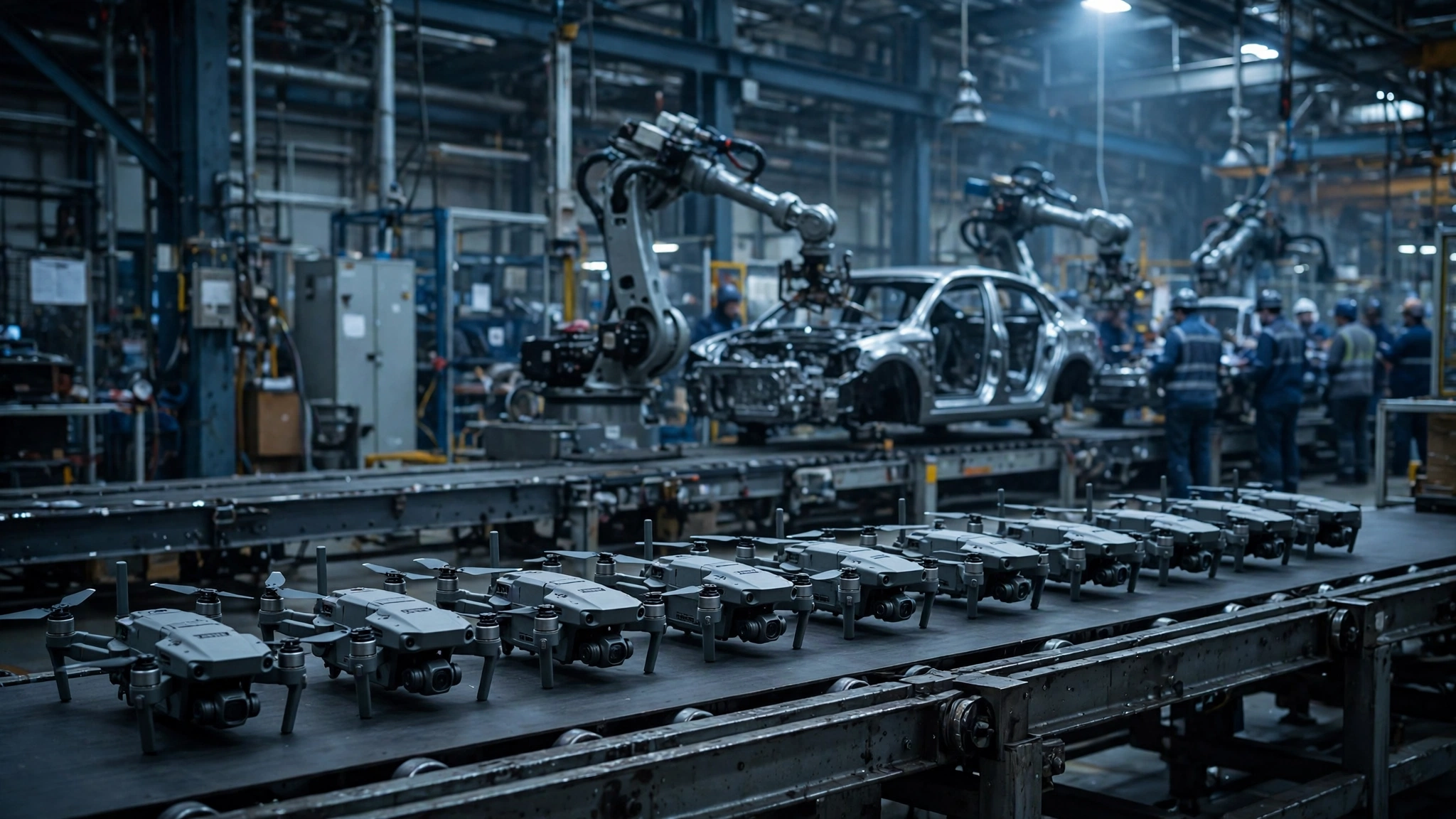
Detroit's assembly lines may soon be building more than cars. The Pentagon is in talks with General Motors, Ford and other manufacturers about mass-producing military drones, The Wall Street Journal reported on Tuesday, in the latest effort by the US military to enlist the car industry's sprawling factories to scale up production of critical weapons.
Under the arrangements being discussed, the automakers would not build finished drones. Instead, they would supply parts — motors, actuators, sensors, lidar and other components — to drone companies, according to people familiar with the matter cited by the Journal. Reuters also reported the talks, citing the Journal.
General Motors is weighing whether to manufacture drone motors, albeit ones closer in size to a motor that would power a riding lawn mower than a car, the Journal reported. Defence officials have also met leaders at Ford, Canadian parts giant Magna International and other manufacturers, including some outside the auto industry. No deals have been finalised, and people involved described the talks as preliminary.
Millions of drones, and a capacity problem
The Pentagon says it plans to buy millions of drones in the coming years, but defence leaders have concluded that American drone companies — many of them small — lack the manufacturing experience and capacity to deliver at that scale. The department sees the market for military drones reaching $20 billion to $30 billion a year.
The outreach is being run through a four-star combatant command created this autumn by Defence Secretary Pete Hegseth, which aims to consolidate drone production and development across the military branches. The command grew out of Project Agincourt, an initiative to unify drone development and procurement.
Washington has also considered tapping automakers to help manufacture its Lucas drone, modelled on Iran's Shahed, under an approach in which the Pentagon owns the design and farms out production to companies with established assembly lines, a former senior defence official told the Journal.
Detroit's cautious return to defence
GM has been the most interested of the carmakers in getting involved, at the request of high-ranking defence officials, the Journal reported. In a statement, GM said it had "demonstrated a commitment to helping reinforce the US defence-industrial base". The Detroit automaker signed an agreement earlier this year to manufacture housing components for Lockheed Martin's Patriot air-defence missiles, and is in talks with RTX and L3Harris Technologies on similar deals, according to people familiar with the matter.
Ford, by contrast, has long steered clear of weapons manufacturing, sticking to supplying the Pentagon with vehicles and equipment closer to its existing commercial line-up. Its discussions with defence officials have centred on military vehicles and satellites rather than drones, according to trade publication Autoguide.
Some suppliers are already moving. Michigan auto-parts firm Lacks Enterprises took an equity stake in a defence contractor in April and has held talks with about 30 drone manufacturers about producing components. The idea is not new: during the Second World War, Detroit's Big Three suspended car production to build aeroplanes, tanks and munitions for the US government.
Why now
Drones have become central to modern warfare, above all in Ukraine, where cheap unmanned aircraft are used for reconnaissance and strikes in huge numbers. The US military's problem is not design — it is volume. Turning a cottage industry of small drone makers into a mass-production machine is exactly the kind of job Detroit's assembly lines were built for. Whether car executives, worried about thin margins and the politics of weapons work, agree is still an open question.


