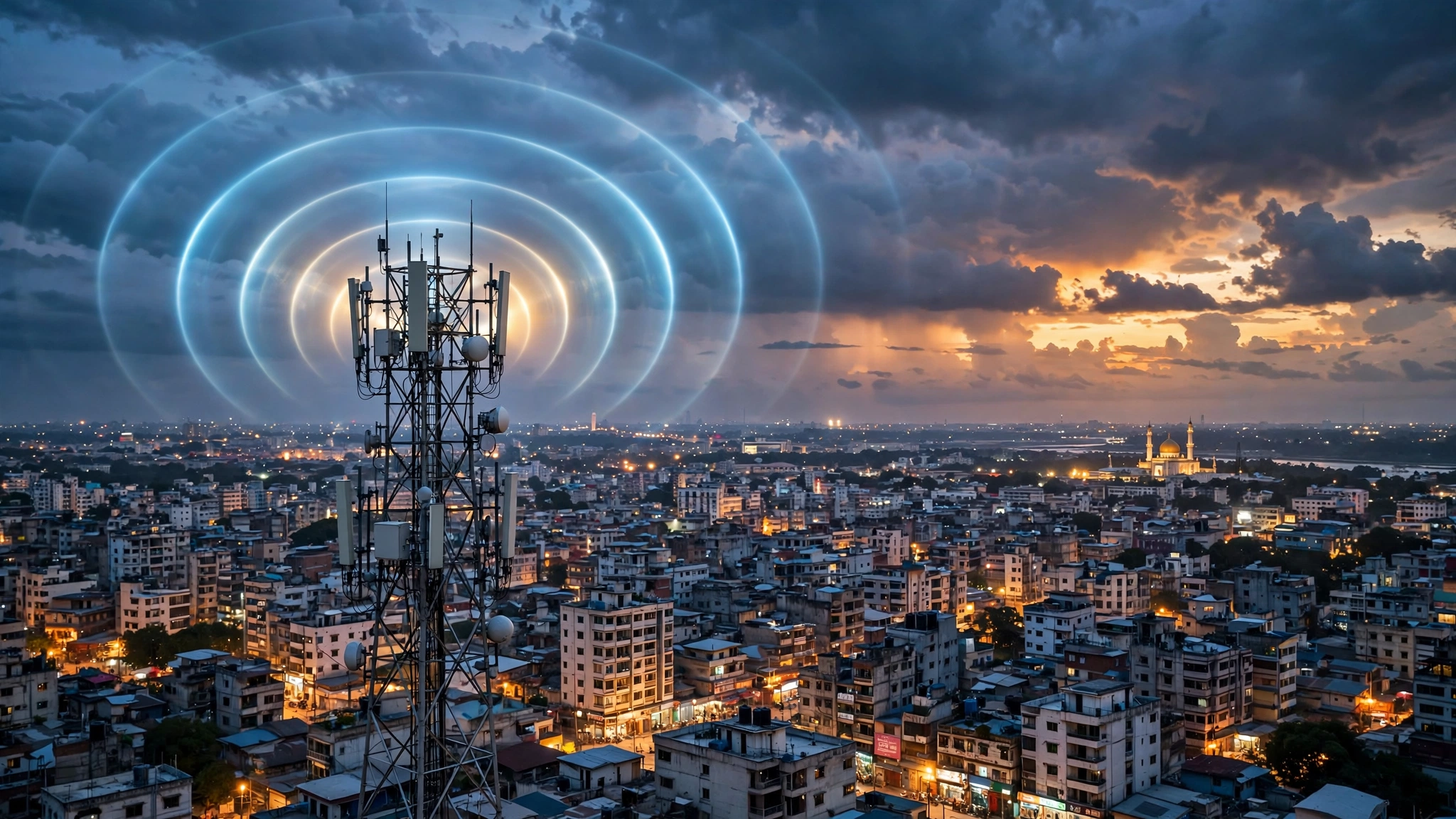
By Hamza Faisal
Pakistan switched on commercial 5G in March 2026, ending one of the longest waits in the country's telecom history. Eight months later, the network reaches 24 cities, counts around 1.8 million users, and still leaves most Pakistanis asking the same question: can I actually use it, and is it worth it yet? This guide pulls together what is genuinely live, what it costs, and what comes next.
How Pakistan got 5G
The road to 5G was blocked for years by a single dispute: spectrum priced in US dollars that operators refused to buy while the rupee kept sliding. The deadlock broke when payments were switched to rupee-denominated instalments. On March 10, 2026, the Pakistan Telecommunication Authority (PTA) concluded the auction, selling 480 MHz of spectrum for about $507 million: Jazz took 190 MHz, Ufone 180 MHz and Zong 110 MHz. Licences were signed on March 19, and commercial services began on March 20. The sale nearly tripled Pakistan's total allocated mobile spectrum, from 274 MHz to more than 750 MHz.
That history matters because it explains the shape of the rollout. Operators bought spectrum in instalments, so they are building in phases rather than all at once, and the regulator attached conditions: alongside 5G expansion, the new licences require operators to keep improving existing 4G services.
Where 5G actually works today
As of the IT minister's October 23, 2026 update, 1,782 5G sites are live across 24 cities. Jazz leads with 1,015 sites, followed by Zong with 640 and Ufone with 127. Karachi leads with 385 sites, then Lahore with 373 and Islamabad with 276. Faisalabad, Peshawar, Rawalpindi and Multan follow, with smaller counts in Sialkot, Quetta, Sheikhupura, Gujranwala, Hyderabad, Abbottabad and a dozen smaller cities.
The important caveat is that a city being "live" does not mean the whole city is covered. Deployment so far is pockets, not blankets: business districts, campuses, hospitals and city centres first, with residential streets catching up later. A user can have 5G on one block and 4G on the next. Before buying a handset or plan, check your own operator's coverage map for your neighbourhood, not just your city.
What you need, and what it costs
Three things, and only three. First, a 5G-compatible phone that supports the right bands: n78 (3.3-3.8 GHz) is the essential one, and n28 (700 MHz) helps coverage travel further. Many imported models skip exactly these bands, so check the spec sheet rather than trusting a "5G" badge. Second, a 4G SIM works fine — no SIM swap is needed. Third, you must be inside a deployed site's footprint.
Price is the real barrier. The cheapest locally available 5G handset costs around Rs 36,000, according to the IT minister, and that puts the technology beyond the reach of many consumers. The local assembly picture is improving — 607,093 5G-capable handsets were assembled in Pakistan between January and August 2026 — but affordable models remain the exception. The government has given no firm timeline for making 5G affordable for ordinary consumers, so the honest advice is: do not pay a 5G premium for a phone that does not list n78 in its specifications.
What is still holding it back
Two bottlenecks remain. The first is fibre backhaul: 5G cells are hungry for fibre, and the inland fibre build-out remains uneven, which limits how fast operators can densify sites. The second is the sheer scale of the build: Karachi's Phase-I target alone is 1,000 sites, and the nationwide Phase-I goal is 2,632, so the current 1,782 sites are roughly two-thirds of the way there. Phase 2, planned for 2027, extends coverage to secondary cities, and the official roadmap runs to 2035, targeting average speeds of 50 to 100 Mbps.
For most Pakistanis, 4G remains the everyday network, and that is fine: the practical value of 5G today sits with hotspots, enterprise zones, fixed-wireless home broadband where fibre does not reach, and the industries — ports, factories, hospitals — that can use private capacity first. Consumers should expect steady improvement through 2027, not a sudden nationwide switch.
What the operators are actually promising
Look past the launch headlines and the operators' plans are more specific than they first appear. Jazz, which holds spectrum across all key bands — 700 MHz, 2300 MHz, 2600 MHz and 3500 MHz — is positioned to offer both wide coverage and high capacity, and has backed its rollout with a $1 billion investment commitment on top of more than $11 billion invested in Pakistan over three decades. Zong has said it plans to deploy and upgrade more than 1,000 5G sites during 2026. Ufone, the smallest of the three so far with 127 sites, is expected to expand as its deployment matures. The pattern to watch is not who launches first in a city, but who densifies fastest: 5G quality depends on site density more than on launch announcements.
The official roadmap also ties 5G to 4G improvement. The new licences require operators to improve existing 4G services alongside 5G expansion, which matters because most users will live on 4G for years. A rollout that improves the network everyone uses, while adding 5G pockets for those who can use them, is worth more than a 5G showcase that leaves 4G to rot.
5G versus 4G: what actually changes for you
For a phone user, 5G's headline benefit is speed, but its practical benefits are latency and capacity: pages and videos load faster, video calls stutter less in crowded places, and networks cope better when thousands of people connect at once — stadiums, universities, busy markets. The official roadmap targets average speeds of 50 to 100 Mbps, with 50 Mbps as the initial goal and 100 Mbps as the ambition for 2030. Those are meaningful improvements over typical 4G, but they are not the gigabit speeds of laboratory demos, and users should judge the network by the speeds they actually get on their street.
The more transformative uses are not about phones at all. Fixed-wireless broadband — a 5G connection replacing a wired home connection where fibre does not reach — could matter enormously in areas where laying fibre is slow or expensive. Private 5G networks for factories, ports and hospitals, and the enterprise zones getting capacity first, are where the technology earns its keep before it reaches every consumer. That sequencing is normal for a new network generation; it is not a failure.
The bottom line
Pakistan's 5G is real, it is growing, and it is still early. If you live in a covered pocket of Karachi, Lahore or Islamabad and already own a compatible phone, it is worth trying. If you are buying a phone mainly for 5G, check the bands, check your street's coverage, and do not overpay for a badge. The network will meet most people where they are — it just has not got there yet.
Sources: TechJuice, Pakistan's 5G network spans 24 cities; Technologistan, 5G in Pakistan: what your phone needs; Pakistan Telecommunication Authority auction updates.