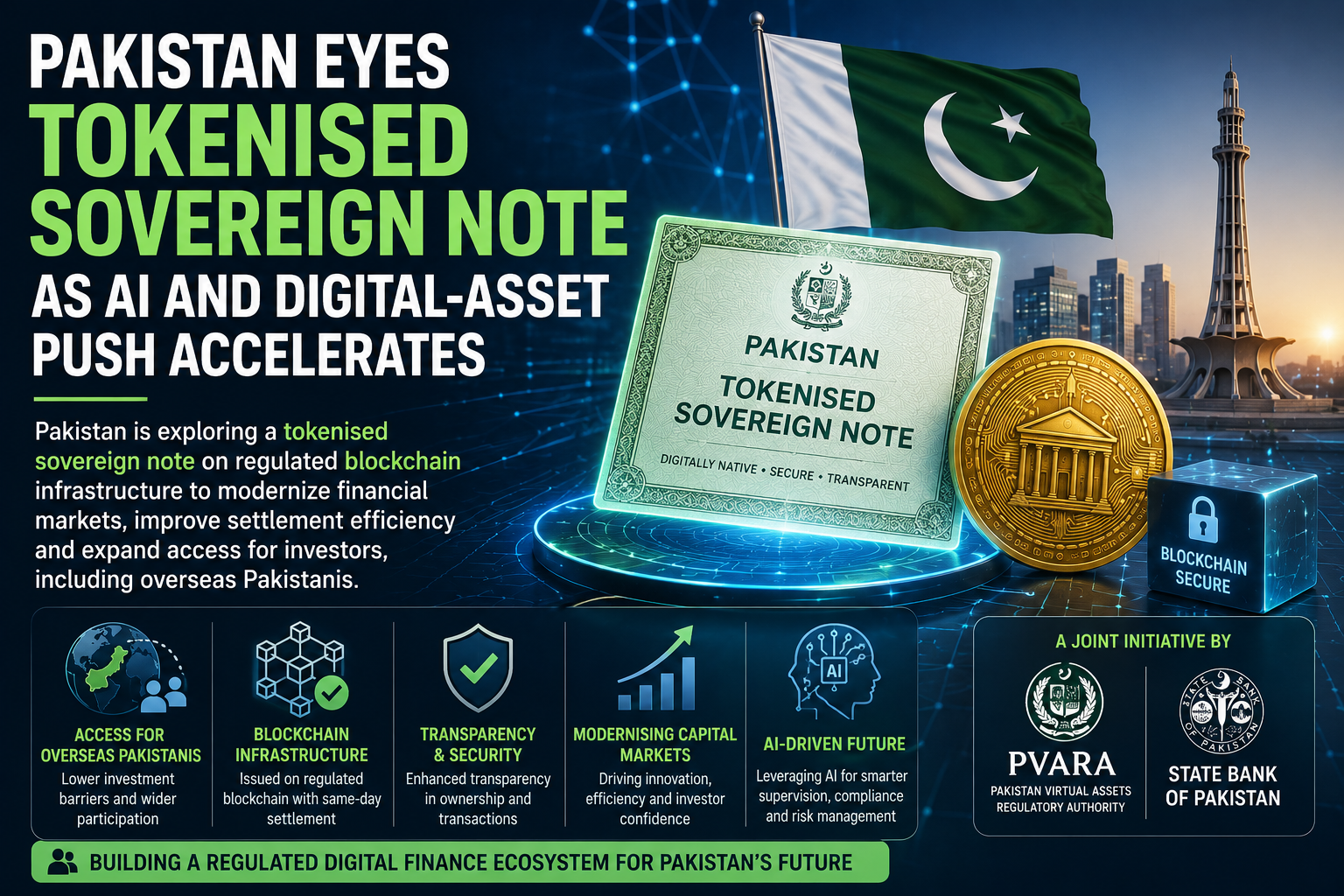
Pakistan Eyes Tokenised Sovereign Note as AI and Digital-Asset Push Accelerates
Pakistan is exploring the development of a digitally native sovereign note as the country moves to modernize its financial markets and build a regulated framework for digital assets.
The initiative is being studied by the Pakistan Virtual Assets Regulatory Authority (PVARA) and the State Bank of Pakistan (SBP). The proposed instrument could be issued through regulated blockchain infrastructure while remaining connected to Pakistan's existing financial system.
Blockchain-Based Government Securities
Under the model being considered, a sovereign investment product would be created digitally on a regulated blockchain rather than being issued solely through traditional financial infrastructure.
The proposed system could support same-day settlement, while maintaining interoperability with Pakistan's existing financial infrastructure. The approach is intended to combine the efficiency of blockchain technology with the safeguards and established processes of the conventional financial system.
Pakistan has already been examining the tokenisation of sovereign bonds and Naya Pakistan Certificates (NPCs). Earlier discussions between the Finance Ministry, PVARA and SBP focused on potential structures, implementation pathways and regulatory requirements for tokenised government debt.
Targeting Overseas Pakistanis
One of the key objectives is to make government-backed investment products easier to access for overseas Pakistanis.
Tokenisation could potentially allow securities to be divided into smaller investment units, lowering the investment threshold for some investors. It could also create more streamlined digital investment channels connected to international markets.
Pakistan's Finance Ministry has previously said that tokenising Naya Pakistan Certificates could potentially broaden retail participation, improve accessibility for overseas Pakistanis and create more seamless digital investment rails.
Faster Settlement and Greater Transparency
According to PVARA Chairman and Minister of State Bilal Bin Saqib, the proposed digitally native sovereign note could reduce investment ticket sizes, shorten settlement times and improve transparency around securities ownership.
The proposed structure would also keep important functions such as coupons, trading and redemption connected to established financial infrastructure rather than creating a completely separate financial system.
Pakistan's Broader Tokenisation Strategy
The sovereign-note proposal is part of a broader push by Pakistan to explore blockchain-based financial infrastructure.
In May, Pakistan began high-level discussions on tokenising sovereign debt and Naya Pakistan Certificates. Officials said the initiative could help modernize capital markets and expand investor participation.
The government has also explored tokenisation beyond government securities. In August, the Finance Division said it was examining possible applications of digital assets and tokenisation in areas including real estate and other investment assets.
From Restriction to Regulation
Pakistan's digital-asset strategy has also undergone a significant shift.
PVARA Chairman Bilal Bin Saqib said Pakistan has moved from restricting virtual assets toward establishing a dedicated regulatory framework. The regulator is intended to provide greater oversight of the sector and reduce the risks associated with activity taking place through offshore platforms.
The State Bank has also introduced a framework allowing regulated banks to provide accounts to licensed virtual-asset service providers, including segregated client-money accounts.
AI Enters the Regulatory Picture
Artificial intelligence is another major component of Pakistan's digital-finance strategy.
Officials have argued that AI will change not only financial products but also the institutions responsible for supervising financial markets. As transactions and financial systems become increasingly automated, regulators may need to use AI and other technologies for supervision, compliance monitoring and risk detection.
This creates a broader vision in which AI, blockchain and digital assets become part of the infrastructure supporting Pakistan's future financial system.
A Proposal, Not Yet a Final Launch
The tokenised sovereign note remains under study and should not be described as an already-issued government security.
PVARA and the SBP are currently examining the structure, regulatory framework and technical model. Any eventual launch would depend on the necessary approvals and implementation decisions.
If adopted, however, the initiative could represent an important step toward bringing Pakistan's sovereign debt market onto regulated digital infrastructure.
Why It Matters
A successful tokenised sovereign-note model could make government securities more accessible, potentially improve settlement efficiency and provide overseas Pakistanis with new digital channels for investing in Pakistan.
It would also place Pakistan among a growing group of countries experimenting with tokenised real-world assets and blockchain-based financial infrastructure.
For Pakistan, the bigger objective appears to be broader than a single digital security: building a regulated digital-finance ecosystem in which traditional capital markets, AI-powered regulation and blockchain-based assets can operate together.