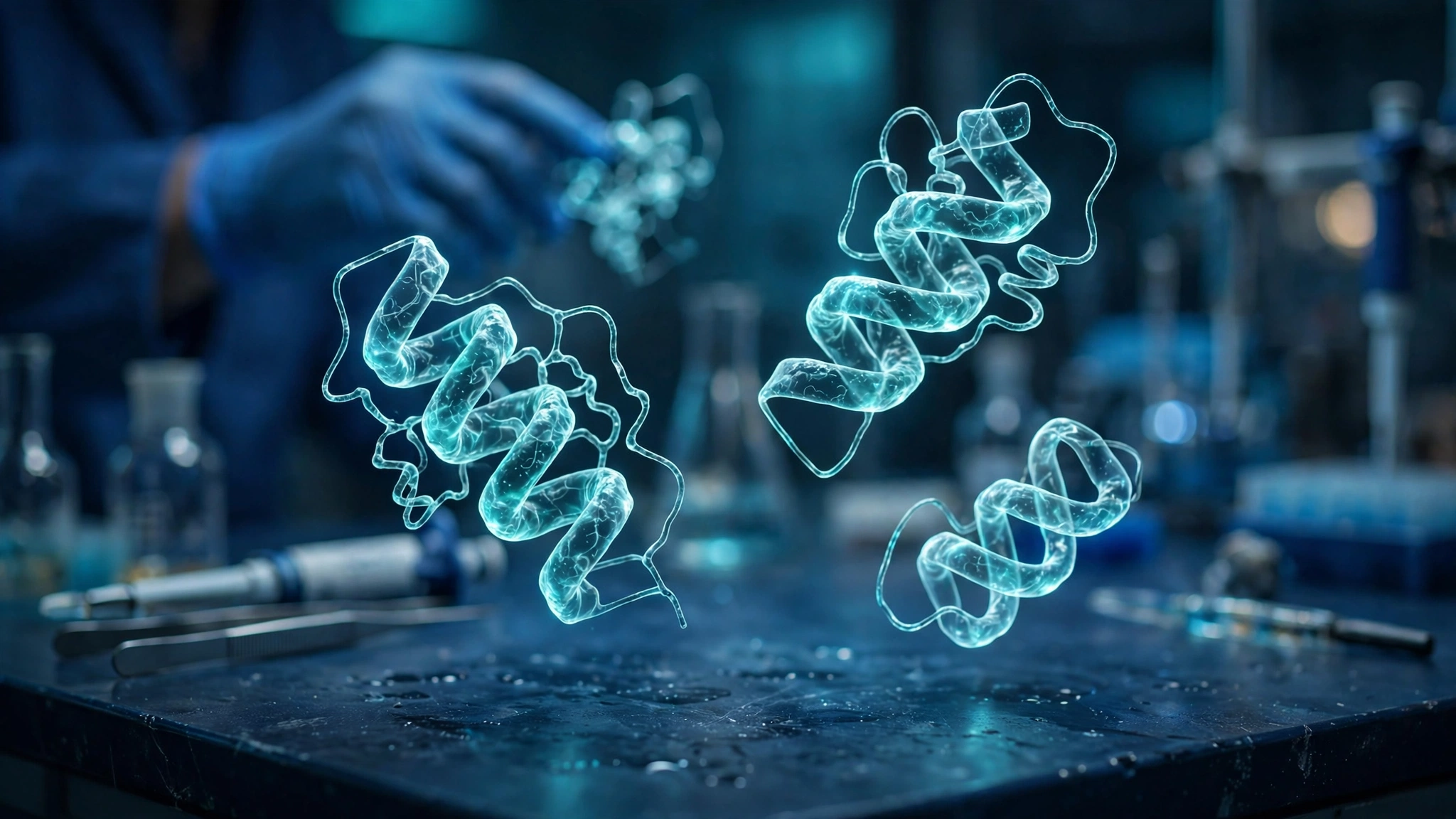
OpenAI says its GPT-6 models can design new proteins from scratch — and this time it has lab results to back the claim. The company published a preprint on November 24 showing that GPT-6.2 sketched three-dimensional protein shapes and amino-acid sequences using only reasoning and general-purpose code, without calling on a specialised biology model to generate the designs. A research partner then built hundreds of those designs in the lab and measured whether they stuck to their targets.
The headline experiment asked GPT-6.2 to design minibinders — very small proteins built to grip a chosen spot — against five human protein targets: PD-L1, IL-7Rα, TrkA, VEGF-A and IL-17A. Of 322 designs tested, 35 showed evidence of binding, a hit rate of 10.9%. It is the first wet-lab number OpenAI has published for a protein-design campaign run without a specialised biology model in the loop, and the company frames it as evidence that a general-purpose model can now do parts of a job that used to need dedicated systems.
What the lab tests actually showed
The hits were unevenly spread. IL-17A accounted for 18 of the 35, followed by VEGF-A with eight, PD-L1 with five, IL-7Rα with three and TrkA with one. Every target produced at least one binder, which OpenAI presents as a sign the approach generalises rather than working on a single easy case. The work was done with lab partner Onava, which synthesised the designs and ran the binding assays.
Other tasks in the study fared better. When the model was handed a known structure and asked to write a new amino-acid sequence for it, 85% of its MDM2 designs and 62% of its VEGF-A designs bound their targets. Redesigned antibody fragments also held up: 128 of 182 variants kept binding to IL-4Rα, and 179 of 272 kept binding to PD-1/PD-L1. On computational benchmarks, GPT-6.2 scored 93% on PoseBusters molecular docking, against 50% for the specialist system DiffDock-L, and 92% on the Scarpino dataset, against 60%.
The catch: specialists still did much of the work
The pipeline was hybrid in practice, and OpenAI is open about that. In the first minibinder campaign, a specialised model called SolubleMPNN assigned the amino-acid sequences, while Boltz-2 and ESMFold2 filtered candidates before any design reached a plate. The GPT models proposed the shapes; specialist tools still chose which ones were worth making.
The weakest area is also the most basic one. Predicting a complete protein structure from its amino-acid sequence alone averaged a TM-score of 0.38 for OpenAI's best internal model, against 0.93 for the dedicated structure predictor ESMFold2 — a wide gap on a 0-to-1 scale where 1.0 is a perfect match. OpenAI also notes that some benchmark scores may partly reflect memorisation, because the structures used in testing were public.
Why it matters — and what it doesn't prove
Binding in an assay is not biological function. The preprint publishes no affinity constants, potency or toxicity data, and none of the designs is anywhere near a medicine. What the result does show is that a general model, steered in plain language — researchers could specify where a protein should attach and how many coils or strands it should contain — can produce designs that survive contact with real biology at a measurable rate.
OpenAI calls the work a proof of concept. Its stated next steps are to test whether the proteins do something useful after attaching, tackle harder targets and extend the approach to other types of molecules. Its longer-term goal, in the company's own words, is for scientists to one day design working medicines simply by prompting. That remains a distant ambition — but the lab numbers give the claim something it did not have before: a hit rate.


