By Hamza Faisal
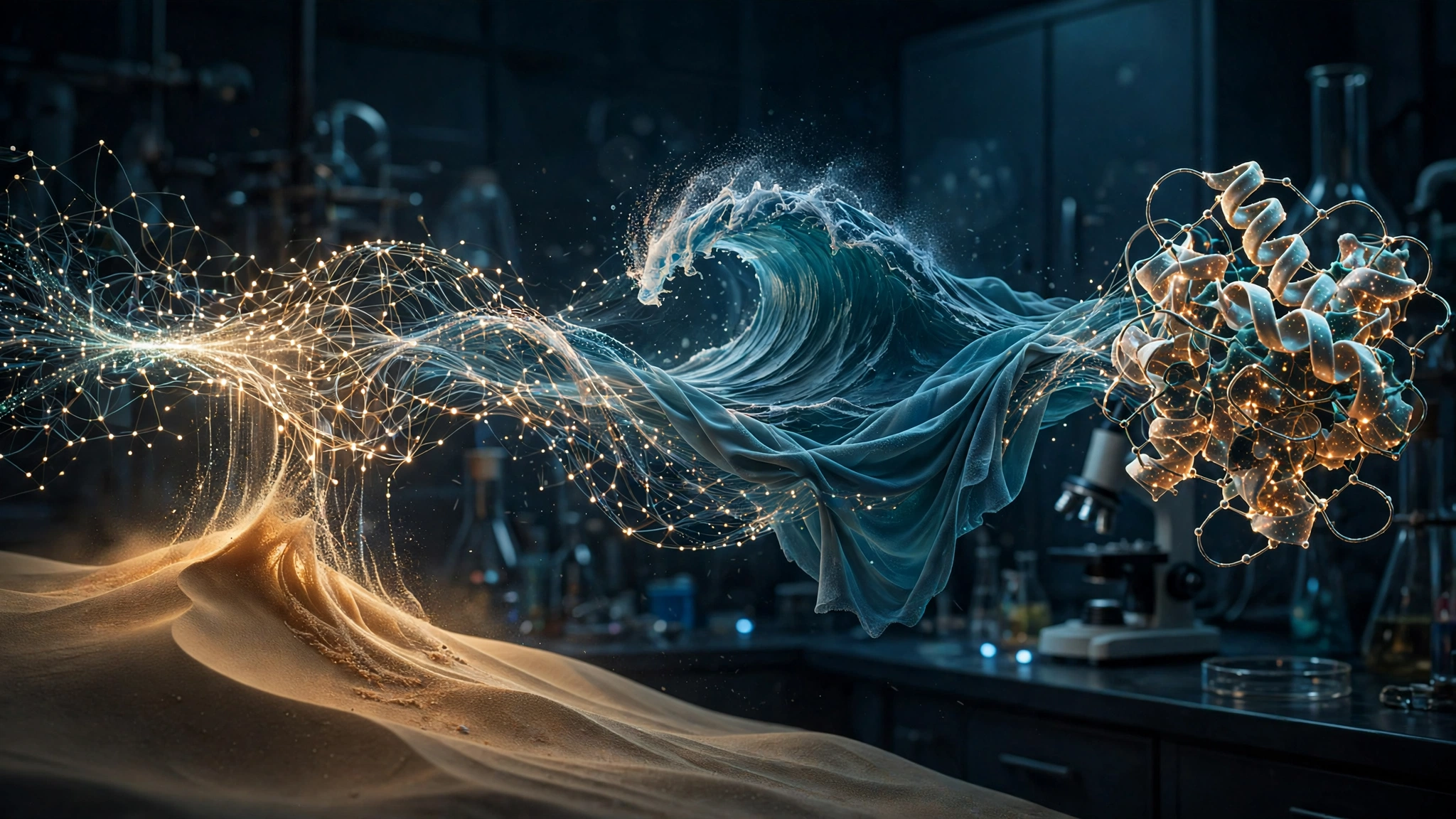
Researchers at MIT and the University of British Columbia have built a single artificial intelligence system that can simulate six very different kinds of physical behaviour, from sand sliding into a pile to a protein folding inside a cell. The system, called WorldParticle, was announced on November 9, and the team behind it says it could be a first step toward a general-purpose simulator for science.
Today, scientists who want to model a physical process usually have to build a dedicated simulator for it. Fluids need one solver, deformable solids another, proteins yet another. Each one is coded from scratch around the governing equations of that material. WorldParticle replaces that patchwork with one transformer-based architecture that learns how matter moves, rather than being handed the equations in advance.
Everything becomes particles
The trick is to treat every material the same way. WorldParticle breaks an object into thousands or millions of tiny three-dimensional dots, or particles, using what is known as a Lagrangian representation. It then tracks the position and velocity of those particles over space and time, predicting where each one will move next.
The architecture is deliberately familiar. As co-corresponding author Peter Yichen Chen, a former MIT postdoc who is now an assistant professor at the University of British Columbia, puts it: it is a similar architecture to ChatGPT, except that instead of predicting one word at a time, the model predicts how particles move, one step at a time, in one-second increments.
Before each step, the system separates out the external forces acting on the material, such as the impulse of an ocean wave slamming into a seawall, then folds those forces back into the simulation to correct its predictions. That separation is what lets the model generalise to materials, forces and environments it never saw during training.
Beating the specialist simulators
The team tested WorldParticle on six physical phenomena, including deformable objects, granular materials, fluids, cloth and proteins, and reported higher accuracy than existing numerical simulation methods across all six. In one example, the model correctly showed a granular object collapsing into a pile, while some baseline methods left sand particles floating in the air. It also modelled protein motion about 100 times faster than numerical simulators.
Handling millions of particles is computationally demanding, so the researchers added a merging technique that compresses particles while preserving fine-grained detail. Even so, the work has limits the team is open about: a separate set of parameters is trained for each category of phenomenon, so a single shared model that handles everything at once is still future work, and the unified model trades some per-phenomenon accuracy against specialist solvers.
A GPT moment for simulation
The researchers, led by Chen and co-corresponding and co-lead author Minghao Guo, an MIT postdoc, alongside co-lead authors Caoliwen Wang and Siyuan Chen and MIT professor Wojciech Matusik of CSAIL, see the system as the start of something bigger. Their stated vision is a foundation model that works out of the box for any scenario a scientist wants to simulate, a goal Chen describes as a GPT moment for simulation.
The paper, published in ACM Transactions on Graphics, will be presented at the SIGGRAPH Asia conference. The team says the framework could eventually be applied to soft robots, RNA evolution and astrophysical events such as merging galaxies. For now it is a research system, but it points at a future in which one model, rather than dozens of hand-built solvers, does the heavy lifting for physics.