By Hamza Faisal
Meta has opened up about the machine that trained its latest frontier AI: Prometheus, a gigawatt-scale supercluster in New Albany, Ohio, now running hundreds of thousands of GPUs and engineered to grow to roughly one million, all functioning in lockstep. In a detailed engineering post published October 19, four Meta infrastructure engineers confirmed the first phase of the project is complete — and it was used to train the Muse family of foundational models, including the Muse Wonder frontier models Meta says deliver state-of-the-art performance on personal and professional agentic tasks.
From web traffic to an AI factory
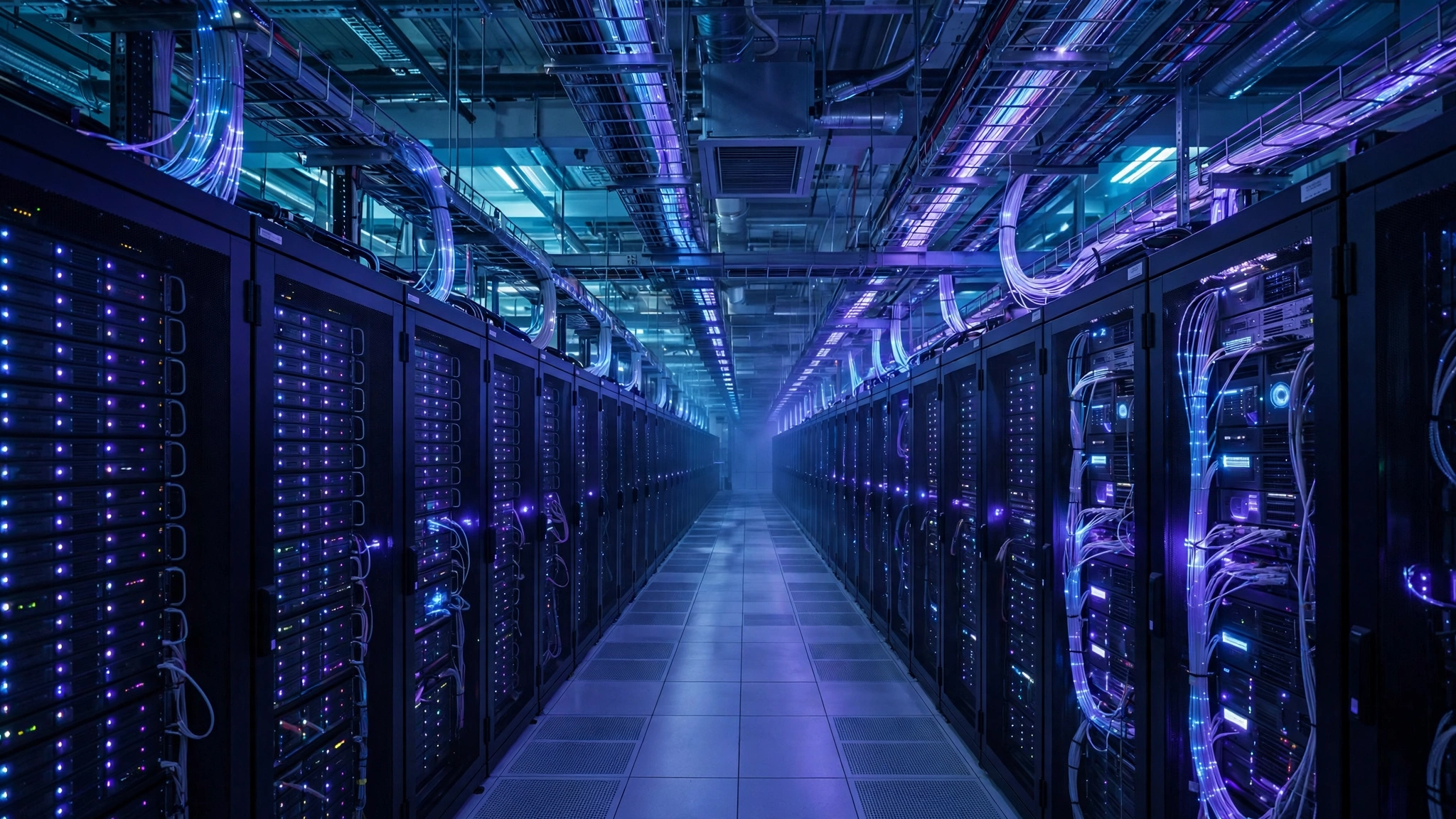
Just two years ago, the New Albany site was a conventional data center serving web traffic. Today, Prometheus spans hundreds of thousands of GPUs across older halls, a new AI-optimized building, quick-build rapid-deployment structures and capacity leased from partners, all stitched together by miles of fiber. At full scale it will hold "roughly 1 million distributed GPUs, all functioning in lockstep," Meta says. The Backend Aggregation network linking the buildings stretches from 2 km to over 100 km — a range so wide that Meta had to tune its training software around the speed of light itself. The cluster counts millions of miles of fiber strand, tens of thousands of switches and millions of optical parts.
Two Nvidia platforms carry most of the weight today: Catalina, a two-rack GB200 NVL72 configuration with 13.4 TB of HBM3e memory, and Clemente, a single-rack GB300 NVL72 with 20.7 TB of HBM3e and over one exaFLOP of peak FP4 compute. A third platform built on Nvidia's Vera Rubin NVL72 is arriving soon, expected to improve performance per watt by 10 to 20 percent over GB300 systems. Closed-loop liquid cooling keeps the dense racks running efficiently.
Taming the 9x fault blast radius
The bigger the rack, the bigger the blast radius. Moving from NVL8 to NVL72 increased the fault blast radius ninefold, so Meta runs a 64-GPU slice per 72-GPU rack and holds the remaining eight GPUs as immediate in-rack spares — 37,656 provisioned GPUs, about 13 percent over-provisioning, to sustain a 32,768-GPU run. During Muse Wonder training, Meta logged over 85 percent goodput in pre-training and over 90 percent in reinforcement learning, with a wall-clock mean time between interruptions of roughly 47,000 GPU hours — later pushed past 54,000 hours through fleet-wide firmware and hardware fixes. The team says it cut daily interruptions by 99 percent from a mid-2025 peak of nearly 1,000 events per 8,000 GPUs, using hardware screening, spare GPUs, checkpointing and automated fault recovery.
What comes next
The next stage of Prometheus, Meta says, is being built with "our next frontier models from Meta Superintelligence Labs in mind." The logic of the AI race has shifted: the winner may be whoever can wire up the most compute, most reliably. For now, that wiring lives in Ohio — and Meta is betting a gigawatt, and a million GPUs, is what it takes to stay in the game.