By Hamza Faisal
AI cloud provider Lambda has announced plans to build a $33.1 billion data centre campus in Lowndes County, Alabama, ending weeks of speculation about the company behind one of the most controversial data centre projects in the American South.
The company said on November 4 that it will serve as the end user of the Red Clay Technology Center Campus, a site near Burkville that developer Cloverleaf Infrastructure has been preparing for months. Construction is expected to begin in the first quarter of 2027 and take up to five years.
The announcement answers the question that dominated local debate since October, when the Lowndes County Commission approved development agreements for the project without naming its operator. Cloverleaf had described the end user only as a nationally recognised company, while residents pressed for details about who would run a facility of this scale in a county of 10,000 people.
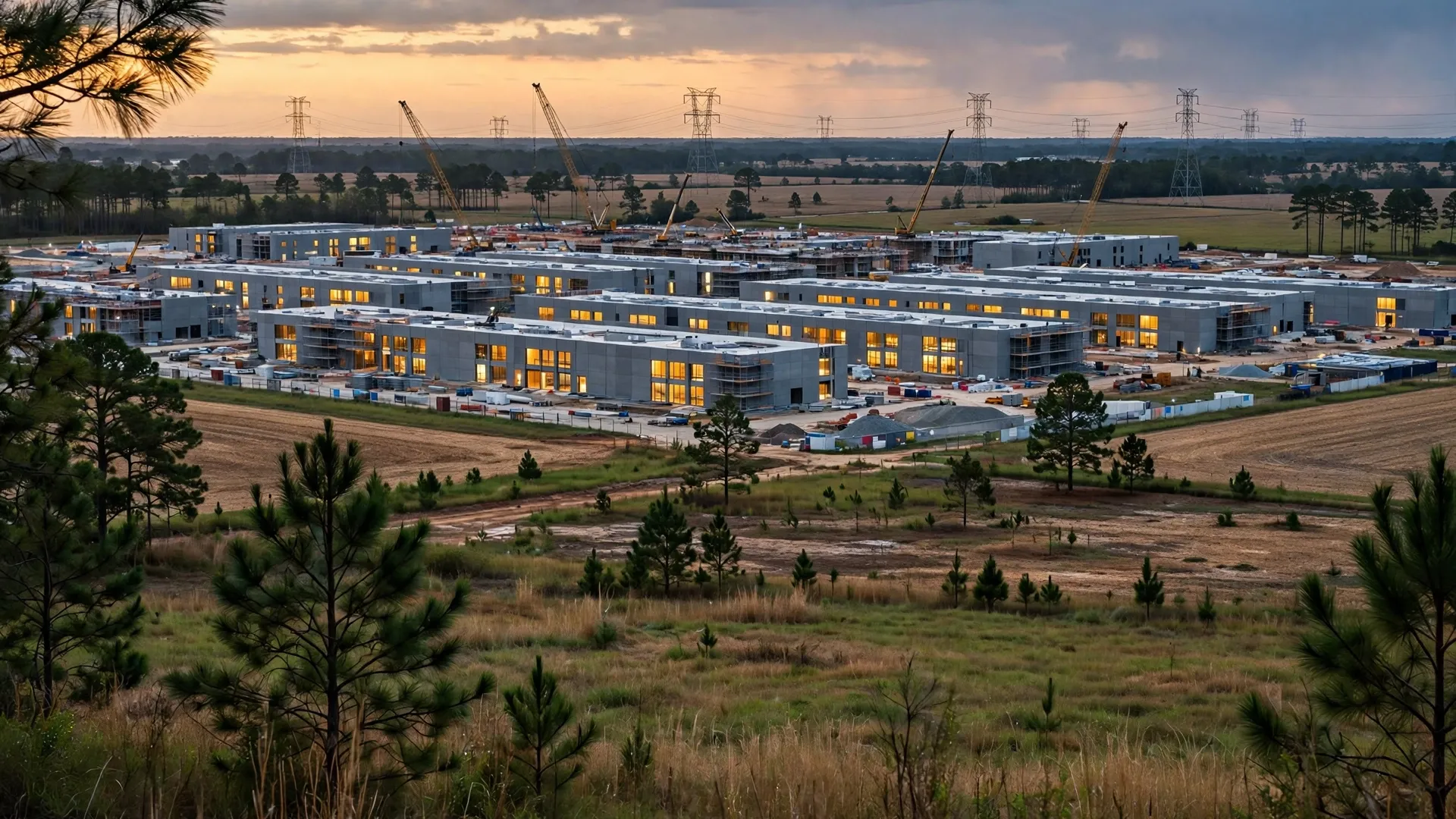
What the campus would look like
The campus is planned for a site near U.S. Highway 80 and Alabama Highway 21, capped at 2,200 acres unless the county agrees to more. Cloverleaf's October planning packet set a 1,000-megawatt base case, with potential expansion to 1,500 megawatts, and the project is expected to create more than 1,000 construction jobs and over 225 full-time operations and technical roles.
Alabama Power would supply the electricity, pending regulatory approval, and final design details are still to be developed. Lambda has committed to closed-loop water cooling technology and a $10 million community benefits agreement through the Central Alabama Community Foundation, and it has signed the White House Ratepayer Protection Pledge with Alabama Power.
The tax deal — and the backlash
The local framework was approved before Lambda's name emerged. The commission voted 3–2 on October 13 to approve the development agreements and a 20-year tax abatement, in a meeting that lasted about ten minutes and allowed no public comment.
The terms abate 50 percent of the county's non-educational property taxes, plus specified sales and use taxes on construction and server equipment, for 20 years. School taxes are not abated. Under Cloverleaf's projections, the 1,000-megawatt model would generate $2.85 billion in county revenue from taxes paid between 2027 and 2049 after abatement, including $1.61 billion for local schools, plus $0.58 billion for the state.
The value of the abatements is disputed: AL.com valued them at more than $1.1 billion, while opponents put the figure higher. The agreements also set legally enforceable standards for setbacks, noise, water use, lighting and backup generator operations. Supporters say the revenue could transform county services; critics say approval came with too little transparency.
Why Lambda, and why now
Lambda is a Nvidia-backed cloud provider that rents graphics-processor capacity to companies training AI models. In October it was reported to be raising up to $4 billion at a $14.5 billion valuation in a final private round before a planned 2027 public listing, with an order backlog of about $50 billion, including a commitment worth roughly $35 billion from a single customer, Anthropic.
Owning a campus of this size would give Lambda dedicated capacity at a moment when AI infrastructure demand is outrunning supply across the United States. The announcement also lands amid a national backlash over data centres, with voters in several states backing new curbs on their tax breaks and infrastructure costs.
For Lowndes County, the stakes are now concrete rather than hypothetical. If built as planned, the campus would be the largest economic investment in the county's history — and the test of whether a rural community can capture lasting gains from the AI boom, or simply host it.