Kazakhstan wants to build what its AI minister calls a "full-stack" artificial intelligence ecosystem — one that runs from the chips and data centres at the bottom to the satellites, startups and digital government services on top.
Deputy Prime Minister and Minister of Artificial Intelligence and Digital Development Zhaslan Madiyev laid out the ambitious roadmap on Friday on the sidelines of the AI & Digital Bridge 2026 conference in Astana.
Speaking to reporters, Madiyev said the country's approach was to encourage innovation while keeping emerging technologies inside basic ethical safeguards.
"The idea is not to over-regulate but to uphold some ethical standards," he said, stressing the need to strike a balance between regulation and innovation.
The plan sits under the country's Digital Qazaqstan strategy, which already covers infrastructure, cybersecurity, GovTech, the digital economy and AI adoption.
But the minister's framing goes further: a single national stack spanning computing infrastructure, data centres, connectivity, satellite technology, startups and digital public services.
A 1-gigawatt Data Center Valley
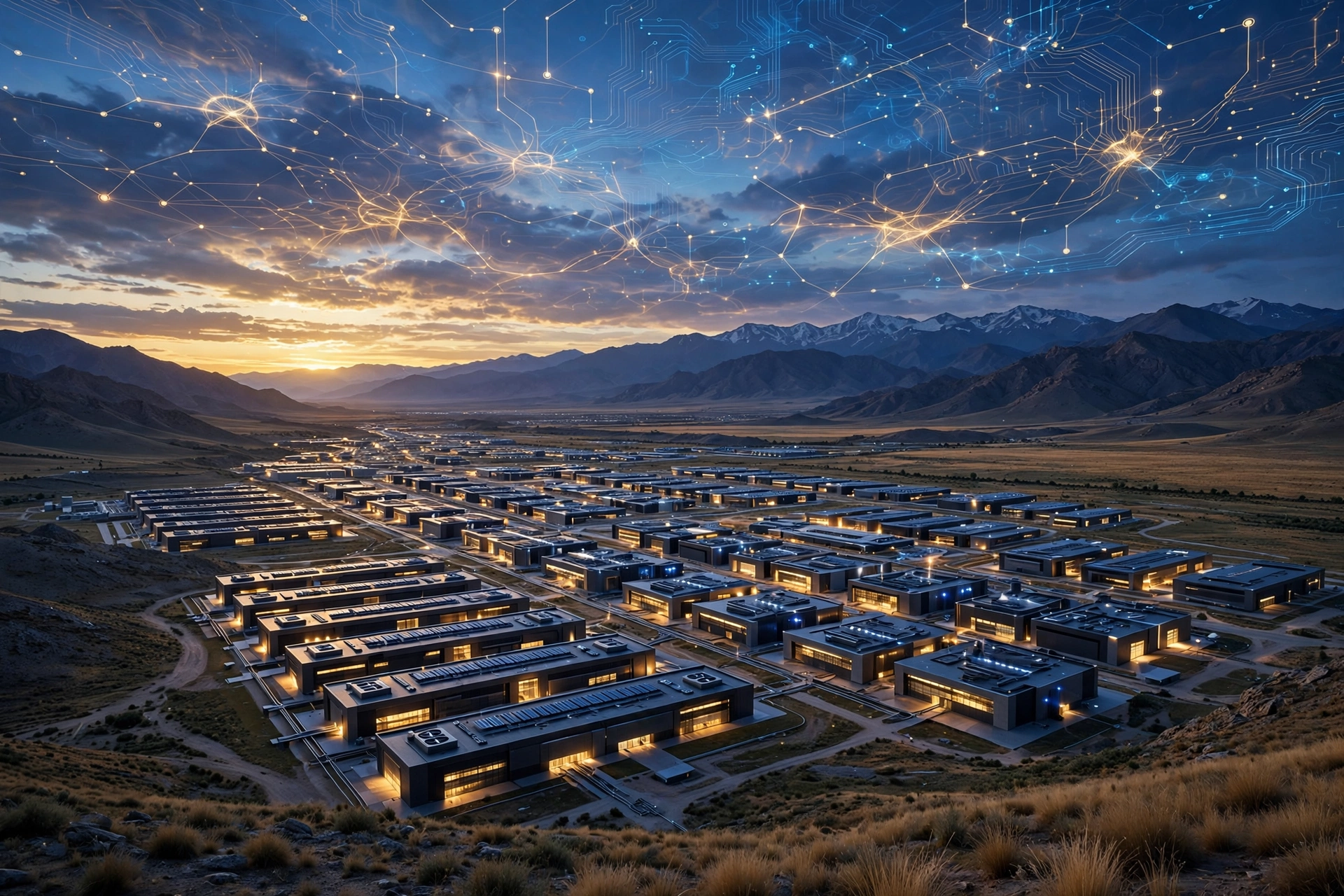
The centrepiece of the roadmap is the Data Center Valley project in Ekibastuz, where Kazakhstan is targeting at least 1 gigawatt of AI computing capacity.
The site is planned to house roughly 100,000 advanced GPUs, making it one of the largest AI infrastructure bets in Central Asia.
Kazakhstan already has a foothold to build on. The country operates two NVIDIA-powered supercomputers, Alem.Cloud and AI-Farabium, which entered the TOP500 ranking in June 2026.
The government has separately announced a $2 billion sovereign AI hub built on NVIDIA technology.
The Ekibastuz project puts Kazakhstan in direct competition with other nations racing to add gigawatt-scale AI compute.
A gigawatt of data-centre capacity can support on the order of a hundred thousand high-end accelerators, enough to train and serve large models domestically rather than renting compute abroad.
NVIDIA's Huang heads to Astana
Underscoring how seriously the country is courting the AI supply chain, NVIDIA founder and CEO Jensen Huang is set to make his first visit to Kazakhstan on October 23, the Times of Central Asia reported.
Huang will hold a fireside chat with Madiyev at the Alem.ai International Center in Astana, closing out the country's "AI Month."
The visit comes as Kazakhstan deepens its cooperation with NVIDIA, whose chips power both of the country's TOP500 supercomputers and the planned sovereign AI hub.
For a landlocked economy long known for oil and minerals, anchoring an AI build-out with the world's most valuable chipmaker is a conspicuous statement of intent.
A homegrown success story as proof
Madiyev held up Higgsfield AI, a generative AI company with Kazakh roots, as the kind of technology ecosystem Kazakhstan wants to develop.
The company has hundreds of engineers and has become one of the fastest-growing startups in the AI creative-tool space, he said, adding that Kazakhstan was seeking to build an ecosystem capable of producing — and retaining — such companies.
Higgsfield said on September 29 that it had crossed a $1 billion annualised revenue run rate, just 18 months after launching its AI-native creative suite. The company has previously raised funding at a $1.3 billion valuation.
That trajectory is the model Astana wants to repeat: local talent building global AI products, now backed by sovereign-scale compute at home.
Whether the full-stack vision delivers will depend on execution — power supply, water for cooling, chip procurement and talent retention are all hard problems.
But with the minister's roadmap, a gigawatt of planned capacity and NVIDIA's CEO landing in Astana this month, Kazakhstan has made its bet unmistakable.