By Hamza Faisal
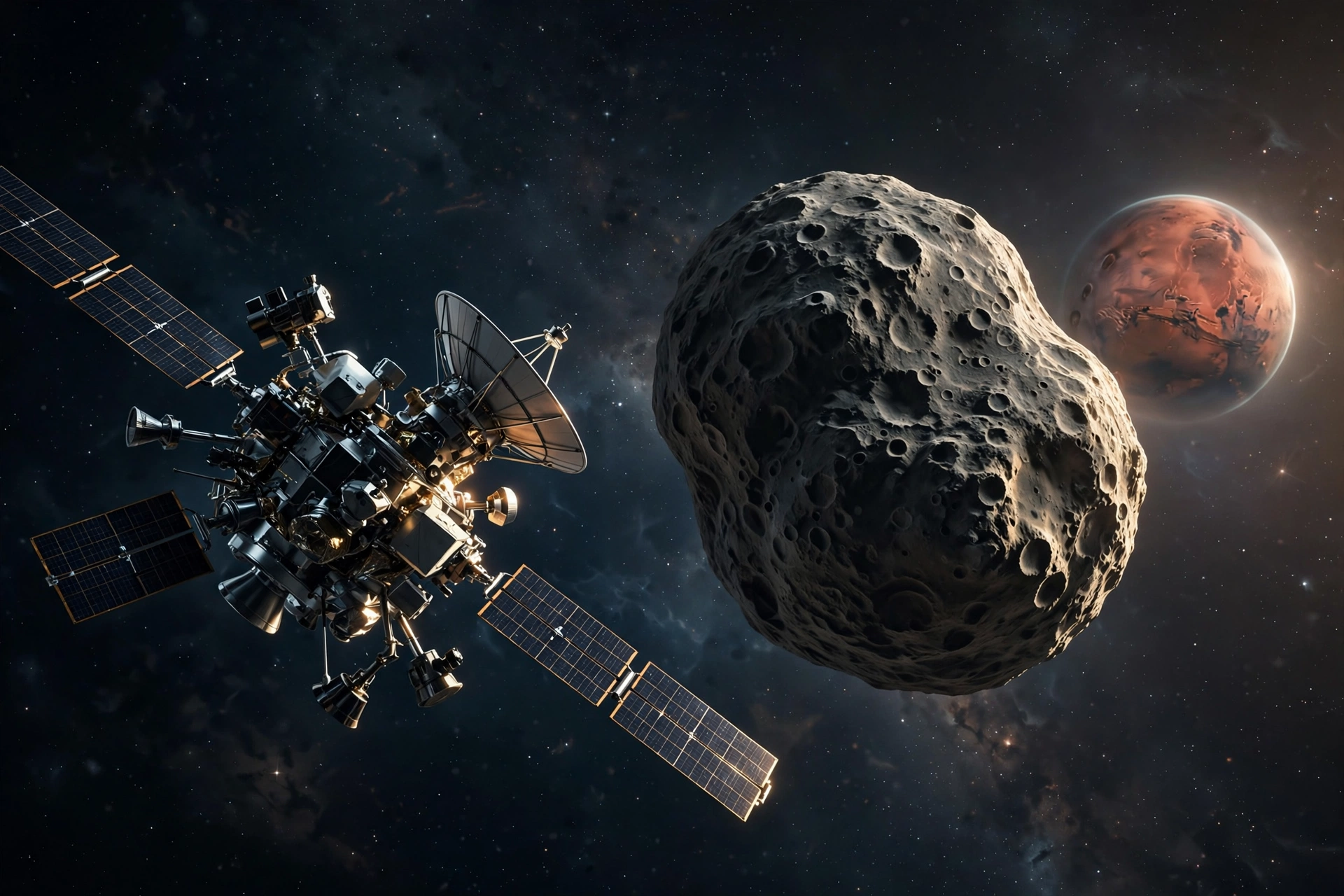
Japan is hours away from attempting something no space agency has ever done: launching a round-trip mission to the moons of Mars and bringing a piece of one back to Earth. The Martian Moons eXploration (MMX) probe is set to blast off aboard a flagship H3 rocket from the Tanegashima Space Center on October 20 at 4:41am local time — 19:41 GMT on October 19 — bound for Phobos, the larger of Mars' two moons.
If the mission succeeds, it will achieve the first-ever return of material from the Martian system to Earth, with the sample capsule due to land in Australia in 2031. The Japan Aerospace Exploration Agency (JAXA) unveiled the completed spacecraft at Tanegashima on October 19, ahead of liftoff.
The solar system's biggest mystery moon
Phobos is a lumpy, potato-shaped moon barely 22 kilometres across — one of the least explored bodies in the solar system. The 4,480-kilogram MMX spacecraft carries eleven science instruments and a small French-German rover called IDEFIX, named after Asterix's dog, which will survey Phobos' rocky surface to identify a safe landing site before the main craft descends.
Once landed, MMX will use two independent sampling systems to collect at least 10 grams of surface material: a coring device on a robotic arm that digs beneath the surface, and a NASA-supplied pneumatic sampler that fires pressurized gas to loft grains into a collection container. The spacecraft is expected to reach the Martian system around August 2027, orbit Phobos for up to three years, and also observe Deimos, Mars' smaller moon, before beginning the long journey home.
Why Phobos matters
Scientists have argued for more than a century over where Phobos and Deimos came from. They may be asteroids captured by Mars' gravity, or debris flung into orbit by a giant impact with the planet. Its dark, asteroid-like appearance clashes with its nearly circular orbit around Mars' equator — a puzzle that samples analysed in Earth laboratories could finally settle.
The material may also preserve evidence of how water, volatile substances and organic compounds reached the inner solar system, potentially contributing to the conditions that made life possible on rocky planets. Laboratory analysis can run isotopic measurements that are impossible from orbit.
A dress rehearsal for Mars
JAXA says the mission will also explore using Phobos as a "natural space station", establishing the requirements for a full round trip to Mars — something the agency calls essential for eventual crewed exploration. "The sampling from Phobos is of course the world's first, but this is the first round trip to the Martian system," said MMX project manager Yasuhiro Kawakatsu.
The mission draws on Japan's asteroid sample-return experience with Hayabusa and Hayabusa2, with partners including NASA, ESA, France's CNES and Germany's DLR contributing instruments and expertise. "There hasn't yet been a successful mission to go to Phobos and bring a bit back to Earth. I think this is an incredibly ambitious and fun mission," said Professor Sara Russell of London's Natural History Museum, deputy for MMX sample analysis.
By Hamza Faisal