The company also said it is on a path to operating breakeven as it carries production-bound automotive programs toward the start of production — a milestone the company frames as evidence of the capital efficiency of its software-first approach.
Beyond the car: mining rigs and robots
The real signal in the announcement is expansion.
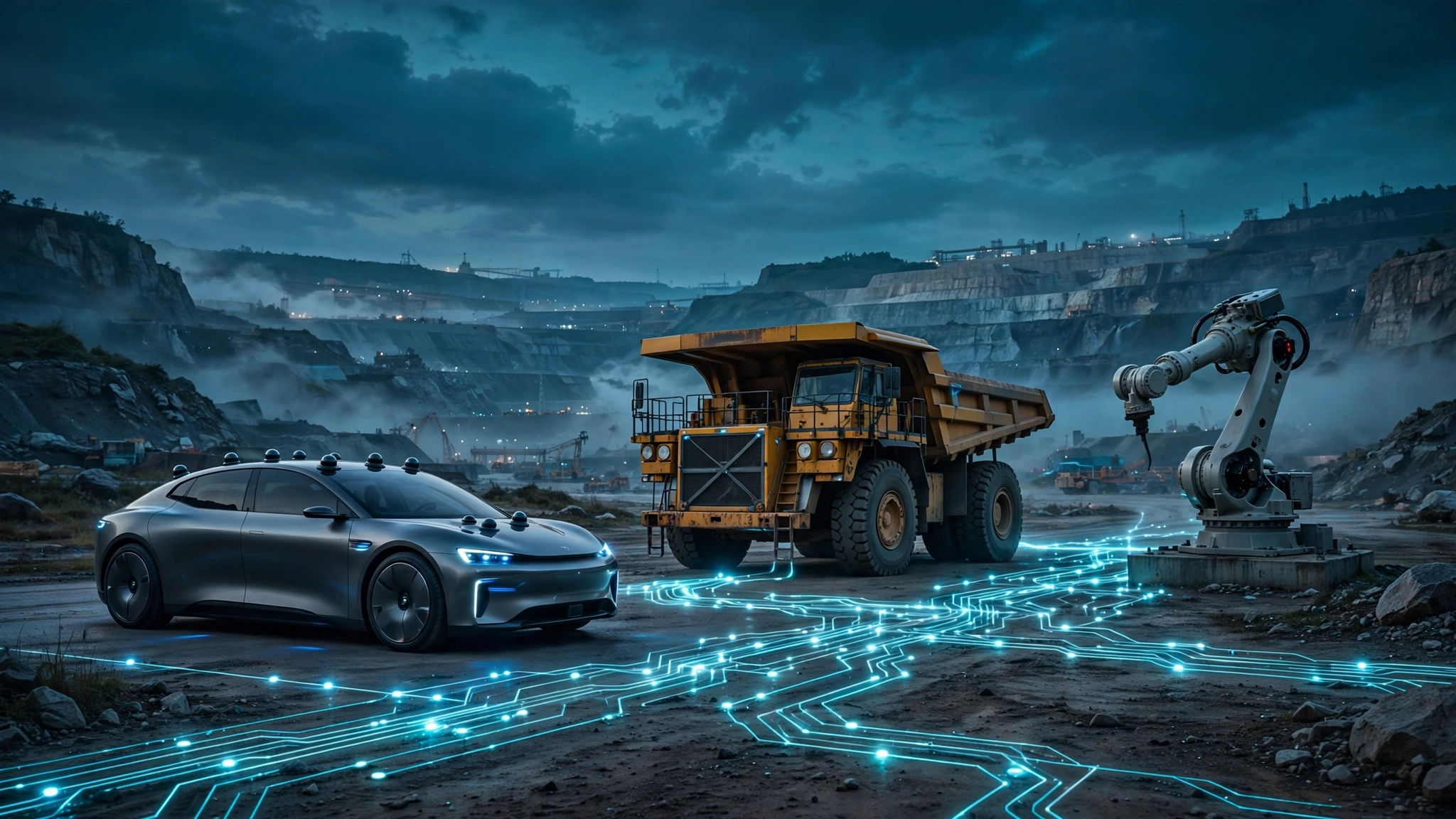
Helm.ai's software already spans SAE Level 2 through Level 4 autonomous-vehicle programs, but its production-track deployments now extend well beyond the road: perception for heavy industrial equipment in open-pit mining, partnerships with customers in construction, and expanding robotics development.
The company says its foundation models learn the structure of the physical world rather than the particulars of any one machine, so the same core intelligence transfers across embodiments — passenger vehicles, industrial machines, and robotics platforms — all built on one model lineage, one training infrastructure, and one validation stack.
In its telling, every deployment strengthens the platform that serves the next one.
Deep Teaching and the road to breakeven
At the heart of Helm.ai's pitch is Deep Teaching, an unsupervised training methodology the company says lets its models learn from a fraction of the data rivals need, generalize to environments they have never encountered, and deploy within the compute constraints of real-world physical systems.
The autonomy industry's dominant approaches, the company argues, carry structural costs that compound with scale: fleet-heavy data collection, monolithic end-to-end models with soaring compute requirements, and premium in-vehicle silicon.
Speaking to The Robot Report, founder and CEO Vladislav Voroninski said projects reaching this level of maturity show "real demand for the technology that we've built" and that it is "clearly crossing that threshold into actually being deployed in the real world."
He added that being on a path to breakeven "is rare in this space," calling it a testament to the capital efficiency of the company's approach.
Physical AI's commercial moment
The announcement lands as physical AI moves from demos to deployment. Helm.ai positions itself as foundational infrastructure — converting autonomy from a capital problem into a software licensing decision.
Its commercial partners already span perception, full-stack autonomous driving, automated data labeling, and generative simulation, and its vehicle programs are in deep integration with next-generation vehicle architectures ahead of start of production.
For automakers and industrial customers alike, the bet is that software that learns the structure of the physical world can transfer far more cheaply than systems trained one machine at a time.
Whether $70 million in signed contracts turns into durable, recurring revenue will be the real test — but for a company founded in 2016 in one of autonomy's toughest capital cycles, the milestone is hard to ignore.
By Hamza Faisal