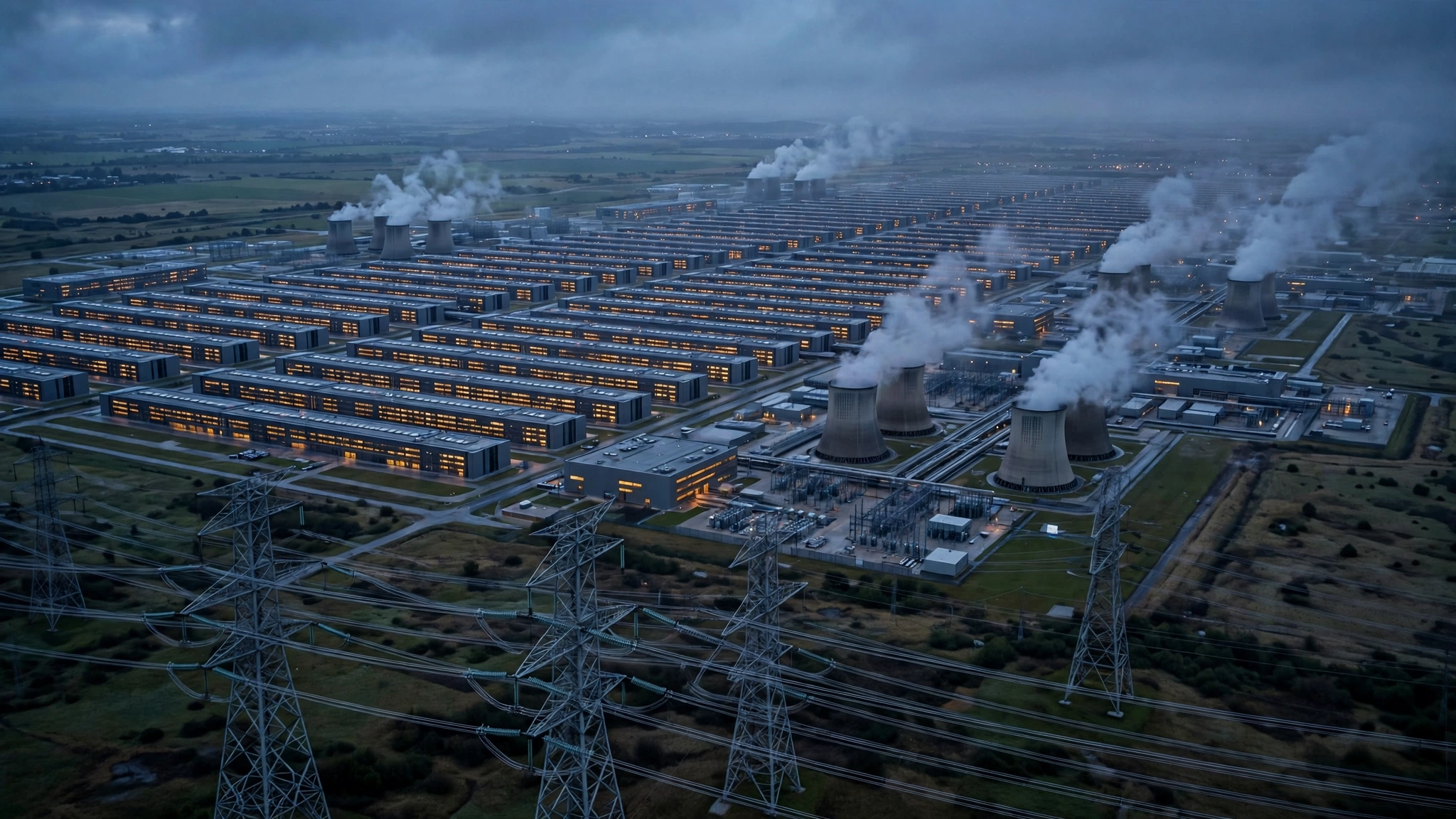
America's largest data centres — the warehouse-sized buildings that power cloud computing and the artificial intelligence boom — draw most of their electricity from fossil fuels, according to a new Harvard-led study published on November 16 in the journal Nature Sustainability.
The researchers, from the Harvard T.H. Chan School of Public Health and the Harvard Data Science Initiative, identified 403 hyperscale data centres across the United States using satellite imagery and commercial databases, then estimated each facility's electricity use between May 2024 and April 2025. Their central estimate: the buildings used about 82 terawatt-hours of electricity in a year — roughly 1.8 percent of all electricity consumed in the United States.
As much power as whole states
Depending on how hard the facilities were running, total use ranged from 68 to 99 terawatt-hours. At the top end, that approaches the annual electricity use of entire states such as Indiana, Michigan and Tennessee. Just four states — Virginia, Oregon, Ohio and Iowa — accounted for more than half of the electricity use studied.
The team started with 675 possible hyperscale sites, but could only verify enough detail — building characteristics and electrical capacity — for 403 of them. The other 272 sites were left out, so the true total is almost certainly higher.
More than half the power came from fossil fuels
Of the electricity attributed to the 403 facilities, 53.9 percent was generated from fossil fuels: 38.2 percent from natural gas and 15.2 percent from coal. The associated carbon dioxide emissions came to about 25.7 million metric tons in a year — within a range of 21 to 31 million tons — two to three times the last peer-reviewed estimate, from 2018. That is roughly as much carbon dioxide as a country the size of Denmark produces in a year.
About a quarter of the electricity was drawn from grid regions dirtier than the national average. The authors are careful about what the numbers do and do not show: they are model estimates, not readings from facility meters, because operators do not publish detailed energy data. And the study could not separate electricity used for AI-specialised work from general-purpose cloud computing.
The numbers are already out of date
The study period ended in April 2025, and the buildout has only accelerated since. Lead author Gianluca Guidi said the reported electricity use and carbon footprint "could already be substantially larger now in 2026". Senior author Francesca Dominici, director of the Harvard Data Science Initiative, said the lack of reliable facility-level data was the biggest obstacle when the research began.
The figures also sit apart from the industry's own claims: renewable-energy purchases and net-zero pledges are not part of the study's physical grid accounting, which counts what regional grids actually burned to supply the power. The researchers say they plan to investigate the health effects of data-centre emissions next. For now, the study offers the first facility-level picture of what the AI era's physical footprint actually looks like — and it is bigger, and dirtier, than the last official estimate suggested.


