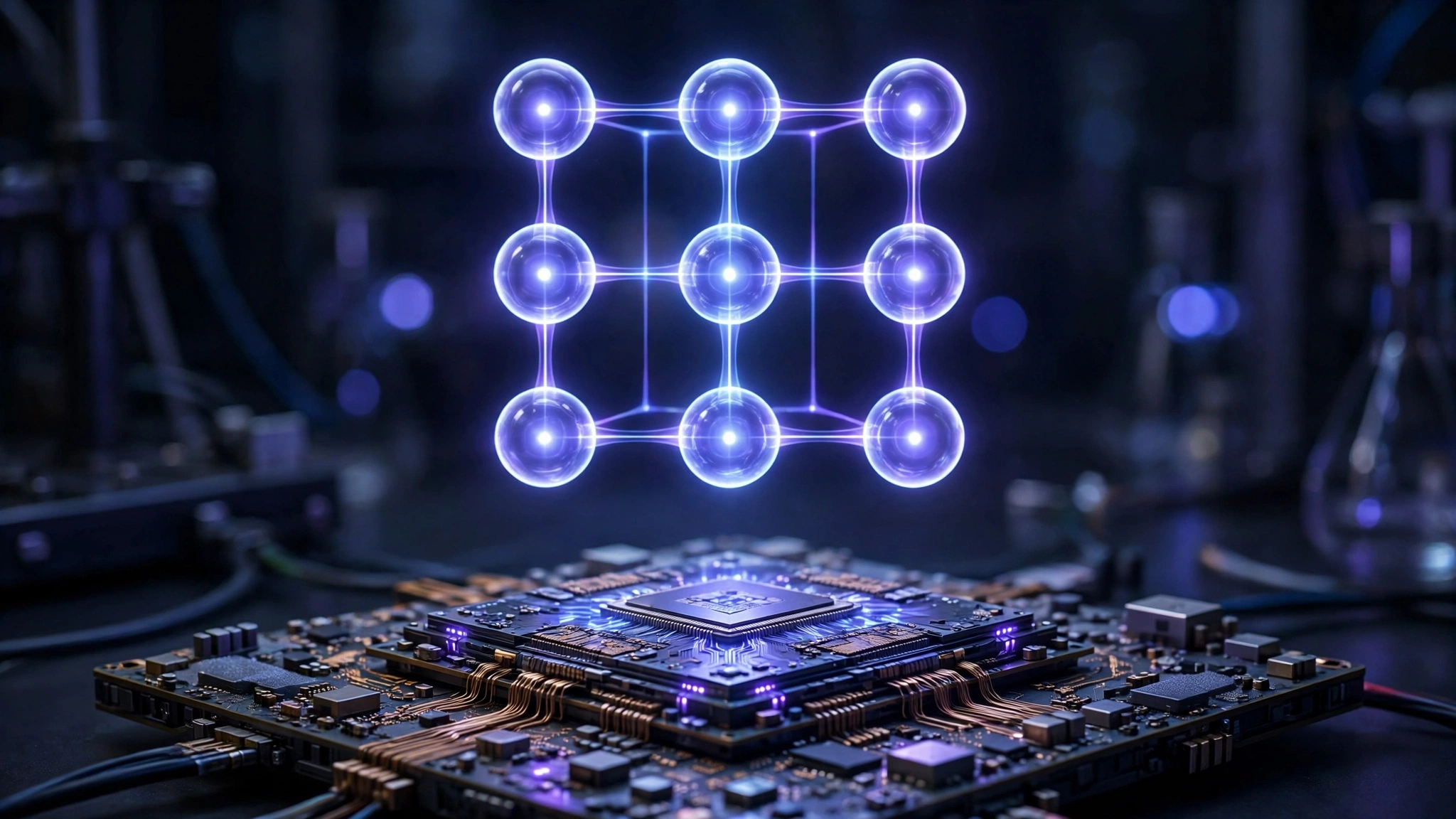
Google's Willow quantum processor has beaten a game that classical logic says it should not be able to win as often as it did. In a study published on the cover of Science on November 19, researchers at Google Quantum AI showed that Willow won the so-called magic square game 98.3 percent of the time, clearing the 88.9 percent ceiling that limits any strategy written down in advance.
The experiment is a demonstration of quantum contextuality, the strange property that the result of measuring a quantum system can depend on which other measurements are made alongside it. While entanglement usually gets the credit for quantum computing's power, Google's team argues that contextuality may be the deeper resource behind certain algorithms, and that it can now be put to work at scale.
A game classical logic cannot win
The Mermin-Peres magic square asks two players to fill a 3-by-3 grid with plus-ones and minus-ones so that every row multiplies to plus one and every column to minus one, with the two players agreeing on the value where their row and column cross, without communicating. No such grid exists, so any pre-agreed classical strategy wins at most eight of nine rounds, or 88.89 percent.
Willow played the game using four qubits holding two entangled pairs. Across 900,000 rounds, it won 98.3 percent of the time, losing roughly once in every 60 rounds. The remaining losses came from residual noise in the hardware, not from the rules of the game: a perfect quantum machine would win every round.
The team also measured contextuality directly with a Bell-Kochen-Specker test, scoring 5.59 against a classical limit of 4 and a quantum maximum of 6.
Scaling up to 105 qubits
Google did not stop at four qubits. The researchers extended the tests to multiplayer games involving up to 71 qubits and ran a hidden linear function problem across all 105 qubits of a Willow processor, beating classical strategies with limited resources at every scale. Google describes the result as the first unconditional quantum advantage for a restricted class of circuits.
The claim comes with a caveat. Independent analysis notes that the 105-qubit comparison rests on a conjecture, and the proven classical lower bound for the hidden linear function problem only becomes relevant at around a million qubits. The magic square result, by contrast, is a direct experimental measurement, not a conjecture.
A sharper ruler for quantum hardware
Perhaps the most practical outcome is a new way to measure quantum machines. The contextuality tasks catch subtle hardware errors that standard random-circuit benchmarks miss, giving engineers a sharper ruler for building better processors. Google chief executive Sundar Pichai highlighted the results in a post on X, noting the 98.3 percent win rate, the 5.59 contextuality score and the 105-qubit run.
Willow itself is a 105-qubit superconducting processor that Google first announced in December 2024. The new study does not prove that quantum computers beat classical ones in general, and the researchers are careful to frame it as a benchmark rather than a practical application. But it does show that one of quantum mechanics' strangest properties survives at the scale of a real processor, and that it can be measured, repeated and used to judge the hardware itself.


