By Hamza Faisal
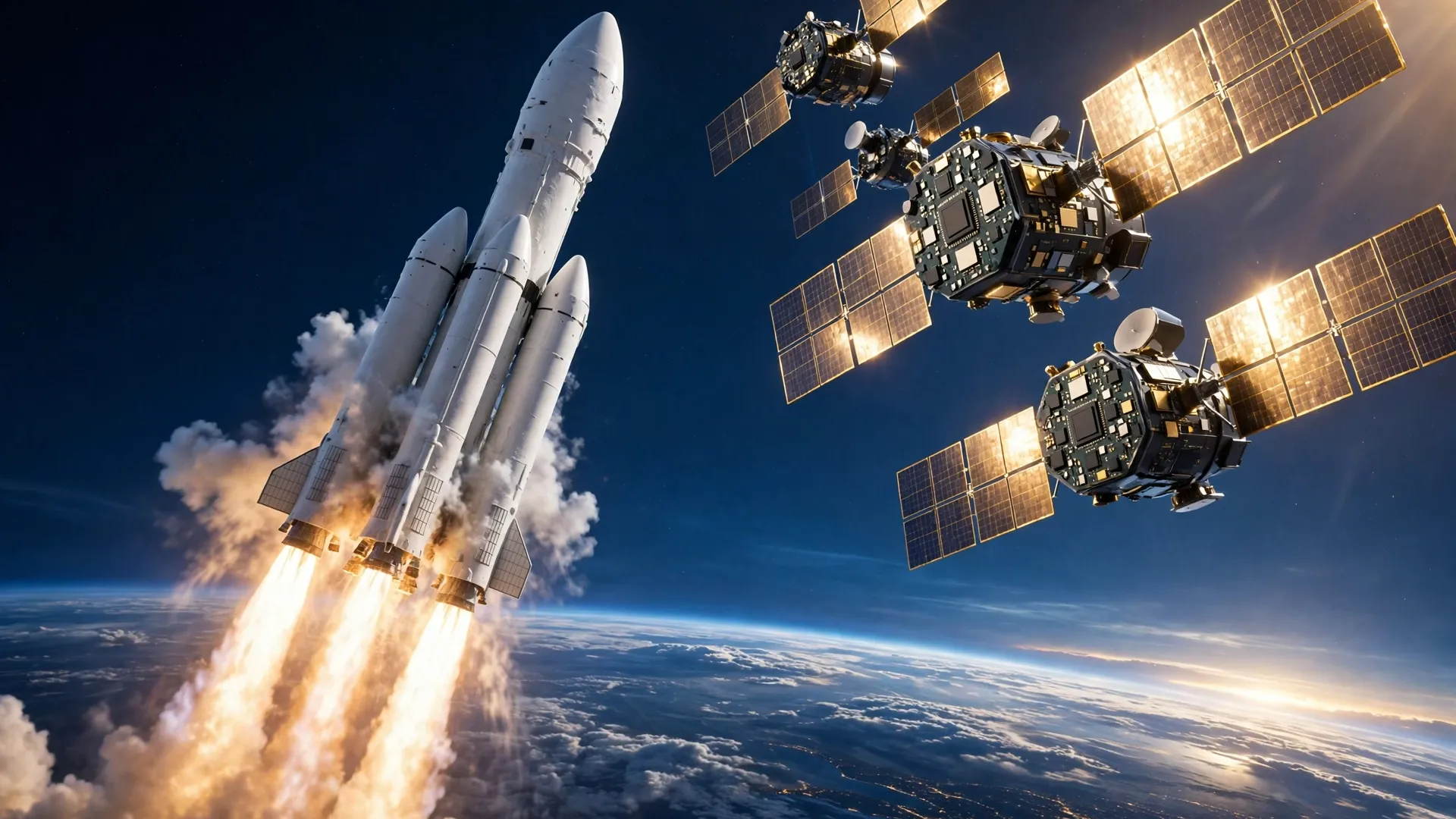
Google is taking its AI chips to space — and it has hired Jeff Bezos' Blue Origin to get them there. The two companies announced on Thursday that Blue Origin's New Glenn rocket will carry the first dedicated heavy-lift mission for Project Suncatcher, Google's experiment in running machine-learning workloads on solar-powered satellites, with the launch targeted for the first quarter of 2029.
The mission will deploy several computing satellites into sun-synchronous orbit, each carrying Google's Tensor Processing Units — the in-house chips that power its AI systems. Each satellite will hold computing capacity roughly equal to one rack of servers in a conventional data centre, according to Blue Origin. Neither company disclosed the value of the launch services agreement, or how many satellites the flight will carry.
Why Google wants its data centres in orbit
Project Suncatcher is Google's long-term research bet that the hardest part of scaling AI is not the chips, but the power and cooling to run them. A satellite in orbit gets near-constant sunlight, so the idea is to run compute where solar energy is abundant and free, easing the pressure on electricity grids, land and water that giant ground-based data centres now demand.
The project took its first step into orbit on October 1, when a refrigerator-sized prototype satellite — carrying four TPUs and powered by solar panels supplying about one kilowatt — launched aboard a SpaceX rideshare mission with Planet Labs as partner. Google has said the prototype is operating as expected after establishing contact. The public roadmap now calls for two satellites talking to each other over laser links in 2027, followed by the multi-satellite deployment on New Glenn in 2029.
A big vote of confidence for New Glenn
For Blue Origin, the deal is a major future mission for a rocket that has had a difficult year. A test explosion at its Cape Canaveral launchpad in May, tied to a BE-4 engine valve, damaged the pad and pushed New Glenn's next flight to January 2027. Google is now the only hyperscaler with a signed launch contract for AI compute in orbit, and the win gives Blue Origin a flagship customer as it works to build a regular launch cadence.
"Project Suncatcher represents the ambitious missions New Glenn was built to support," said Jordan Charles, Blue Origin's senior vice president of New Glenn, pointing to the rocket's heavy-lift capacity and seven-metre payload fairing, which can lift 45 metric tons to low Earth orbit. Travis Beals, Google's senior director of Project Suncatcher, called the dedicated launch a milestone for the project.
The cost question is still open
For all the ambition, Suncatcher remains firmly in the research phase. A paper published in the journal Joule modelled the cost of power in orbit at roughly $14,700 per kilowatt-year at today's launch prices, against $570 to $3,000 for a data centre on the ground. Google has not announced any timeline for a fully operational constellation beyond the 2029 flight, and the mission's real test will be whether satellites can stay linked and keep computing reliably in orbit.
Still, the direction of travel is clear. SpaceX and other launch providers are already competing for orbital infrastructure work, and Google has now put a date on the calendar. If the 2029 mission works, the next question will not be whether AI can run in space — it will be how much of it belongs there.


