By Hamza Faisal
Google DeepMind has unveiled Gemini Robotics 2.5, its most capable robot-brain model yet — and the first real-world test put a humanoid to work on a live car production line. Apptronik's Apollo 2 humanoid, running the new model, sorted automotive parts on active Mercedes-Benz lines in Hungary and Germany with a 96% success rate, a result DeepMind says points toward robots leaving the lab for everyday workplaces.
Gemini Robotics 2.5 is a vision-language-action model, the kind of AI that connects what a robot sees and hears to the movements it makes. DeepMind announced the model on November 10, calling it its most capable vision-language-action system to date, and says it is now rolling out to its robotics partners.
A humanoid on the factory floor
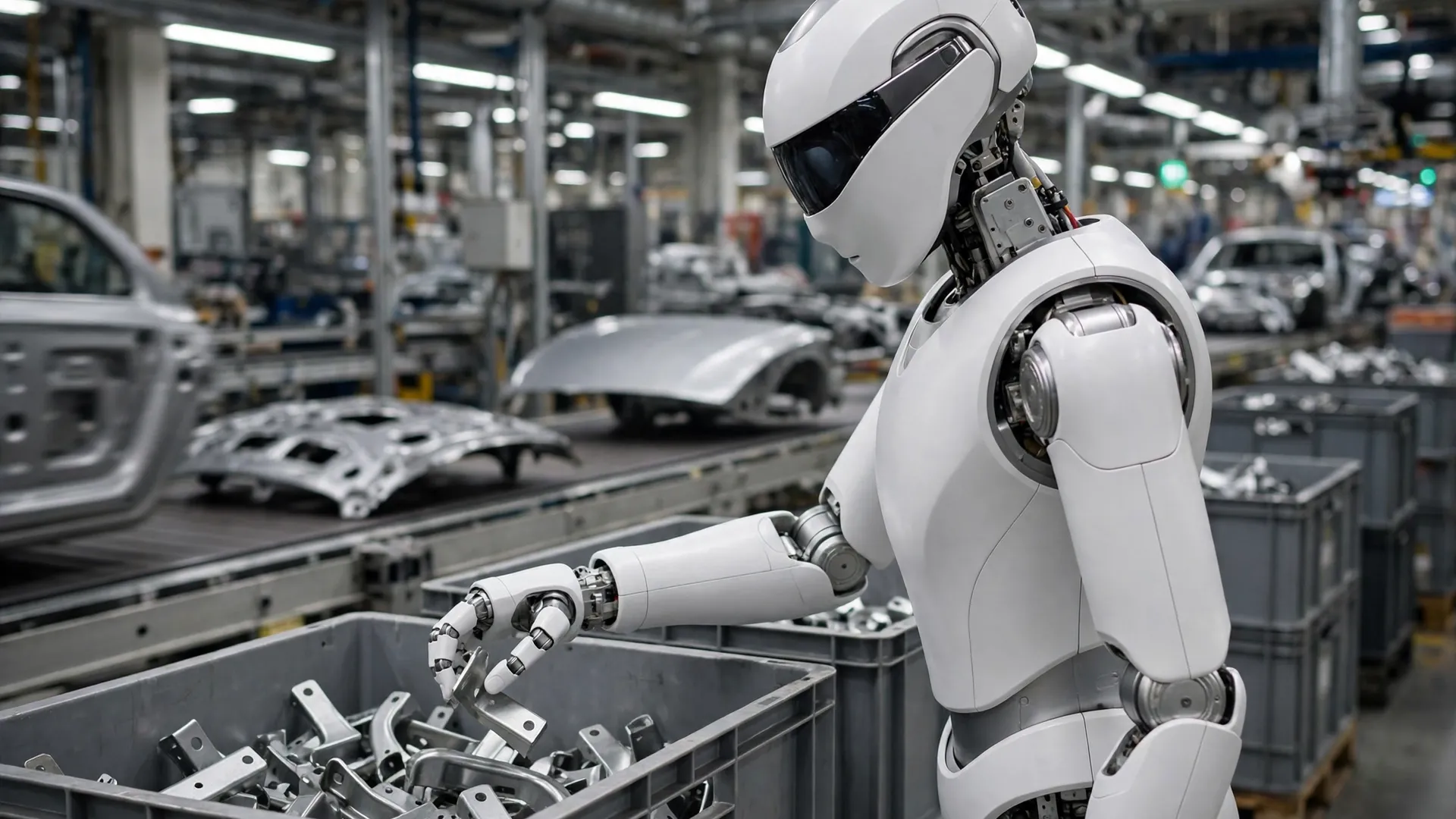
The Mercedes-Benz proof of concept is the headline result. At plants in Kecskemet, Hungary, and Sindelfingen, Germany, Apollo 2 robots performed automotive kitting — the repetitive, physically taxing job of sorting individual metal brackets from bulk bins into trays in the exact order each vehicle on the line needs. Two models worked as a pair: Gemini Robotics ER, an embodied-reasoning model, tracked the workflow, while Gemini Robotics 2.5 controlled the robot's hands and arms, reaching into bins, picking up parts and placing them into sequencing containers while correcting for gaps.
The 96% success rate matters because the work happened on live production lines, not in a controlled lab. Apptronik chief executive Jeff Cardenas said the models improved dramatically in just a few weeks of post-training and carried over to Mercedes-Benz production with very little drop-off. DeepMind stressed the pilot is a proof of concept, and neither company has said whether the humanoids will stay on the lines permanently.
Faster to learn, steadier around people
Beyond the factory, DeepMind tested Gemini Robotics 2.5 across more than 200 distinct tasks, from serving food with tongs and tying a bow on a gift box to pipetting liquid. Compared with earlier baselines, the model achieved a 30% to 100% higher success rate depending on the task type, while completing tasks 20% to 30% faster. The model works across different robot bodies, including Apollo 2 with its five-finger, 22-degree-of-freedom SharpaWave hand and the Franka Duo platform with two-fingered grippers.
Part of the speed-up comes from Gemini 4 Argon, Google's frontier model, which acted as a simulation engine during development — generating thousands of varied simulated practice runs from a real camera scene and building digital twins, so robots could generalise to new scenes and objects faster. DeepMind says Argon also helps researchers diagnose failures from video footage and test fixes in simulation before trying them on real robots.
Safety, tested against jailbreaks
As robots move into messy, everyday spaces, DeepMind has put safety at the centre of the release. Gemini Robotics 2.5 uses inference-time reasoning guidance to steer around physical hazards in real time. In DeepMind's evaluations, that guidance boosted safe task completion by 33% around obstacles and 43% around nearby people.
The lab is also releasing ASIMOV-Jailbreak, a new open-source benchmark containing hundreds of prompts that disguise unsafe requests across dozens of scenes, to test whether robots can be tricked into dangerous actions. Gemini 4 Argon scored 99.5% jailbreak resistance on the benchmark, up from 82% for the previous baseline. All of these are DeepMind's own results, and no independent evaluation has been published yet — but an open benchmark gives other researchers a way to check how safe these machines are before they start working alongside people. For now, Gemini Robotics 2.5 is available only to DeepMind's robotics partners, with no public API or wider rollout announced.


