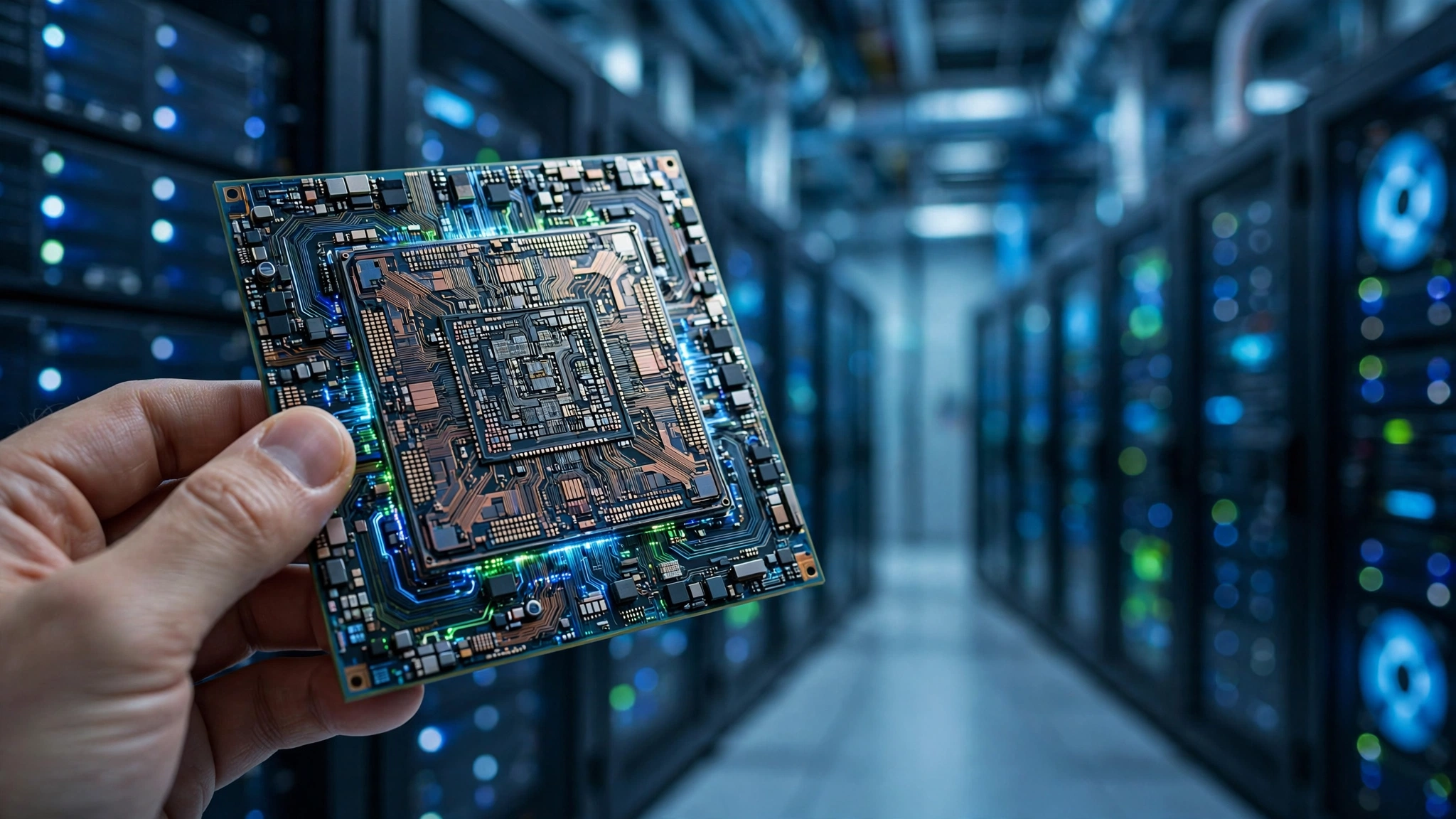
Google has added two new systems to its eighth-generation TPU lineup, the TPU 8tx and the TPU 8i Max, in a direct challenge to Nvidia's dominance of the AI hardware market. The company announced the additions on Monday, November 9, in a blog post by Amin Vahdat, Google's chief technologist for AI and infrastructure.
The two systems are not brand-new chips. They repackage the silicon Google introduced in April — the TPU 8t for large-scale training and the TPU 8i for real-time reasoning — into configurations built for two specific jobs customers keep asking for: keeping sensitive data safe while it is processed, and running AI workloads that need enormous context windows.
One system locks data down, the other doubles the memory
TPU 8tx is built for confidential computing. It uses the same silicon as the training-focused TPU 8t, but pairs it with fifth-generation AMD EPYC processor hosts and the low-latency Boardfly network Google developed for real-time reasoning. Google says the system delivers up to twice the latency performance of TPU 8t, with almost no offsetting performance loss.
The target customer is clear: governments and regulated enterprises running frontier or proprietary models and autonomous agents alongside sensitive data. The hardware is designed to keep data and model weights isolated even while computation is running — closing the gap in conventional encryption, where information is protected at rest and in transit but must be decrypted in memory to be used.
The same system can also handle small-scale training, so teams can fine-tune models on private data and train agents through reinforcement learning without moving private information between separate clusters.
TPU 8i Max tackles a different bottleneck: memory. It packs two TPU 8i chips into a single package, delivering double the compute, double the on-chip SRAM, and double the high-bandwidth memory bandwidth of a single TPU 8i — all within the existing rack footprint.
That matters for workloads where dozens of AI agents work across an entire software codebase or hours of video at once, turning memory bandwidth into the limiting factor. Google points to drug discovery, mathematics, and programming as the use cases that benefit most.
Four TPU systems in a single year
Google says 2026 is the first year it has introduced four TPU systems. The company now counts nearly 100 TPU customers across frontier AI labs, trading firms, retailers, and universities. Reported customers include Oracle, Anthropic, and OpenAI.
The underlying TPU 8i pairs 288 GB of high-bandwidth memory with 384 MB of on-chip SRAM, the baseline that the 8i Max doubles. Google's argument is that its modular AI Hypercomputer approach — treating TPUs as building blocks whose memory, networking, packaging, and security can be adjusted — lets engineers deliver specialized supercomputers in months rather than the years a new chip design would take.
The Nvidia rivalry, by specialization
Bloomberg framed the launch as an escalation of Google's rivalry with Nvidia, whose GPUs still power most AI training. Google's bet is that specialization, not raw scale, is where it can win: confidential inference for regulated industries on one side, and massive-context workloads on the other.
Both new systems are due next year, according to Bloomberg, and Google has not given prices or a date when customers can start using them. Alphabet shares rose about 3 percent in premarket trading on Monday after the announcement.
The launch also lands on a bruising day for Nvidia, whose shares fell after its board opened an independent investigation into reports that chief executive Jensen Huang was targeted by a Chinese spy effort.


