French robotics startup Genesis AI has raised $500 million in a Series A funding round that values the company at $3.5 billion, the company announced on Tuesday, in one of the largest financings ever for a European robotics startup.
The round was co-led by Premji Invest, Khosla Ventures and Eclipse, and drew backing from former Google chief executive Eric Schmidt, French tech entrepreneur Xavier Niel, Nvidia, AMD Ventures, Samsung Next, Ericsson and French state-backed investor Bpifrance. The funding brings Genesis AI's total disclosed capital to $605 million since its founding in 2024, following a $105 million seed round in July 2025.
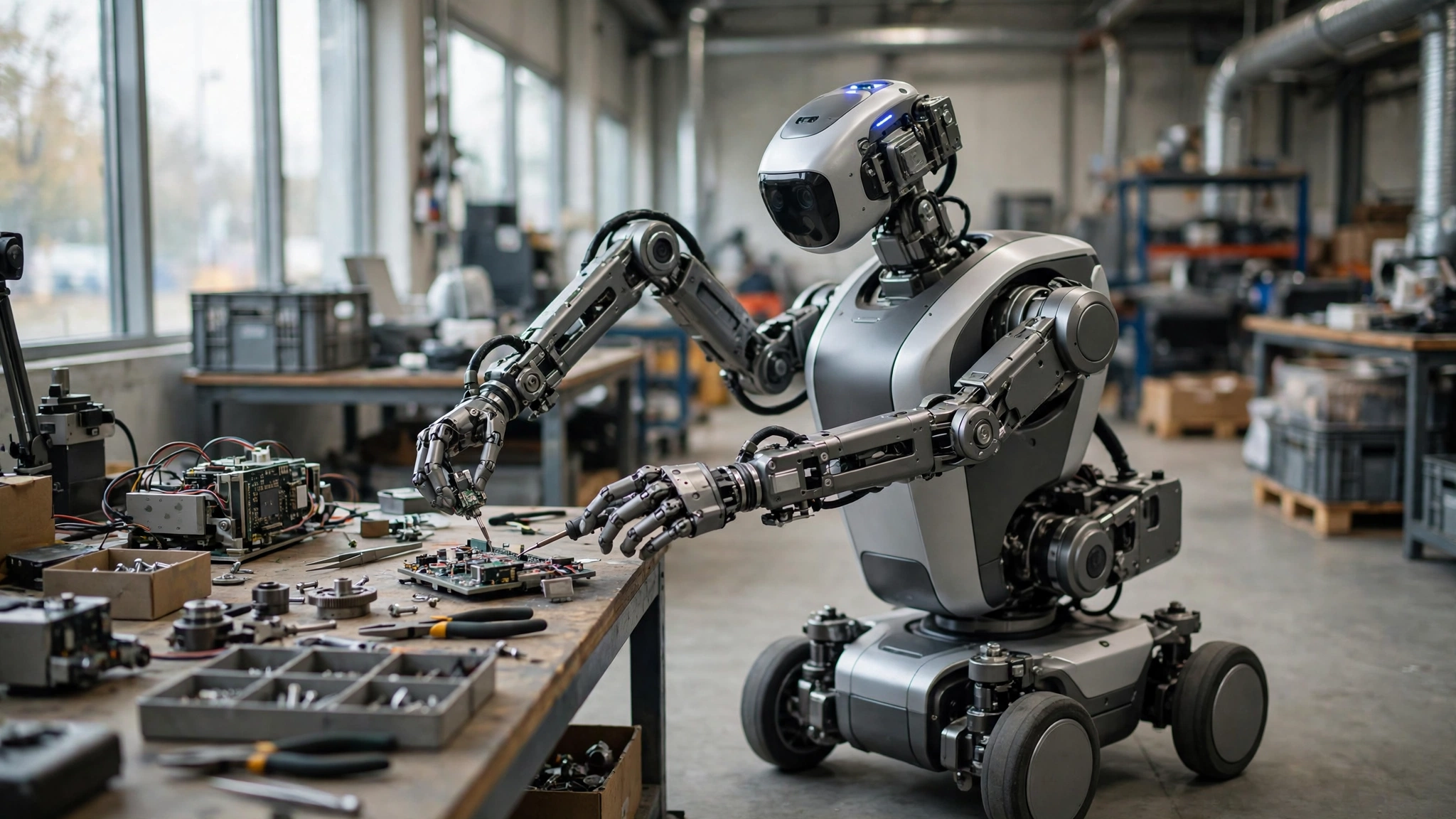
Genesis AI, based in Paris and San Carlos, California, is building Eno, a general-purpose robot designed to work in factories, warehouses and laboratories. Unlike the two-legged humanoids that dominate robotics headlines, Eno moves on a wheeled base, with three body segments mounted on a rotating platform and two articulated arms ending in dexterous hands.
A robot trained by human hands
Each of Eno's hands has 20 actuated degrees of freedom, close to the dexterity of a human hand, and the company says the robot is built to handle equipment designed for people. Genesis AI trains its GENE foundation model inside a proprietary simulation platform, Genesis World, and collects real-world training data from workers wearing sensor gloves and cameras as they perform routine tasks on the job.
The company has built between 30 and 40 Eno units so far and is piloting the robot with a small number of unnamed customers. Mass production is slated to begin in 2027 through a US contract manufacturer, with a wider customer rollout expected the same year.
Chief executive and co-founder Zhou Xian said the new funding will go toward increasing production of Eno, expanding data collection and AI training, and improving the robot's ability to manipulate objects with its hands. The company also plans to hire more AI researchers, robotics experts and engineers.
Europe's robotics bet
Genesis AI was co-founded by Zhou and Théophile Gervet, a former researcher at French AI lab Mistral AI. It is part of a growing group of Europe-based robotics companies valued at more than $1 billion, as investors bet that AI-enabled robots will move from research labs into real factories.
The round comes as physical AI — robots powered by large AI models — draws some of the biggest checks in venture capital. Investors are wagering that general-purpose robots can take on the dull, repetitive and physically demanding work that has resisted automation, from moving materials in warehouses to handling instruments in laboratories.
Genesis AI has not disclosed its revenue, unit pricing or paying customer count, and the $3.5 billion valuation reflects investor expectations rather than current sales. For now, the test is whether Eno can move from a few dozen pilot units to a production line — and whether hands that learned from human workers can keep up on a factory floor.
By Hamza Faisal