The startup says the robot is already operating in real-world environments after about a year of field testing. Its early customers work in manufacturing and food service, with the company's machines reportedly cooking in restaurants in Japan and cleaning science laboratories. Revenue has already crossed $1 million, according to the company.
"You can't buy a Tesla robot today and develop on top of it," co-founder and CEO Hoa Duc Mai told TechCrunch, drawing a sharp line between Feather's approach and that of the biggest humanoid players.
A platform, not a product
Unlike Tesla and Figure, which are building both robot hardware and the foundational AI models meant to control it, Feather sells only the hardware and developer tools.
Customers bring their own intelligence: the platform supports outside robotics AI models rather than locking developers into a single stack, and Feather names Nvidia, Skild and Physical Intelligence among the model providers its hardware can work with.
Co-founder Mai arrived at Feather after co-founding humanoid robotics startup Kind Humanoid, which was acquired by 1X in early 2025.
His co-founder, Chief Product Officer Parsa Bakhtiari, previously worked as a Tesla Model 3 engineer and at one point reported directly to Elon Musk. The pair founded Feather in 2025 with the stated ambition of building the "Android of the robotics industry."
Hardware developers can reconfigure
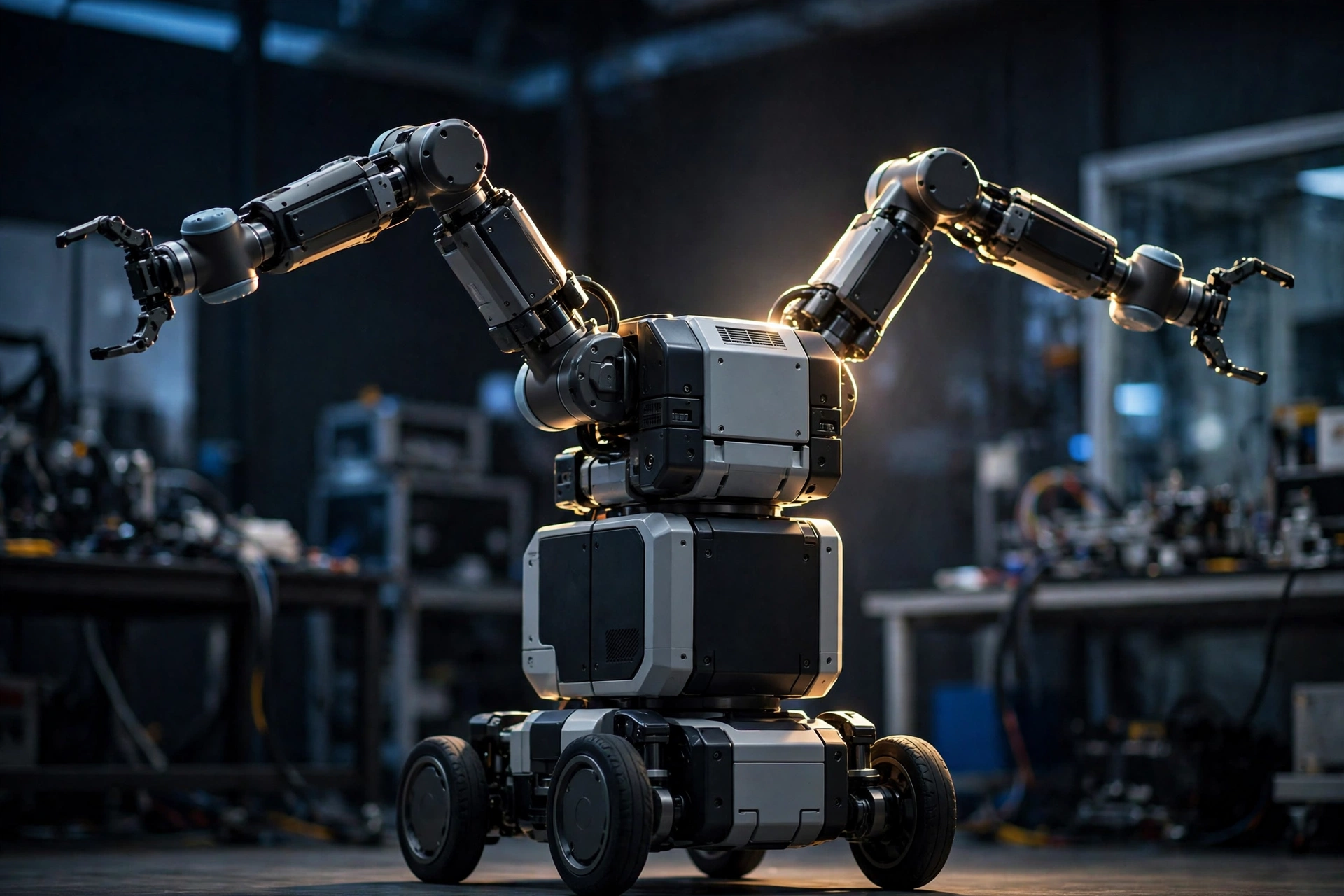
The robot itself is a roughly adult-sized bimanual mobile manipulator: two seven-degree-of-freedom arms mounted on an adjustable torso over an omnidirectional wheeled base.
It offers about a metre of reach, 600 mm of vertical travel and hot-swappable batteries, and developers can modify arm configurations, compute, cameras and end effectors for different applications.
Onboard compute can be configured with Nvidia Jetson modules, and the software side ships with an open SDK supporting Python and ROS 2. The platform is available to order online, and the company says it is designed for production rather than research-lab duty.
Betting on the physical-AI boom
Feather has raised $7.6 million in pre-seed funding led by Gradient Ventures, and the company says a larger product launch is being prepared now that field testing has resolved most early problems.
The startup's bet is that physical-AI companies would rather buy a shared robot platform than build their own hardware, a middle path between expensive closed systems and research hardware that needs heavy engineering before it can do useful work.
Customer names, deployment counts and independent reliability data remain undisclosed, but with a $30,000 price tag sitting well below many competing humanoid platforms, Feather is pitching developers a practical on-ramp into physical AI. Whether the platform becomes robotics' Android moment will depend on what those developers build on top of it.