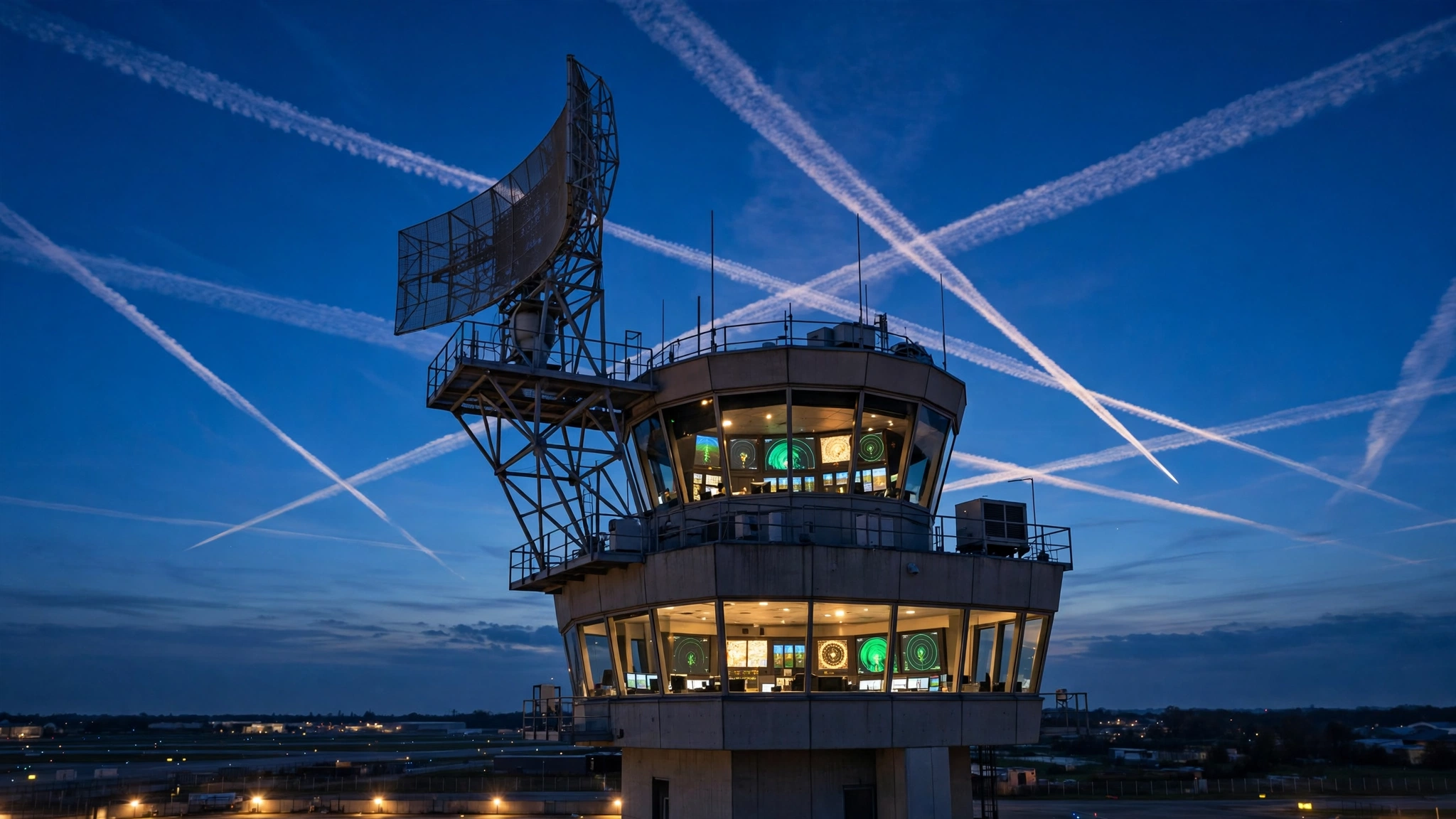
Three days before every departing flight in the United States was grounded, the Federal Aviation Administration finished switching on a new artificial intelligence system across all 22 of its air route traffic control centres.
The system is called SMART — Strategic Management of Airspace, Routes and Trajectories — built by Boston startup Air Space Intelligence under a 12-year, $875 million contract. The FAA announced the nationwide expansion on November 10.
On Friday, November 13, communications failures hit multiple air route centres and the FAA ordered a nationwide ground stop — only the third in US history. More than 11,000 flights were affected before airspace reopened at 8:15 p.m. Eastern, four hours later.
The timing raises an obvious question: did the new AI system have anything to do with the shutdown? The builder and the transport secretary say no — but the controllers' union says it was never consulted, and more than two dozen lawmakers had already asked the FAA to pause the rollout.
What SMART actually does
SMART is a cloud-based planning platform, not an autopilot. It pulls in roughly 200 live data streams — weather, flight paths, traffic, airport capacity and staffing — and predicts where congestion will build.
It then suggests reroutes, departure times and arrival sequences, which FAA specialists review before passing on to controllers. Local controllers keep the final say: they can accept or reject any suggestion, and SMART cannot take control of an aircraft or replace a controller.
SMART first went live in the Washington area on September 21, then extended to Atlanta, Jacksonville and Miami. In that pilot the agency says it helped reroute 180 flights, saving about 10 minutes and nearly 80 gallons of fuel per flight.
On November 10 that coverage extended to all 22 centres — effectively the whole country.
Three days, then a nationwide halt
The ground stop was blamed on ageing communications infrastructure, not the new system. Transportation Secretary Sean Duffy said outdated switches, routers and copper lines in an old time-division multiplexing system were overwhelmed by data, and he repeated his call for Congress to approve $50 billion to replace it.
On Saturday, Duffy blamed a router installed during a contractor's copper-to-fibre upgrade at a remote FAA facility — installer error or a faulty router, he said. FAA Administrator Bryan Bedford said there was no evidence of anything nefarious or AI-related.
Air Space Intelligence moved quickly to distance its product from the outage. 'The current ground stop is not based on or a result of the SMART system, any product of ASI or our integration with FAA and ATC,' the company said in a post on X while the stop was still in force.
Homeland Security Secretary Markwayne Mullin was more cautious, saying officials were still investigating whether a cyberattack or artificial intelligence played a role — no indication of a malicious attack, but nothing ruled out.
Controllers were never consulted
The National Air Traffic Controllers Association, representing 15,000-plus professionals, objected that controllers were left out of SMART's design, testing and implementation. It has asked the Government Accountability Office to assess the system's safety risks.
More than two dozen lawmakers had already asked the FAA to pause the rollout in October, asking how the system was tested for safety and how staff were trained. The November 10 expansion notice did not answer them.
The first real test of the nationwide system comes with the Thanksgiving travel rush, its heaviest load yet. Duffy has said operations should be back to normal before then; the agency has not said whether the expansion continues at all 22 centres.


