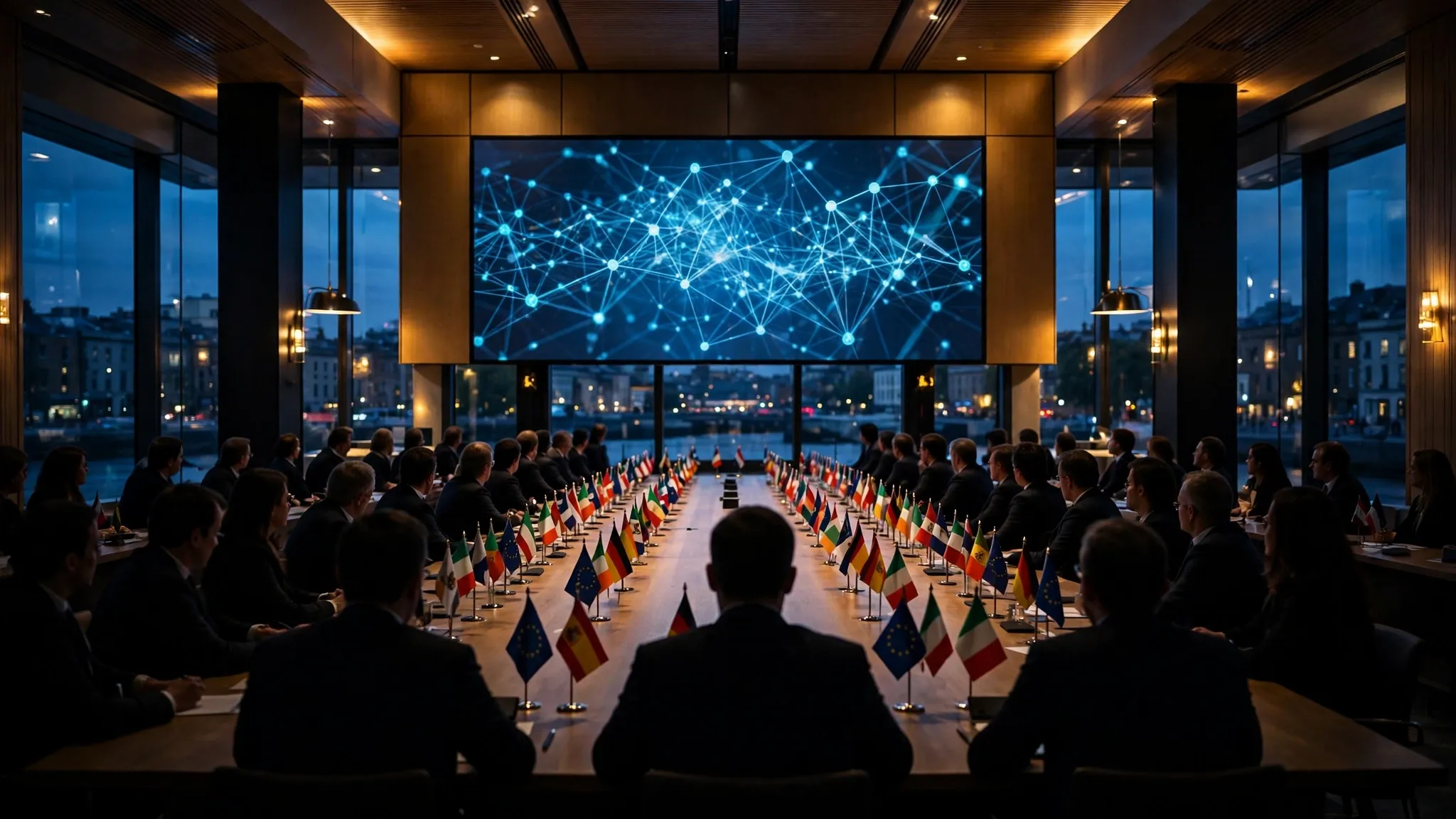
European Union leaders met in Dublin on Friday for the first dedicated discussion of artificial intelligence among the bloc's heads of state and government, a summit meant to answer an awkward question: how does the region that wrote the world's AI rulebook catch up in building the technology itself?
The informal summit, chaired by European Council President António Costa and hosted by Irish Prime Minister Micheál Martin, brought together leaders of all 27 member states at the Convention Centre Dublin. It followed the ninth European Political Community summit held at the same venue a day earlier.
Leaders were briefed by Arthur Mensch, chief executive of French AI company Mistral, on Europe's standing in the global AI race, and by Nobel laureate Geoffrey Hinton on AI safety, cybersecurity, jobs and the technology's wider impact on society. The agenda, according to the European Council, was strengthening Europe's competitiveness, cutting red tape and reducing dependence on American and Chinese technology.
A competitiveness gap, not just a rulebook
Europe's dilemma was on full display in Dublin. The bloc set the global regulatory benchmark with its AI Act, yet its industrial ambitions have struggled. Its Chips Act target of doubling Europe's share of the global semiconductor market to 20 percent by 2030 is widely seen as off track, and leaders are divided over how much to spend on computing power and AI infrastructure in the next long-term budget.
Mensch has argued that compliance obligations and bureaucracy are suffocating domestic innovation and pushing talent and intellectual property toward countries with lighter testing regimes and deeper capital markets. Hinton, by contrast, has warned for years that increasingly capable systems need stronger safety checks before deployment, and has previously put the risk of AI escaping human control at 10 to 20 percent.
The summit also took place against a turbulent backdrop for the industry. Nvidia, the company at the centre of the global AI buildout, lost its chief executive, Jensen Huang, this week amid a scandal that has rattled markets and raised questions about the leadership of the most important supplier of AI chips.
Ukraine overshadowed the agenda
The AI discussion shared the day with diplomacy. A day earlier, Ukrainian President Volodymyr Zelenskyy met US envoys Jared Kushner and Steve Witkoff at a military airbase outside Dublin, and leaders used Friday's gathering to debate Europe's role in any future peace negotiations and the security guarantees that might follow a ceasefire.
European Commission President Ursula von der Leyen told leaders the EU is preparing its 22nd sanctions package against Russia and a proposal to cover Ukraine's financial needs for 2027. A special European Council meeting on November 26-27 is set to take up Ukraine funding and the EU budget.
No decisions yet, but a first step
Friday's meeting was informal, and no formal conclusions or commitments were announced. That is the point, and the limitation, of a first leaders-level discussion: it puts AI on the agenda of the EU's most powerful table, but the hard choices on spending, regulation and compute capacity still lie ahead.
Whether Dublin marks a pivot or another declaratory exercise will become clearer at the November 26-27 council and in the months that follow, as the Commission drafts the 2028-2034 budget that will decide how much Europe is actually willing to pay to build its own AI future.
By Hamza Faisal


