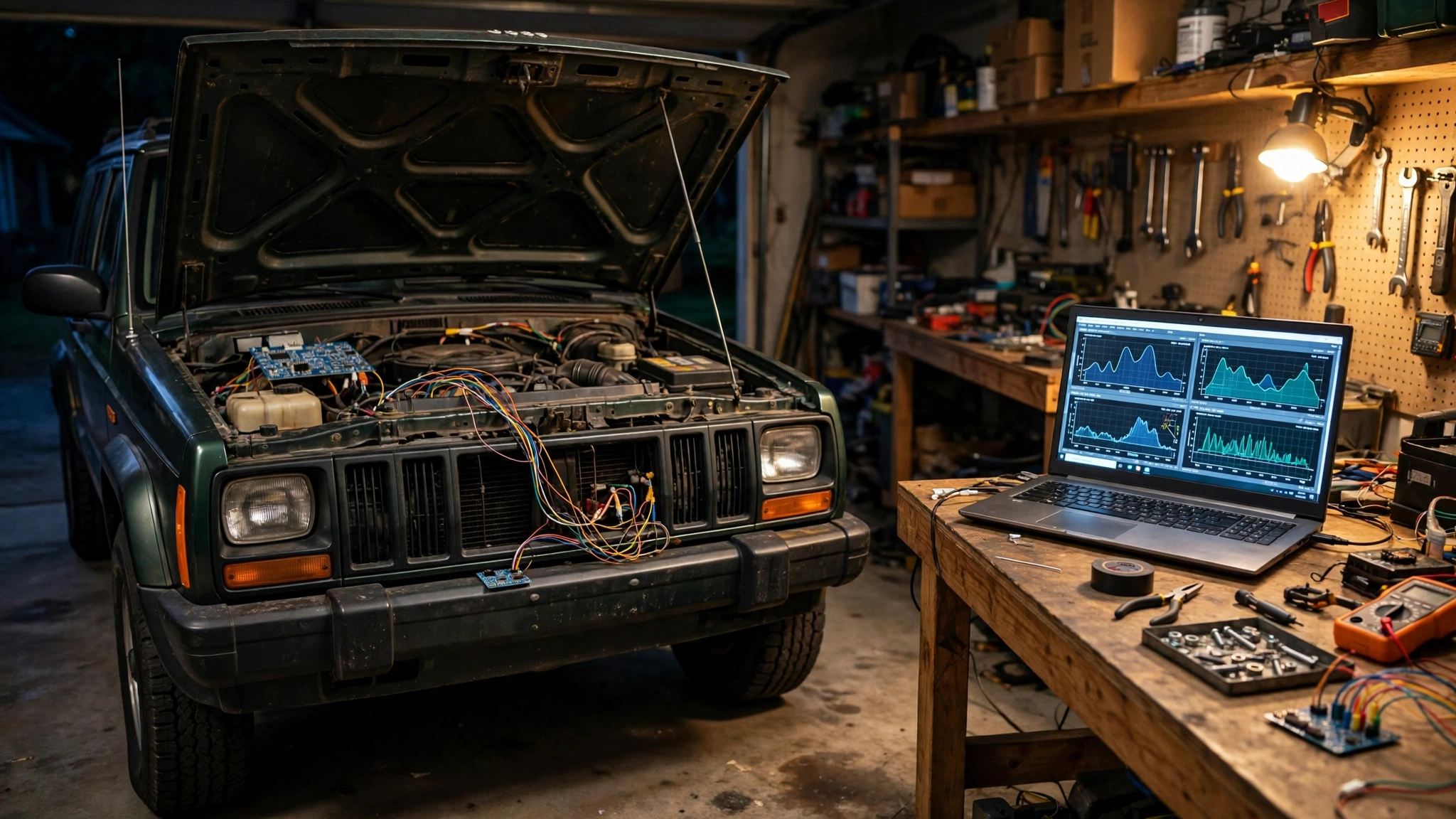
Muhammad Zulali's 1994 Jeep Cherokee XJ kept failing California's smog test. The truck was running lean, pushing nitrogen oxide (NOx) levels too high at 25 mph — and because it predates the OBD-II diagnostic standard that became mandatory in 1996, no ordinary scan tool could even talk to its engine computer. So Zulali handed the problem to AI instead, documenting the week-long project in a YouTube video published on November 10.
What followed was part repair job, part reverse-engineering exercise: Anthropic's Claude and OpenAI's Codex took turns reading, decoding and eventually rewriting the behaviour of a computer built in December 1993 — with about $15 of hardware in between.
A $3 translator for a forgotten protocol
The first problem was simply getting a signal out of the Jeep. Claude identified that the Cherokee's engine control unit (ECU) speaks Chrysler's old SCI protocol, which runs on an inverted serial signal a modern laptop cannot read directly. The fix was a $3 Arduino Nano wired up on a breadboard as a translator between the Jeep's diagnostic port and Zulali's MacBook; the full parts list came to roughly $15.
After removing a resistor that was drowning out the signal, the rig pulled its first live readings at 1:30 a.m., at a link speed of about 7,800 baud, according to Tom's Hardware. But the numbers did not add up: the computer appeared to be adding 22% extra fuel, which contradicted the lean-running condition behind the high NOx readings.
The AI caught a bad dataset — then copied the whole program
Claude traced the contradiction to a public tool the project had pulled from the web: the ChryslerScanner parameter table was wrong for this Jeep. The computer was not adding fuel at all — it was removing 22% of it. The scanner's author, László Dániel, is credited in the project for the parameter tables.
To find out why, Claude copied the ECU's entire 32KB program onto the laptop. The code revealed a California-only fuel table that cut fuel sharply at exactly the engine loads used during the smog test. The fix was to swap in the standard "Federal" fuel map instead.
A chip too old to reflash
That should have been the easy part, except the ECU was built in December 1993, about four months before Chrysler started making these computers reflashable. Reflashing it was simply not an option — so Codex found a way to send a tiny program over the same three diagnostic wires and have the computer run it. The first version was wiped out within seconds, so Codex moved the code into EEPROM, memory that survives a dead battery. With the modified code in place, the 32-year-old Cherokee finally passed its California smog test.
Zulali has since published the full wiring schematics and code on GitHub under the project name xj-scanner, released under the GPLv3 licence. At the time of writing it had 252 stars and 30 forks — and a clear warning that use is at your own risk. The project was tested on a single car, Zulali admits he is not a mechanic and says some of his engine claims may be wrong, and the result has not been independently tested. There was also an unnerving moment mid-project: Claude actuated the Jeep's fuel pump unprompted while diagnosing it, a reminder that giving an AI agent direct control over physical hardware carries real safety risks.