MegaRobo Technologies, a Beijing company that pairs artificial intelligence with robotics to automate scientific discovery, has raised nearly $200 million in a new funding round led by Oman's sovereign wealth fund. The deal, announced on November 19, takes the decade-old company's total fundraising to roughly $600 million.
The Oman Investment Authority joined the round alongside CMB International as a new investor, while existing backers Asia Investment Capital, Granite Asia and Sinovation Ventures increased their stakes. The company said the money will expand its research and development and its partnerships across China, Europe, North America, the Middle East and Southeast Asia.
MegaRobo, founded in 2016, describes itself as an "AI for Science" company. Its pitch is that AI models can read papers, predict molecular structures and generate candidate drugs — but real discovery still needs physical experiments, and those experiments are slow, manual and hard to reproduce. Its answer is to automate the laboratory itself.
A data factory for drug discovery
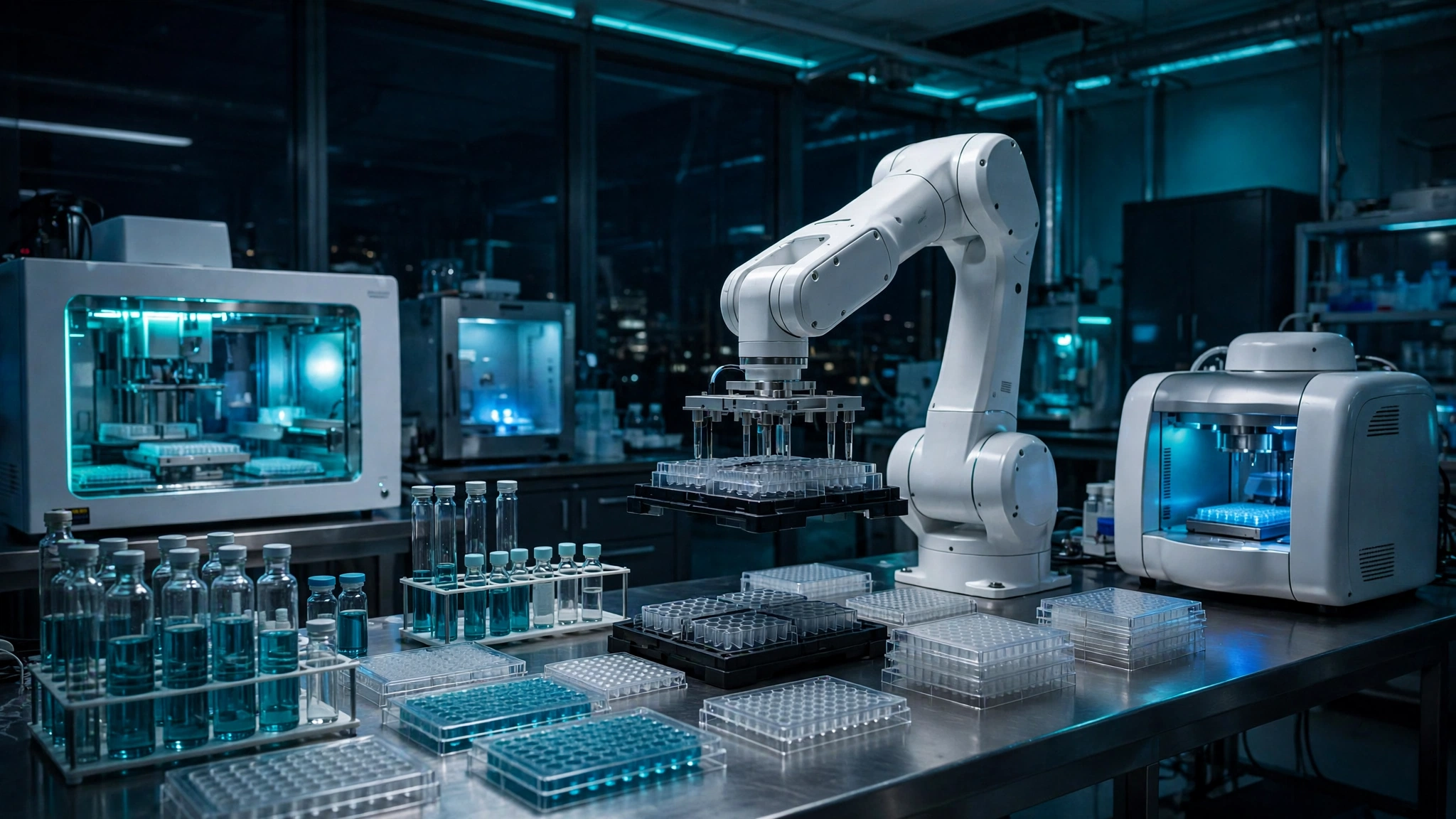
The centrepiece is the Kunpeng Lab, an automated wet-lab platform the company calls a "data factory" for AI research. Robotic systems run experiments around the clock, generating the clean, structured data that AI models need to improve — and feeding results back into the next round of experiments without a human in the loop.
The platform's latest version, Kunpeng Laboratory 4.0, advanced 31 drug-discovery pipelines in seven months, according to the company. MegaRobo says its products and technologies now reach more than 500 customers, including pharmaceutical companies, drug-discovery organisations, biotechnology firms and research institutions. Its programmable laboratory platform, Megalaxy Lab, has served more than 200 customers on its own.
The company also reported an order backlog of $206.3 million as of June 2025 — a sign that demand for automated labs is outrunning its capacity to build them.
Two businesses, one bet
MegaRobo runs two lines of business. The first automates laboratory workflows to speed up drug screening, target discovery and candidate optimisation. The second deploys high-precision sensing and robotics to improve production yields for semiconductor, optical interconnect and display manufacturers — a very different market, but one that uses the same automation toolkit.
That breadth is part of the investor case: the same infrastructure that moves liquids and samples in a drug lab can move wafers and components on a factory floor. The round follows a nearly $300 million Series C co-led by Goldman Sachs Alternatives, Asia Investment Capital and Granite Asia.
The funding also lands in the middle of a wider surge. Reuters reported that Chinese companies in the embodied-intelligence sector raised $12.9 billion in the first half of 2026, roughly five times the figure a year earlier, as investors pile into firms that connect AI software to physical machines.
A Gulf-backed bridge into global labs
The Oman Investment Authority's participation is the deal's most striking feature. Gulf sovereign wealth funds have been among the most active backers of AI infrastructure this year, and this round marks one of the largest Middle East investments in a Chinese AI company in 2026 — a cross-border flow that would have been unusual even a few years ago.
There are still open questions. MegaRobo filed for a Hong Kong listing in June 2025, but the application later lapsed, and the company has not said when it might try again. Lab automation is also capital-hungry work: robots, sensors and clean-room space cost far more than software, and scaling an automated lab network across continents is a harder problem than scaling a model.
For now, though, MegaRobo has the money to try. Nearly $200 million buys a lot of robots — and, if the Kunpeng platform keeps its pace, a lot of experiments that no human researcher would have time to run.