By Hamza Faisal
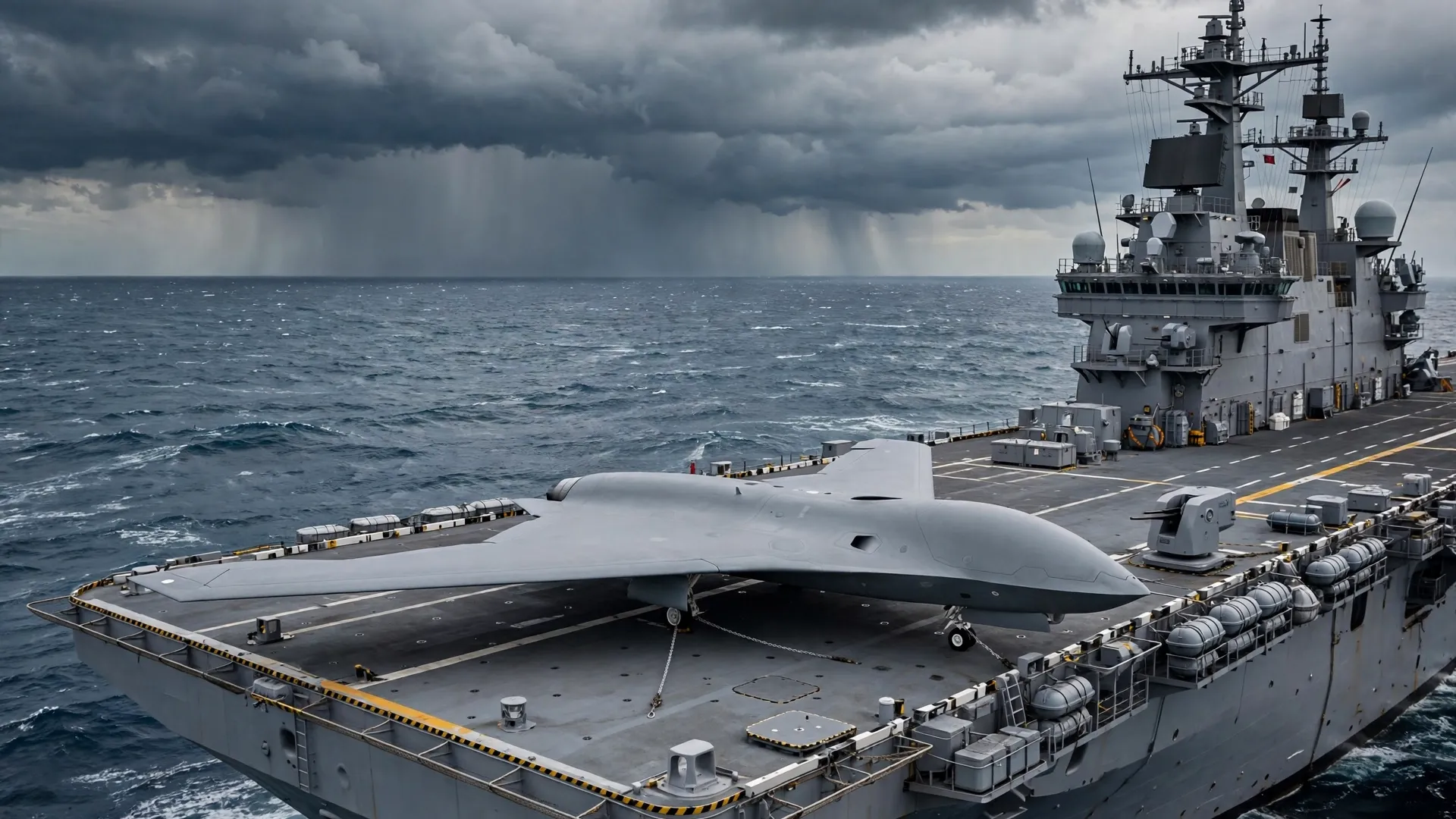
China's first carrier-based stealth reconnaissance and strike drone has completed its first takeoff and landing aboard a warship, state media reported on Friday, marking a new milestone in Beijing's push to put unmanned aircraft at the centre of its naval power.
The GJ-21 recently completed the trial on the Sichuan, China's first Type 076 amphibious assault ship, according to state news agency Xinhua. The agency hailed the test as "a breakthrough in China's amphibious assault ship programme" and said it shows the navy's ability to operate fixed-wing stealth drones from large naval platforms.
The trial underscores Beijing's long-running drive to weave drone technology into its military modernisation, a decades-long effort that has already produced advanced warships, fighter jets, missiles and increasingly capable unmanned systems. Until now, China's carrier-based drone operations had not been publicly demonstrated from a ship of this kind.
A smaller, reusable strike platform
The GJ-21 first appeared in public at a military parade Beijing held in 2025 to mark the 80th anniversary of the end of World War II, where it was displayed alongside a range of other weapons. Details of the aircraft remain limited, but state tabloid the Global Times reported on Friday that it has a substantial combat radius despite a smaller airframe than China's stealthy J-35 and J-20 fighters, citing military expert Zhang Xuefeng.
Zhang described the drone as low cost and reusable, a combination he said sets it apart from single-use weapons. "Unlike hypersonic missiles, it can be recovered and redeployed multiple times. It can also deploy small, low-cost glide-guided bombs. Under high-tempo operations, it offers greater fire delivery efficiency with better cost control," he was quoted as saying.
That reusability is central to the GJ-21's appeal for naval planners: a stealth aircraft that can launch from a ship, strike or scout, and return for another mission, rather than being spent in a single attack.
The ship behind the test
The Sichuan is the lead vessel of China's Type 076 amphibious assault ship class. Launched in December 2024, it features electromagnetic catapult and arresting technology, a full-length flight deck and a twin-island superstructure, and can carry fixed-wing drones, helicopters and amphibious equipment.
The vessel has a full-load displacement of more than 40,000 metric tons, putting it in a class of large-deck warships designed to project power far from shore. China's state television CCTV said on Friday that the indigenously developed vessel conducted consecutive sea trials in late October, though it did not disclose their locations.
China's navy said in April that the Sichuan had sailed to waters in the South China Sea for scientific testing and training missions, describing the deployment at the time as a routine test that did not aim at any specific target.
What it signals
The successful takeoff and landing suggest China is moving from displaying carrier-capable drones to operating them at sea. For navies watching the region, the test raises questions about how quickly unmanned strike and reconnaissance aircraft could be folded into routine carrier and amphibious operations.
It also fits a wider pattern: as drones reshape warfare on land and at sea, major militaries are racing to field systems that combine stealth, range and low operating costs. The GJ-21's first shipboard trial shows China intends to be among the leaders of that shift, even as many technical details — including the drone's range, payload and sensor suite — remain undisclosed.
Whether the GJ-21 enters regular service, and how it is deployed alongside crewed fighters like the J-35, will be closely watched in the months ahead.